Terry Cook, Williamson County Commissioner, signs the Sign4ERA.org petition after warning, "We don't seem to have a fervor for the ERA that once existed and it could be [young women] just don't realize how bad things were - how controlled women were." Photo: Nina Zacuto
Georgetown, Texas — From Jessie Daniel Ames to the Courthouse Steps, the Fight Has Always Been Local
Georgetown, Texas holds an important place in the history of women's suffrage and the broader fight for women's rights, showing how local organizing helped drive statewide and national change. Although women in Texas were denied voting rights throughout the 19th century, momentum grew in the early 1900s as advocates organized across the state. Georgetown became a key center of activity during this critical period.
Local men formed a suffrage league, reinforcing that voting rights for women were a shared civic cause
At the heart of this effort was Jessie Daniel Ames, who founded the Georgetown Equal Suffrage League in 1916 — the same year Alice and Nell drove across Texas. Through newspaper columns, public meetings, and direct outreach, Ames educated the community and helped build support for women's voting rights.
The movement reached a turning point in 1918, when Texas women won the right to vote in primary elections. With only 17 days to register, Georgetown activists mobilized quickly and effectively. Using telephone networks, organized outreach, and training sessions, they registered thousands of women across Williamson County. When the time came, women turned out in large numbers, marking one of the most successful grassroots efforts in Texas.
The campaign also drew broad community support. Local men formed a suffrage league, reinforcing that voting rights for women were a shared civic cause. These efforts helped pave the way for Texas to become the first Southern state to ratify the 19th Amendment in 1919.
Georgetown's impact on civil rights extended beyond suffrage. Jessie Daniel Ames went on to become the first president of the Texas League of Women Voters, continuing her work to expand civic participation. She later became a prominent advocate for broader human rights, including anti-lynching efforts and social reform. The town's history stands as a powerful example of how local action can help secure lasting national change — and it was clearly reflected during our visit.
Our visit to Georgetown was hosted by local partners including the League of Women Voters of Williamson County, Southwestern University, and Lark & Owl Booksellers. The activities drew students, community leaders, and residents into a day of reflection, education, and action.
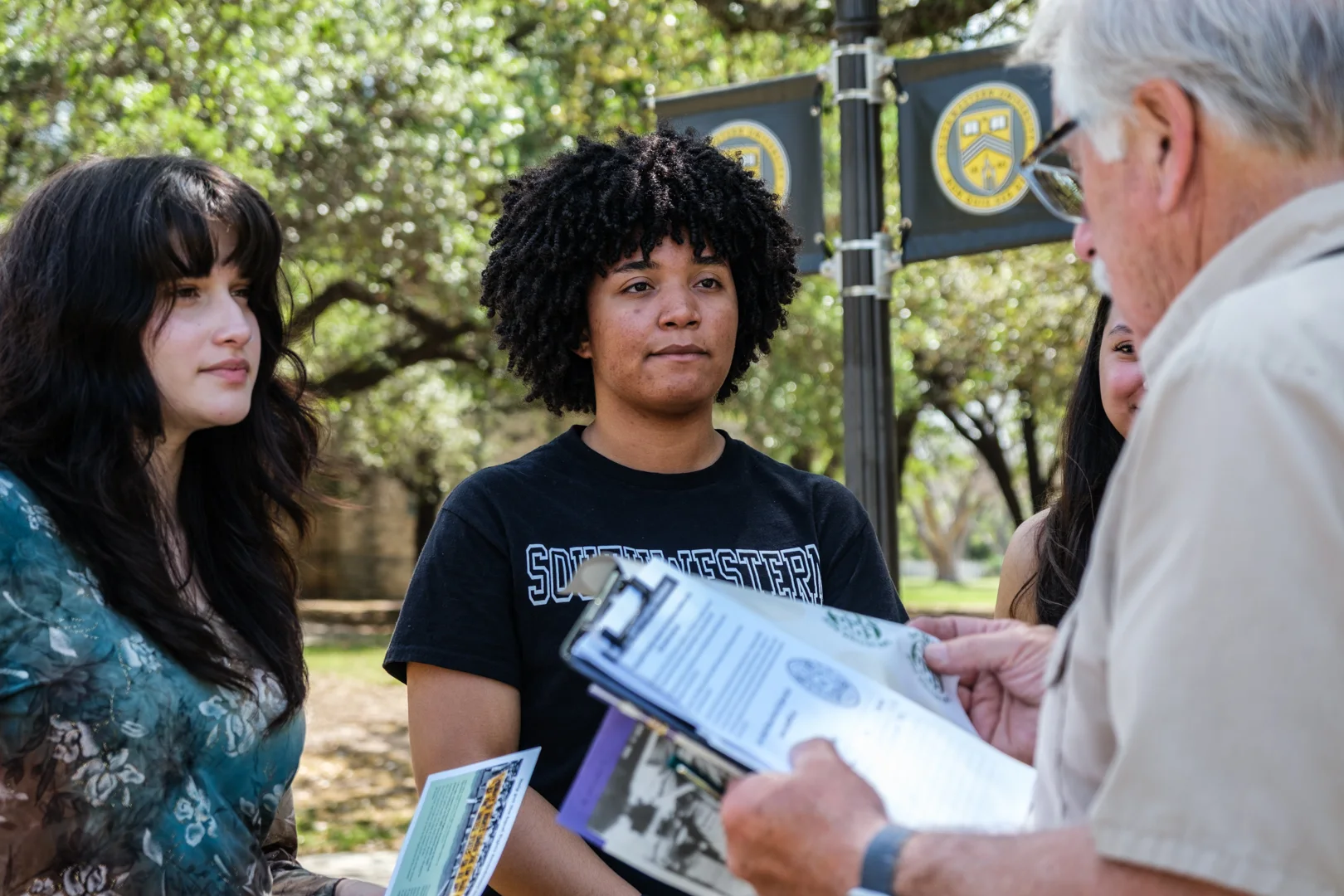
Peter Brown — master mechanic and ERA advocate — fills Southwestern University students in on the status of the ERA at Roy Cullen Academic Mall. The Golden Flyer II drew them in. The story kept them there. Photo: Nina Zacuto
The Golden Flyer II again demonstrated that it is miles beyond a vintage automobile — it is not only an important symbol of the 1916 suffrage journey for voting rights, but a vessel for a movement — a magnet that draws in new audiences to the fight today for equality. Its arrival at Southwestern University's Roy Cullen Academic Mall created an immediate sense of connection to that history. Students gathered for photos and to sign the national Sign4ERA.org petition, reinforcing the day's purpose: to mobilize support for the Equal Rights Amendment as the 28th Amendment to the U.S. Constitution.
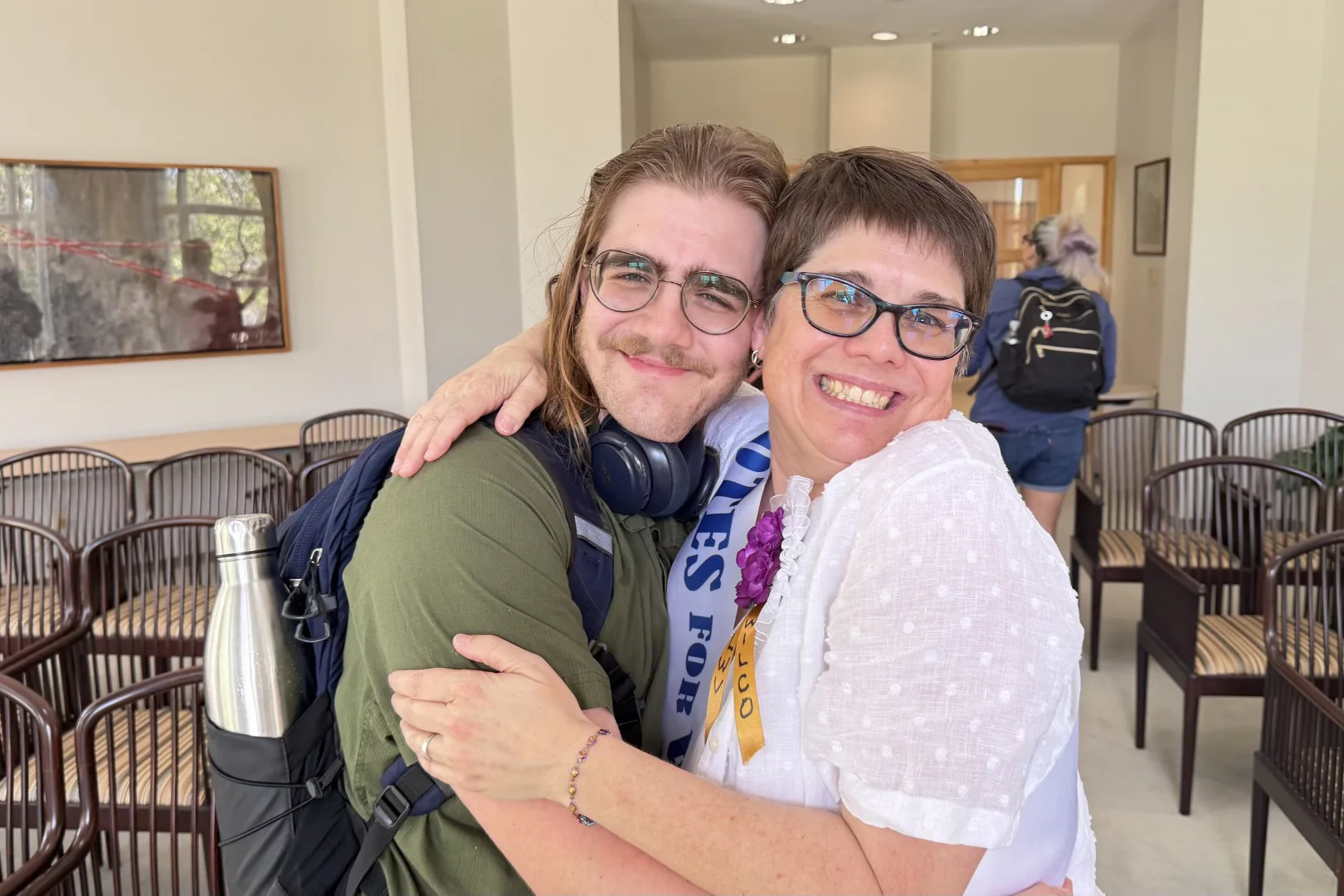
Felicia Miyakawa, President of the League of Women Voters of Williamson County, and her son Lucien Tannenhill-Miyakawa — government major, campus voter registration organizer, and member of SU Votes — share a proud moment after the ERA panel discussion at the Smith Library Center. Two generations, one cause, one very big hug. Photo: Kathy Bonk
A panel discussion inside the Smith Library Center brought together voices across generations. Leaders including Felicia Miyakawa of the League of Women Voters, student representative Lucien Tannenhill-Miyakawa, author Jeryl Schriever, historian Helen Cordes, and ERA NOW board member Kathy Bonk connected the suffrage movement to today's ongoing fight for constitutional equality. The discussion emphasized that while the 19th Amendment secured voting rights, the broader promise of equality remains unfinished — and voting rights are at risk under the proposed SAVE Act being debated in Congress.
Felicia proudly introduced her son, Lucien, who later told us he is a government major with an eye to public service. He has been organizing voter registration campaigns on campus and mobilizing students. After the stimulating program, mom and son gave a big hug, both so proud of each other.
Our tour then moved through Georgetown's historic landscape, stopping at the former home of Jessie Daniel Ames — a key Texas figure in women's rights organizing — before arriving at the Williamson County Courthouse. There, speakers addressed the crowd from the courthouse steps, highlighting the legacy of local women leaders and the urgency of modern ERA advocacy.
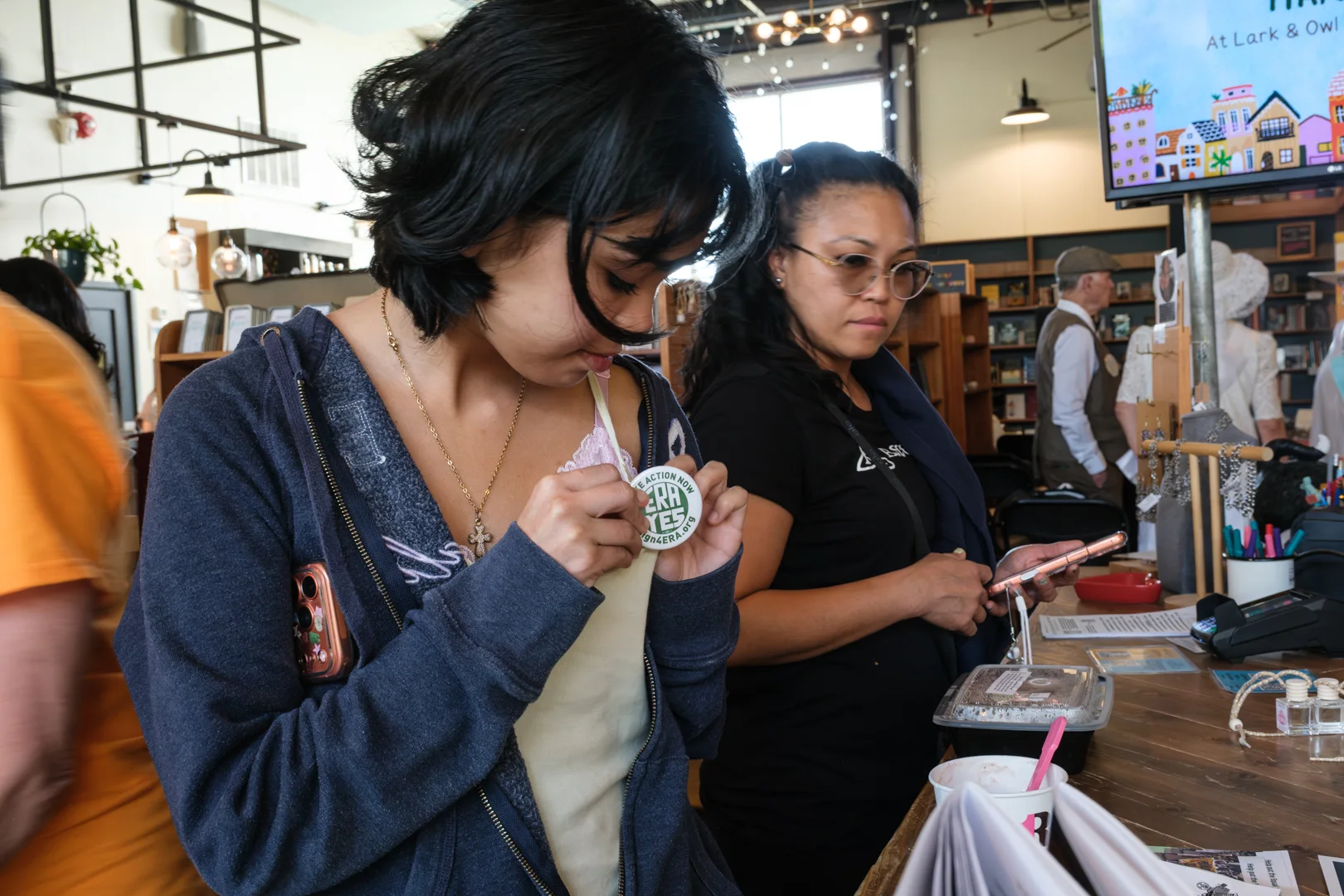
A young woman pins on her Sign4ERA.org button at Lark & Owl Booksellers after learning the ERA is stalled and adding her name to the petition — because knowing the truth has a way of turning bystanders into advocates. Photo: Nina Zacuto
The day concluded at Lark & Owl Booksellers, where Jeryl shared lively stories about Alice and Nell, the two women featured in Driving the Vote for Women, and she signed copies, while the Golden Flyer II parked out front, once again serving as a powerful visual reminder of the movement's enduring spirit.
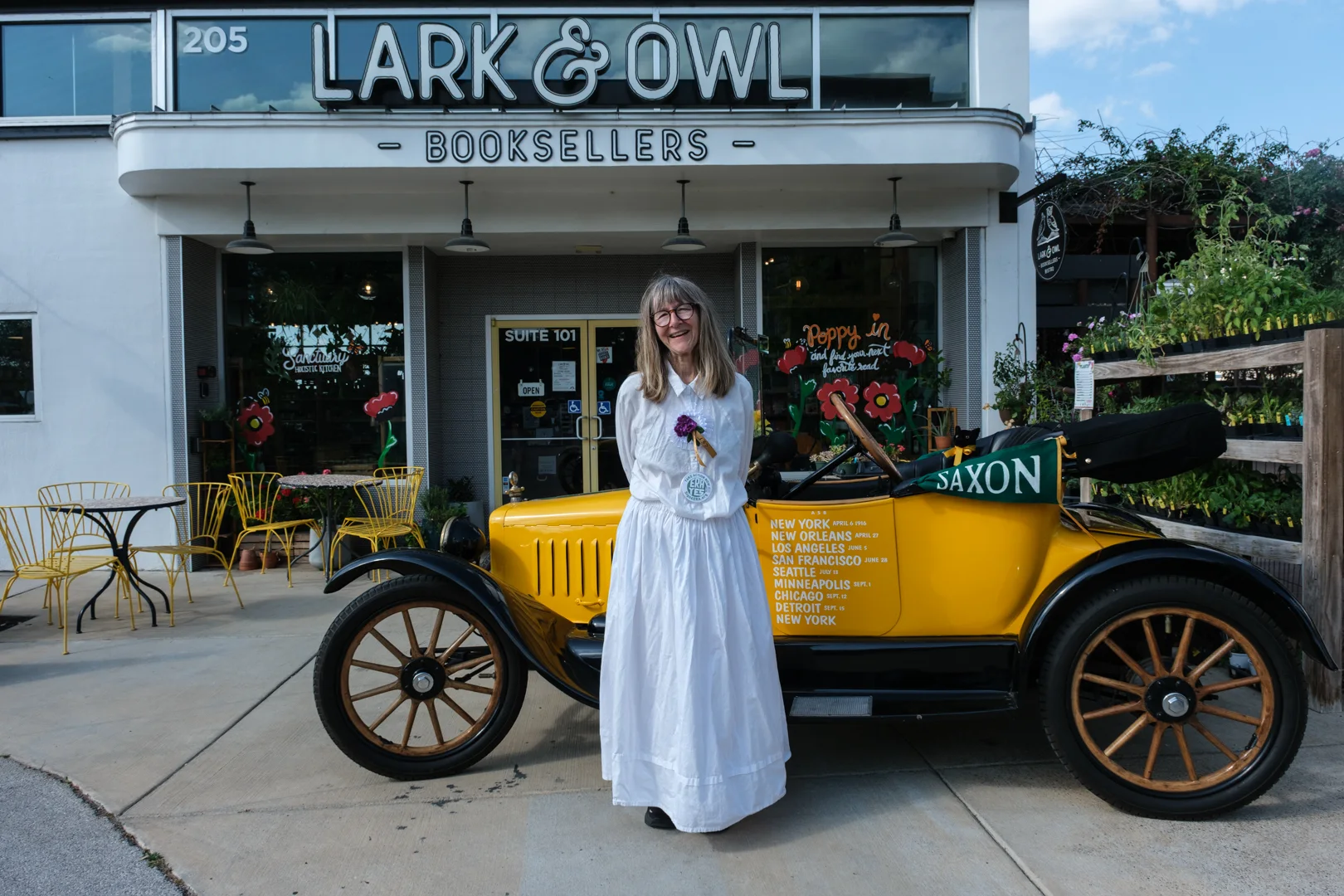
Helen Cordes, journalist and historian, at Lark & Owl Booksellers after two days with the tour in Austin and Georgetown — bringing the history of women's suffrage and civil rights in Williamson County to life at the Smith Library Center panel and reminding the crowd that the past is never as far away as we think. Photo: Nina Zacuto
Lark & Owl is yet another woman-owned independent bookstore — a treasured, sacred place for those in the audience. Founded by a group of women including Jane Estes, who welcomed us to a diverse and inclusive space designed to benefit the community with "a belief in authenticity, interconnectedness, intersectionality and fun and in books."
"We do not take one dollar or one minute of your time that you spend here for granted. This is a place where you can be yourself, you can feel all the feelings here — we see every human emotion at the bookstore, every day: grief, curiosity, anger, sadness, joy, confusion, boredom, celebration and more — and we will join you in that collective mourning and celebrating."
A fitting message for the end of our day.
From campus conversations to courthouse steps, Georgetown's participation in the Driving the Vote for Equality Tour underscored a central message: just as suffragists refused to accept delay in 1916, today's advocates are pressing forward to ensure equality is fully recognized under the Constitution. The journey continues — with history as both guide and inspiration.
Follow the Journey
Watch history happen. The Golden Flyer II is rolling — New York to the Pacific and back. Track every stop as we drive the ERA fight across 25 states. Real stops. Real people. Real pressure.

