Golden Flyer II greets crowd at Yuma Public Library
At the Edge of Everything: Yuma, Arizona
At the edge of the desert, where California and Arizona meet and the Colorado River cuts a path through history, Yuma has always felt like a gateway — between places, between stories, between past and future. When the Golden Flyer II rolled into town, it wasn’t just another stop on the map. It was a reminder that this journey has always been about crossing boundaries — geographic, political, and cultural — in pursuit of something larger.
The Saxon pulled up to the Yuma Public Library, and the choice of venue was no accident. In 2020, that same library produced a remarkable short film marking the 100th anniversary of suffrage — a tribute to the very journey we are now carrying forward.
110 Years Ago: The Worst Mental Journey
More than a century ago, Alice Burke and Nell Richardson crossed this same stretch of Arizona on what they would later describe as their “worst mental journey” — a passage haunted by the constant horror of thirst.
Leaving Phoenix on May 29, 1916, they faced grueling, unmarked dirt tracks filled with “high centers” — raised ridges worn into the road by years of wagon traffic — that repeatedly snagged the small Saxon. The extreme heat forced them to pour their precious drinking water into the boiling radiator just to keep moving.
When the car became stuck on a high center, they asked passing men for help. The men refused — they were in a hurry — and simply pointed toward a town six miles behind them. With only a pint of water left, Alice and Nell abandoned the car and walked through deep desert sand on foot.
Jeryl Schriever, author of Driving the Vote for Women — and the woman who portrays Alice Burke on our tour — read from her book at the Yuma stop. The entry dated Monday, May 30, 1916 speaks for itself:
"Out of Phoenix, we went through our worst mental journey. The horror of thirst was ever with us…. Several times we were stuck on that part of the journey through the high centers in the road, which absolutely no motor car could negotiate.
We were stuck and asked the assistance of some men in a passing vehicle. A little help would have gotten us through the high center… but the men were in a hurry.
We only have a pint of water left in the car and started out on foot to the nearest town, six miles away. That was the longest six miles of our journey."
It got worse. They lost the trail entirely and ran out of water completely. After walking another seven miles, they found a hole marked as a “well.” What they found inside was water filled with feathers and a dead chicken. They drank it anyway.
"The water tasted good. Water on the desert is a funny water. The more you drink of it, the more thirsty you get, but it keeps you from dying."
Through it all, the women gave their very last drop of clean water to their kitten mascot, Saxon. After wandering lost in the desert for two days — terrified not only of thirst but of bandits who might target their highly publicized trip — they finally reached Yuma and sent a telegram that said everything:
“WANDERED IN THE DESERT TWO DAYS. WILL MAKE SAN DIEGO THURSDAY.”
Back home, alarmed friends had already begun circulating rumors that the women were missing. A Saxon Motor Sales Company representative named Andrew Baldwin was forced to issue a public statement denying they were lost — prompting the Los Angeles Times to run a headline on June 1, 1916 that read simply: “THEY’RE NOT LOST.”
2026: The Story Still Stops People Cold
More than 100 years later, Jeryl’s reading stopped the room. TV cameras were there to capture it, and one thing became clear again and again: people are still amazed by the story of Alice Burke and Nell Richardson. They cannot believe two women in 1916 drove more than 10,000 miles across America to demand the vote. And then comes the realization — if Alice and Nell could do that for suffrage, surely we can carry the fight for the Equal Rights Amendment forward today.
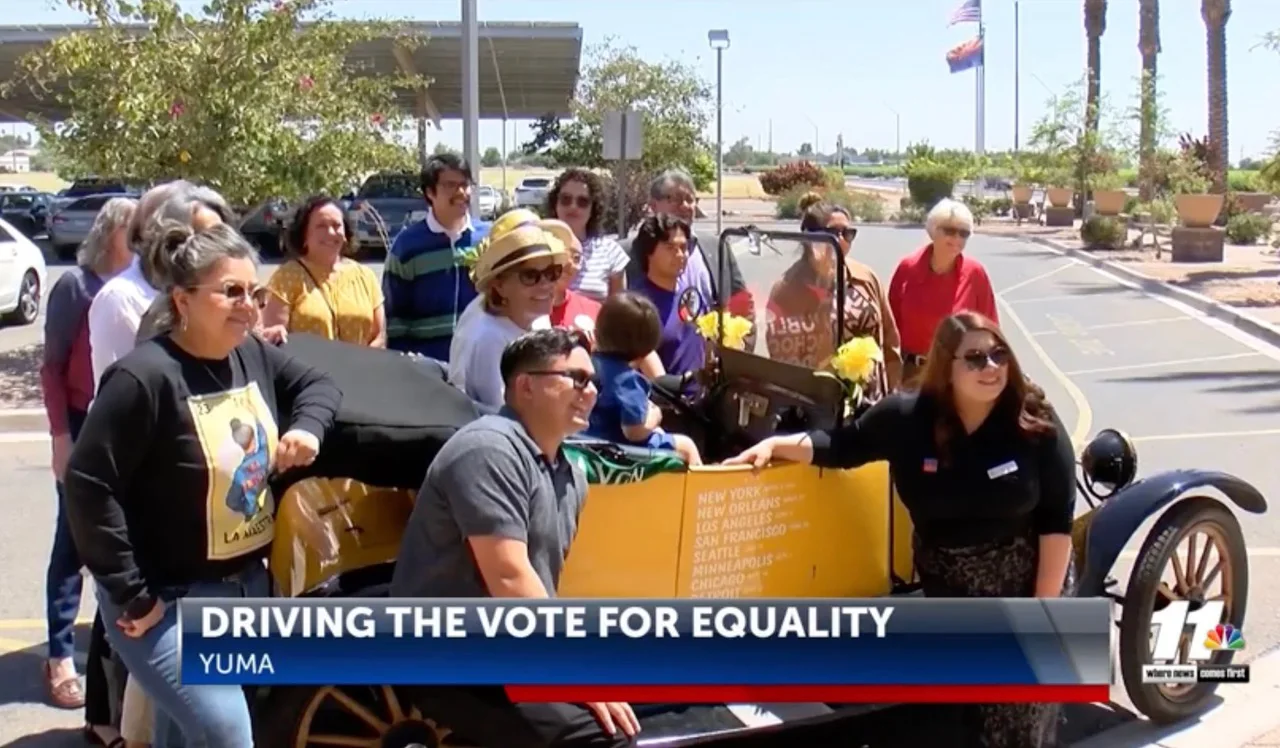
KYMA, Yuma's NBC affiliate, brings the Golden Flyer II's stop to the airwaves — carrying the ERA story to living rooms across the Arizona-California border. See the coverage at kyma.com
Yuma is a community shaped by movement — of people, of ideas, of resilience. It sits at a crossroads of cultures and experiences where questions of voice, representation, and equality are not abstract. They are lived every day. And as we gathered to share the story of the 1916 journey and invite this community into the movement, it became clear that this stop, like so many others, is about more than remembering history. It’s about continuing it.
Their journey reminds us that progress has never come because people waited patiently. It came because ordinary people were willing to take extraordinary action. The road to equality has always required courage, persistence, and the belief that the next generation deserves more than the last.
More than 100 years later, the wheels are turning again. And just like Alice and Nell, we are driving forward — with faith that equality is not only possible, but inevitable if we refuse to stop.
Add your name to the one million:
Every dollar keeps the Golden Flyer II on the road:
Follow the Journey
Watch history happen. The Golden Flyer II is rolling — New York to the Pacific and back. Track every stop as we drive the ERA fight across 25 states. Real stops. Real people. Real pressure.

