ERA NOW founder Carolyn Maloney is joined by Barbara Blaisdell, who often portrays Susan B. Anthony, and staff members of the National Women’s Hall of Fame as the Golden Flyer II makes stops around Seneca Falls. Photo: Nina Zacuto
Where It All Began: Seneca Falls, New York
There is no more fitting place on earth for the Driving the Vote for Equality Tour to stop than Seneca Falls, New York — the birthplace of the American women’s rights movement. Thanks to Marilyn Tedeschi, who reached out repeatedly and insisted the Golden Flyer II make its way to upstate New York, it did. She was right.
In July 1848, Elizabeth Cady Stanton, Lucretia Mott, Frederick Douglass, and 300 allies gathered at the Wesleyan Chapel for the first Women’s Rights Convention. Their Declaration of Sentiments boldly proclaimed that “all men and women are created equal” — launching a movement that would ultimately secure the 19th Amendment in 1920. But those gathered in Seneca Falls understood from the beginning that voting rights were only one step toward full equality under the law. More than 175 years later, that work continues.
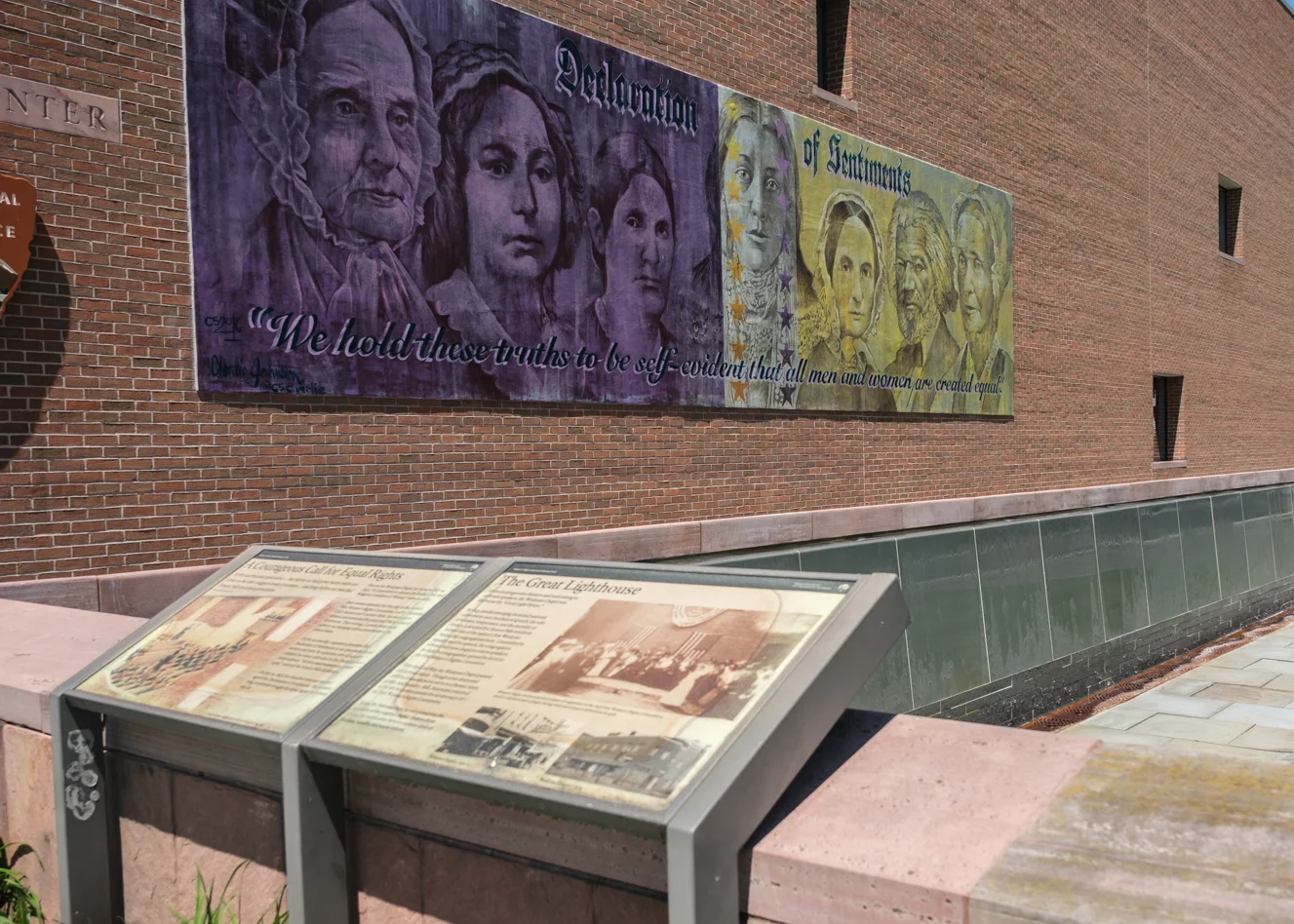
The Women’s Rights National Historical Park Visitor Center features an outdoor Waterwall with words from the Declaration of Sentiments etched beneath a cascading waterfall. Photo: Nina Zacuto
Our visit centered on the Women’s Rights National Historical Park — part of the National Park Service — which immerses visitors in the lives of women and men from a pivotal moment in history.
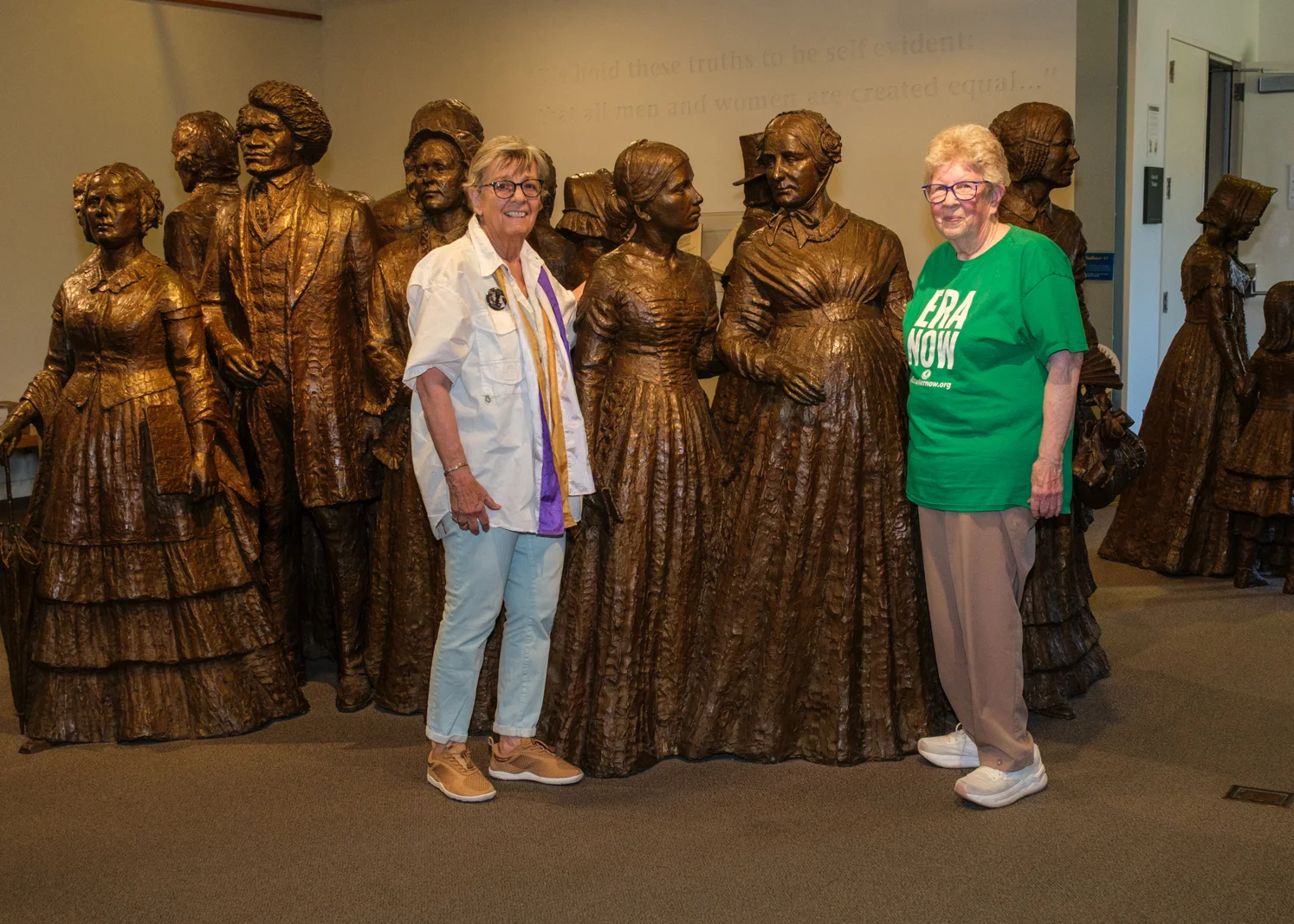
Marilyn Tedeschi, VP of the Women’s Institute for Leadership and Learning and Past President of Friends of the Women’s Rights National Historical Park (left), and Barbara Moore, Treasurer, Rochester NOW President, and ERA NOW Champion (right), stand among statues of those who attended the 1848 Women’s Rights Convention. Photo: Nina Zacuto
The Golden Flyer II then made its way to the National Women’s Hall of Fame, the nation’s first and oldest organization dedicated to honoring distinguished American women. Born from a “Founders’ Tea” in 1968 — echoing the tea-table conversations of 1848 — the Hall of Fame was established in 1969 and now resides in the magnificent former Seneca Knitting Mill, just steps from the Park.
“Seneca Falls is a beacon for human rights that people around the globe still seek out. You can feel it here.”
— Diana Smith
Together, we honored the generations of women who organized, marched, petitioned, and persevered — from Seneca Falls in 1848, to the suffragists of 1920, to those who gathered here in 1923 as the National Women’s Party to introduce the Equal Rights Amendment on the steps of the First Presbyterian Church.
It was Alice Paul who stood at that podium on July 21, 1923 — with veterans of the suffrage movement and the next generation of women’s rights leaders beside her — and declared that the vote was only the beginning. The proposed amendment, then called the Lucretia Mott Amendment, was formally seconded by Frances Dickinson, a cousin of Susan B. Anthony. Seventy-five years after Stanton and Mott demanded equal rights, Paul unveiled the ERA. Our visit to Seneca Falls concluded at that same First Presbyterian Church, where several speakers delivered remarks from the very podium Alice Paul used in 1923.
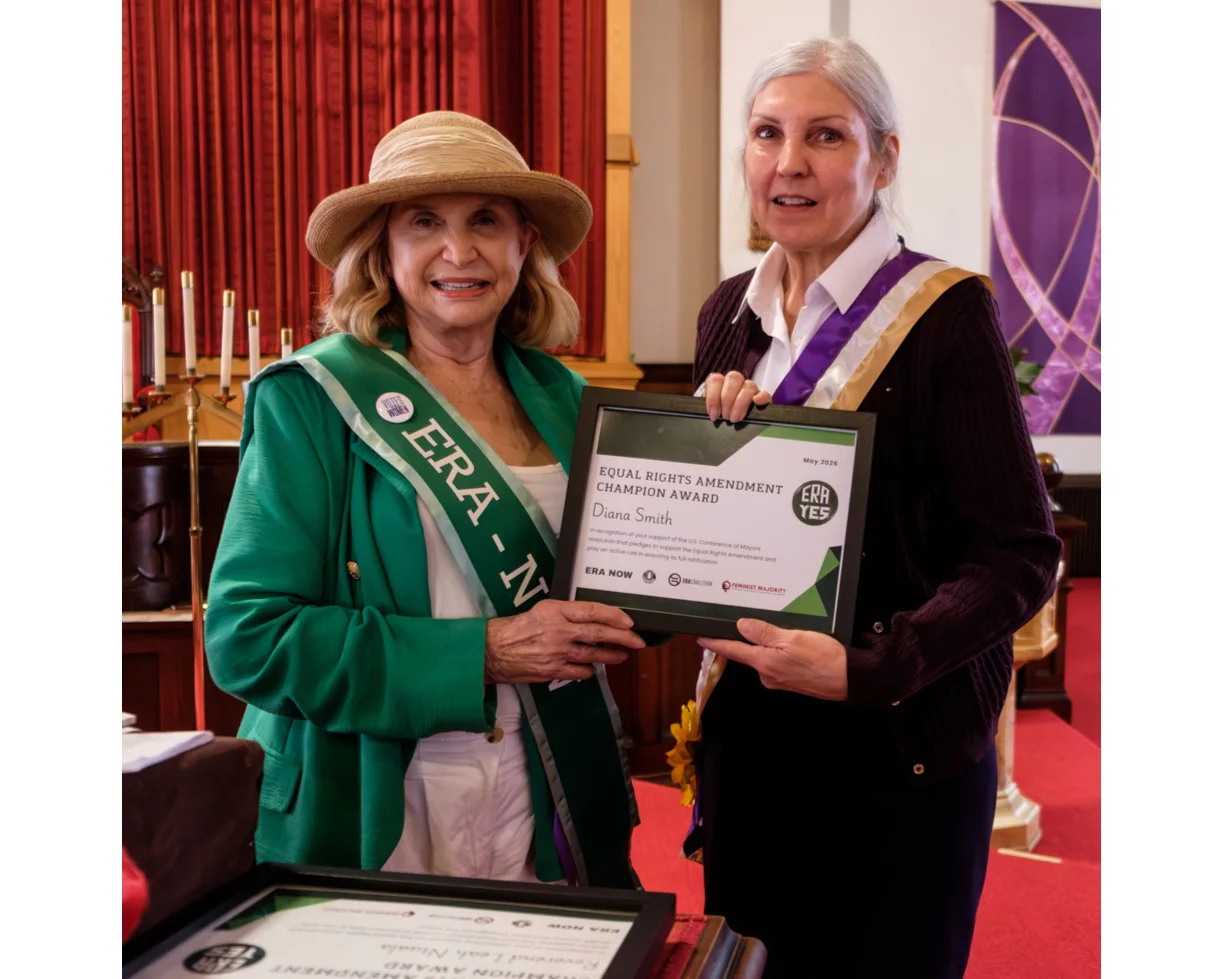
ERA NOW President Carolyn Maloney presents a special ERA Champions Award to former Seneca Falls Mayor Diana Smith for her support of the U.S. Conference of Mayors ERA resolution. Photo: Nina Zacuto
Diana Smith — founding member and president of WILL (Women’s Institute for Leadership and Learning) and the former mayor of Seneca Falls — opened the ceremony by grounding everyone in the power of place. She spoke of the 1848 Convention as “a moment of revelation” and “a beacon in a sea of human events” that still draws people from around the world. “People come to Seneca Falls to embrace it and to be reinvigorated and inspired,” she said. “The fight still goes on. That beacon is still carrying us forward.”
Councilmember Gabby Cosentino — one of the youngest elected officials in New York State, elected last November — connected her campaign spirit directly to the ERA. Her slogan, “It’s Cool to Care,” she said, “isn’t just a slogan. It’s how we make things better — by being involved, having hard conversations, and showing up for one another.” She closed by invoking the ERA’s own language: “Equality of rights shall not be denied by any state on account of sex.”
Carolyn Maloney has visited Seneca Falls many times — as a Member of Congress, as a leader of the 2020 bus tour commemorating the 100th anniversary of the 19th Amendment, and now as founder of ERA NOW. Standing at the Alice Paul podium, she was direct: “We are in a dangerous period of our movement’s history, with an opposition determined not just to stop our progress but to roll back everything we have won.”
She then turned to the room and asked how many had already signed the ERA petition at Sign4ERA.org. More than half the hands went up. “Wow!” she said. “Now the job is for each of you to sign up and ask five others to sign, and ask them to do the same thing. We know what to do. Now let’s do it!”
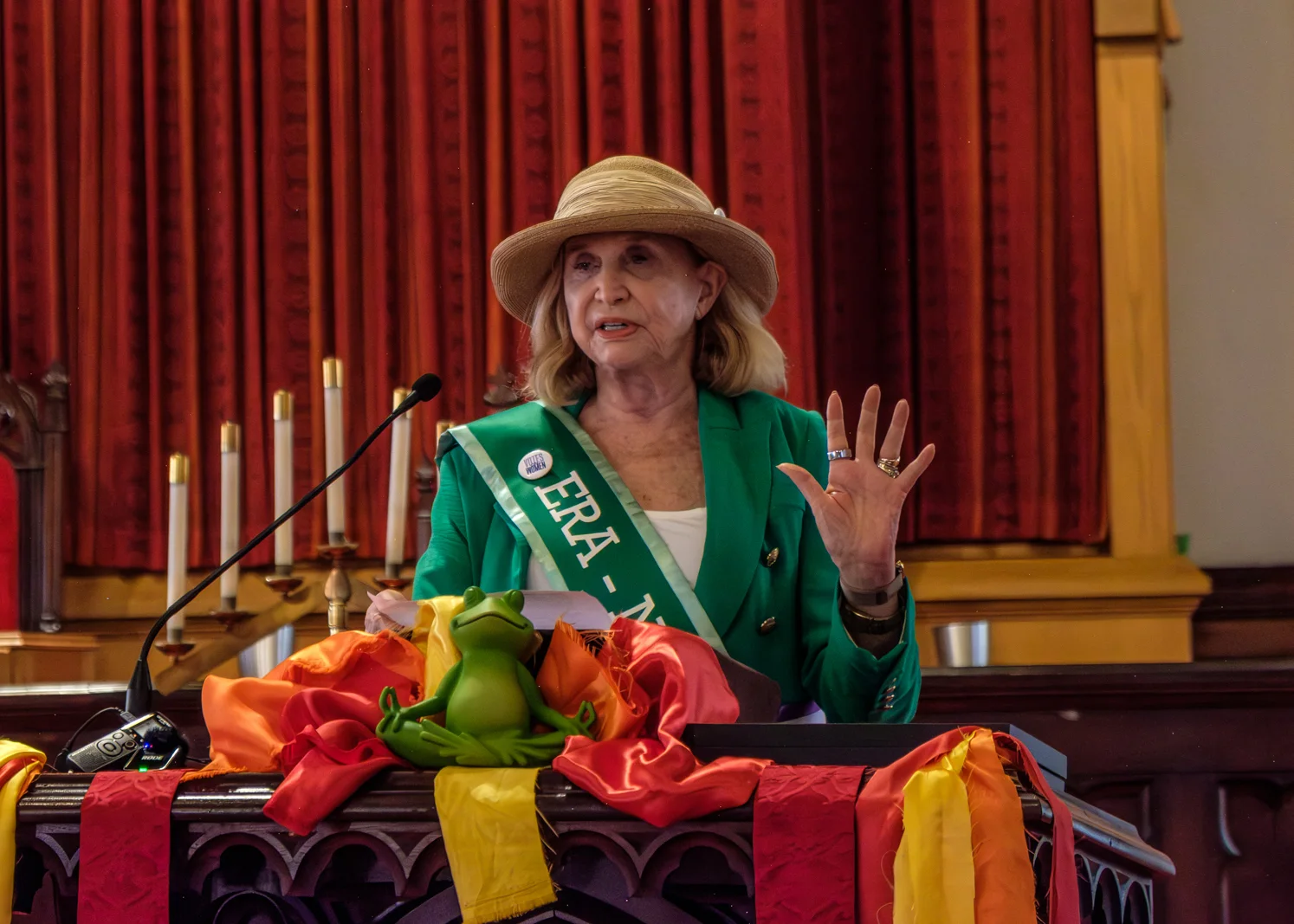
Standing at the same podium used by Alice Paul in 1923 when the ERA was first introduced, Carolyn Maloney tells the gathering: “Now let’s do it.” Photo: Nina Zacuto
Reverend Dr. Leah Ntuala — a Peace Corps veteran and longtime community activist who has served as pastor of First Presbyterian since 2011 — has opened these historic doors to every group working to advance human rights. She received a special ERA Champions Award and offered a reminder about interconnected struggle: “We are a collective,” she said. “Others’ rights denied are my rights denied. We cannot know who is next. We are passing the torch.”
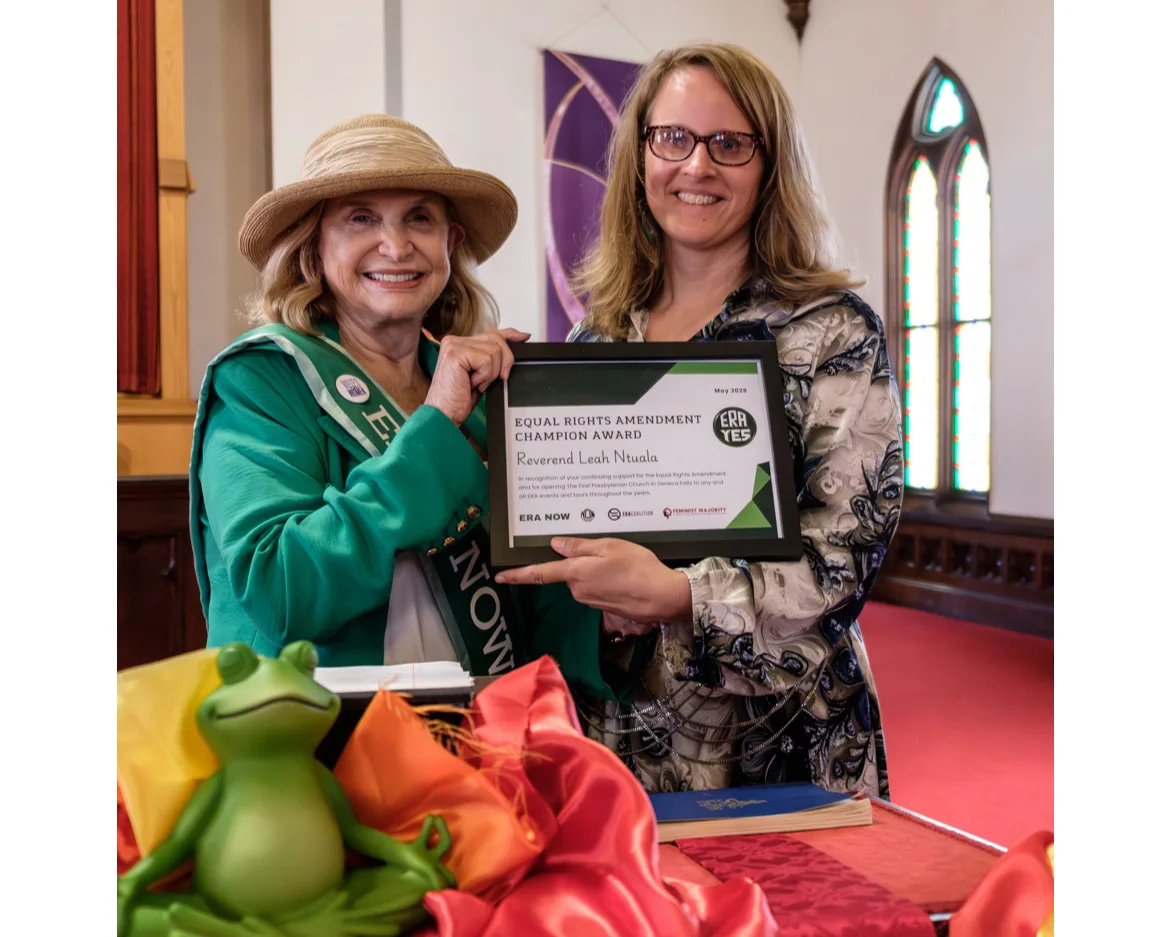
Reverend Dr. Leah Ntuala, pastor of The First Presbyterian Church of Seneca Falls, receives a special ERA Champions Award for her decade of dedication to women’s rights as human rights. Photo: Nina Zacuto
Several more community voices added depth and urgency to the gathering. Judy Wentzel, executive director of the Bonafiglia Family Foundation and driving force behind the Seneca Falls Mural Project, spoke about the power of relationship-building: “Those ties have made it possible for Seneca Falls to accomplish things that would otherwise have been impossible.”
Julie Bazan, Director of Operations for the National Women’s Hall of Fame, issued a clear challenge: at a moment when women’s contributions to history risk being minimized or erased, she said, “we cannot idly stand by and let these accomplishments and achievements be written out or removed.”
Ginny Konz, a Ruling Elder in the congregation and a civic force in her own right at age 82, invoked Alice Paul directly. When Paul stood at this very podium in 1923 and declared that women were “not done yet,” Konz said, she knew exactly what she was talking about. “She was absolutely right, and she’s counting on us to finish the job.” Konz closed with the commitment that has guided her through decades of advocacy: “I do not intend to leave here until I’ve done all that I can — to make sure that my children, their peers, my grandchildren, and all future generations are assured of their rights as citizens of this country and of the world.”
Shauna O’Toole — earth scientist, educator, pilot, Air Force Auxiliary captain, and mother — delivered one of the most powerful and personal testimonies of the Tour. She listed her credentials with precision, then cut to the truth: “None of this matters, because I also happen to be trans. That seems, with this government, to override everything.”
She spoke directly to the phrase “on account of sex” in the ERA text, warning that without the word “gender,” the amendment as written may not extend its protections to transgender, non-binary, and intersex Americans. “Millions of us will be excluded,” she said. But she made clear she would not stop fighting: “I will continue to fight for the ERA. I will continue to fight for people to have control of their body, for civil rights, for body autonomy. Fight for us. We are desperate.” Two-thirds of U.S. states, she noted, are places where she cannot safely travel.
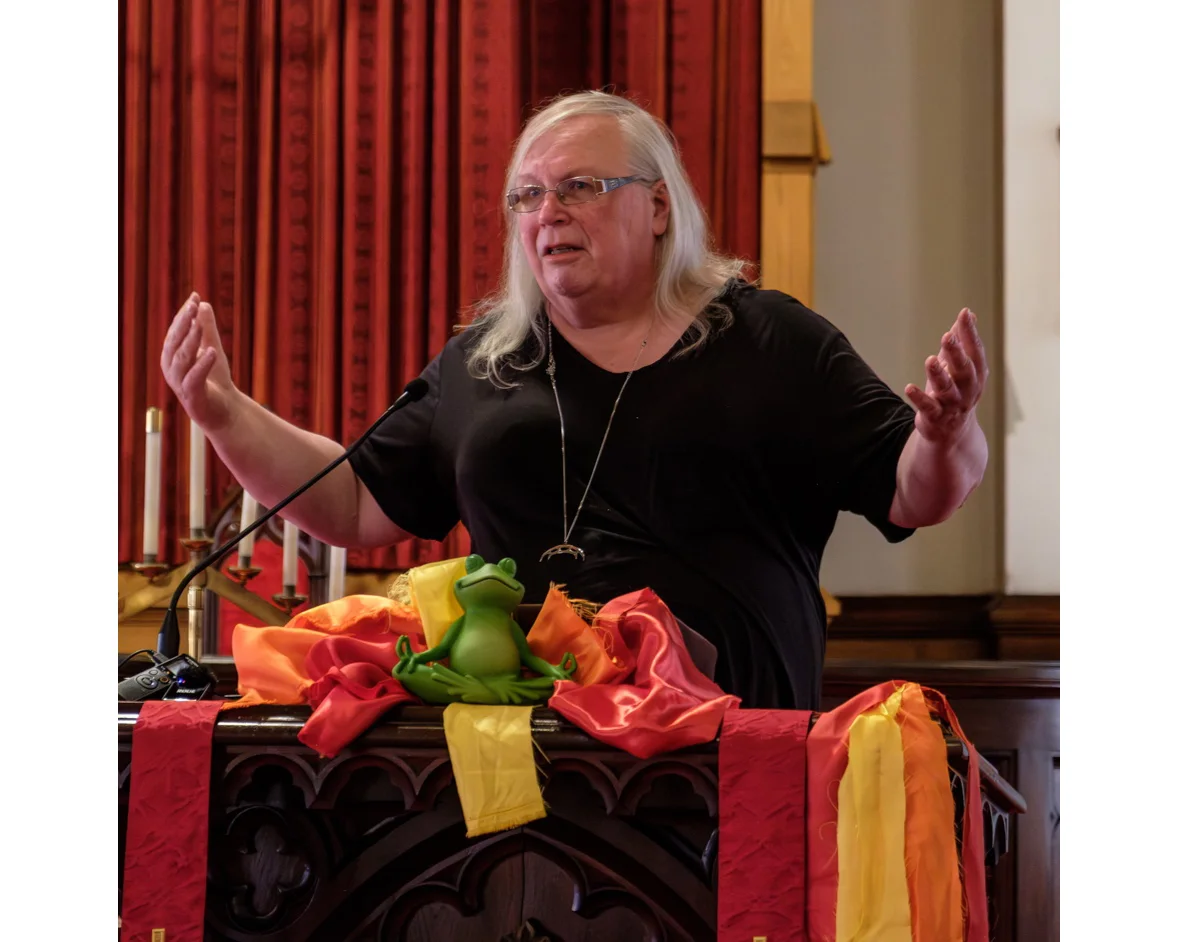
Shauna O’Toole, Executive Director of the We Exist Coalition of the Finger Lakes: “I will continue to fight for people to have control of their body. I will continue to fight for civil rights, body autonomy. Fight for us. We are desperate.” Photo: Nina Zacuto
The final speaker, Lucile Mallard, received a standing ovation before she said a word — and then earned it fully. She opened by invoking Sojourner Truth’s “Ain’t I a Woman” speech, reminding the room that the NAACP — founded in 1909 on Lincoln’s birthday — has always fought for equality and justice for all people, not some. “The color is marginal people,” she said of the organization’s name. “It is the color of America, the color of all of the citizens.”
She shared her own story: born in the segregated South, arriving in Geneva, New York at age 12, hiding in a school bathroom rather than face an integrated lunchroom for the first time. It was a male teacher, Raymond Gagnon, who came in and called her out by name — and became her mentor for the rest of his life. “Lucille would still be that quiet girl sitting in the bathroom if you had not come and told her to come out,” she told him years later.
She closed with the words of civil rights icon John Lewis, whom she had met at Hobart College: “We can protest, we can sign petitions, but our biggest weapon against discrimination or inequality is our vote.” Then she pledged: “I am going to push for the Equal Rights Amendment. Because we have a choice.”
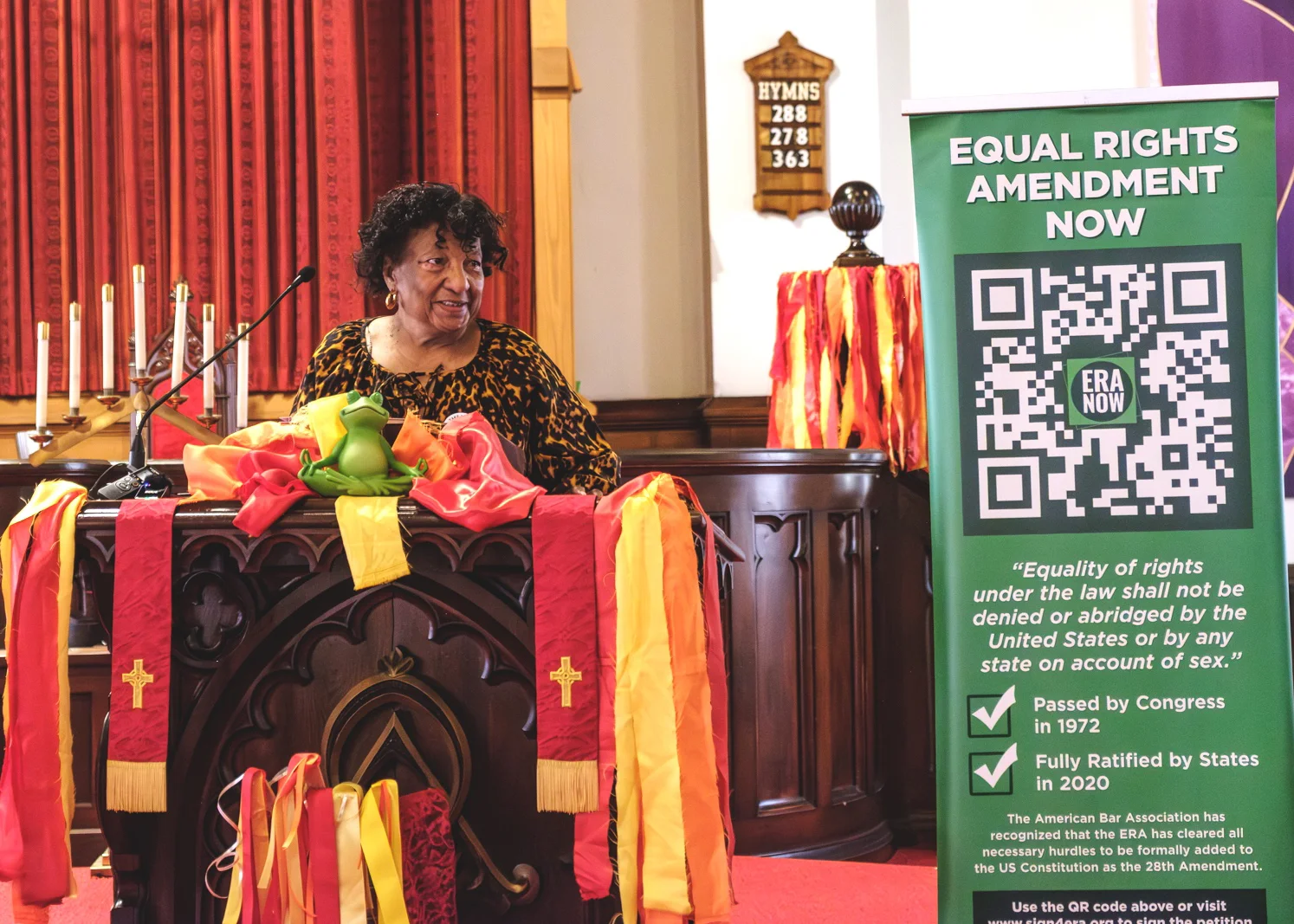
Lucile Mallard, President of the NAACP in Geneva, honorary doctorate recipient from Hobart William Smith, and Board of Trustees member of Finger Lakes Community College. Photo: Nina Zacuto
MC Diana Smith brought the ceremony to a close by thanking everyone “for helping us to once again make history in Seneca Falls” — and with a direct call to action: register, vote, honor the foremothers who fought for that right, and sign the ERA petition. “How great to be able to say,” she added, “I signed it in Seneca Falls.”
The Tour carried forward that history today. We are traveling across the nation to collect signatures at Sign4ERA.org, raise awareness about the Equal Rights Amendment, and remind Americans that democracy is strongest when every voice is heard and every person is treated equally under the law.
Today, we celebrated the pioneers who came before us, the leaders who continue this work, and the next generation who will carry it forward. Let Seneca Falls remind us that history is not something we simply commemorate—it is something we make.
Add your name to the one million:
Every dollar keeps the Golden Flyer II on the road:
Follow the Journey
Watch history happen. The Golden Flyer II is rolling — New York to the Pacific and back. Track every stop as we drive the ERA fight across 25 states. Real stops. Real people. Real pressure.

