The centerpiece of Susan B. Anthony Square Park is a life-size bronze sculpture called “Let’s Have Tea.” It depicts two of Rochester’s greatest champions of equality — Susan B. Anthony and Frederick Douglass — seated across from one another at a small table, engaged in conversation over a pot of tea, symbolizing their partnership. The sculpture was created by Rochester artist Pepsy Kettavong and installed in 2001.
Failure Is Impossible: Rochester, New York
When we stopped in Rochester, New York, we were not simply visiting another American city — we stood in the command center of one of the greatest civil rights movements in our nation’s history. From a modest brick house on Madison Street, Susan B. Anthony organized a national campaign that would ultimately change the Constitution. Here she wrote speeches, welcomed reformers, planned strategy, and was arrested for daring to vote. Rochester reminds us that history is often made not in grand palaces, but around dining room tables, in front parlors, and by ordinary people who refuse to accept injustice.
More than a century later, as the Driving the Vote for Equality Tour continued its journey for the Equal Rights Amendment, we followed in the footsteps of the woman who showed America that Failure is Impossible.
The Memorial Day Parade
Today, the Golden Flyer II joined the Memorial Day parade as we marched in a community that helped shape the course of American history. Just a short distance from here, in neighboring Seneca Falls, the first Women’s Rights Convention was held in 1848, launching a movement that would ultimately secure women’s right to vote and in 1923, began the campaign for the Equal Rights Amendment.
Thanks to our hosts, the National Organization for Women (NOW) — Barbara Moore, Robin Wilt and Jacquelyn Cuyler — and Marilyn Tedeschi of the American Association of University Women (AAUW), we had an exceptionally great day.
Our homebase for the morning was originally founded in 1897, thanks to suffragists in the first women’s graduating class from the University of Rochester — a club formed through their dedication and perseverance. What then became the Rochester branch of AAUW, it supported the women’s suffrage movement and sent ten members to serve overseas during World War I. A beautiful home was later donated, now called the Perkins Mansion, that provides a home to AAUW, and as it happened — sits right on this Memorial Day Parade route.
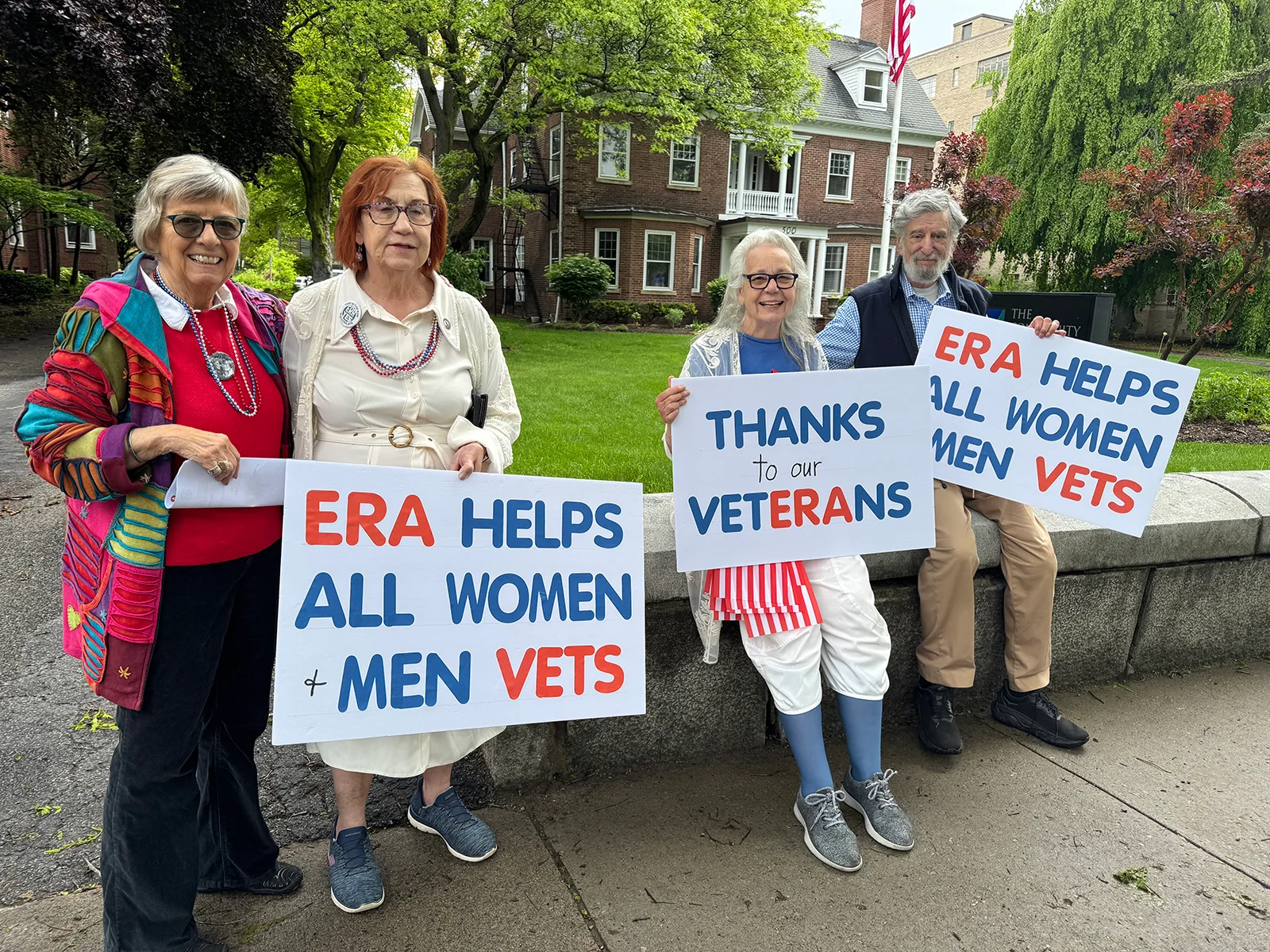
Marilyn Tedeschi, Jeanne Clark, Kathy Bonk and Marc Tucker await the start of the Memorial Day Parade in front of Perkins Mansion — home to AAUW, and as it happened, right on this Parade route.
The Golden Flyer II was the hit of the Parade with overwhelming support, thumbs up and words of “thanks for coming” by many of the several thousand people who came to watch the parade — grandparents, parents, teens, toddlers and small babies.
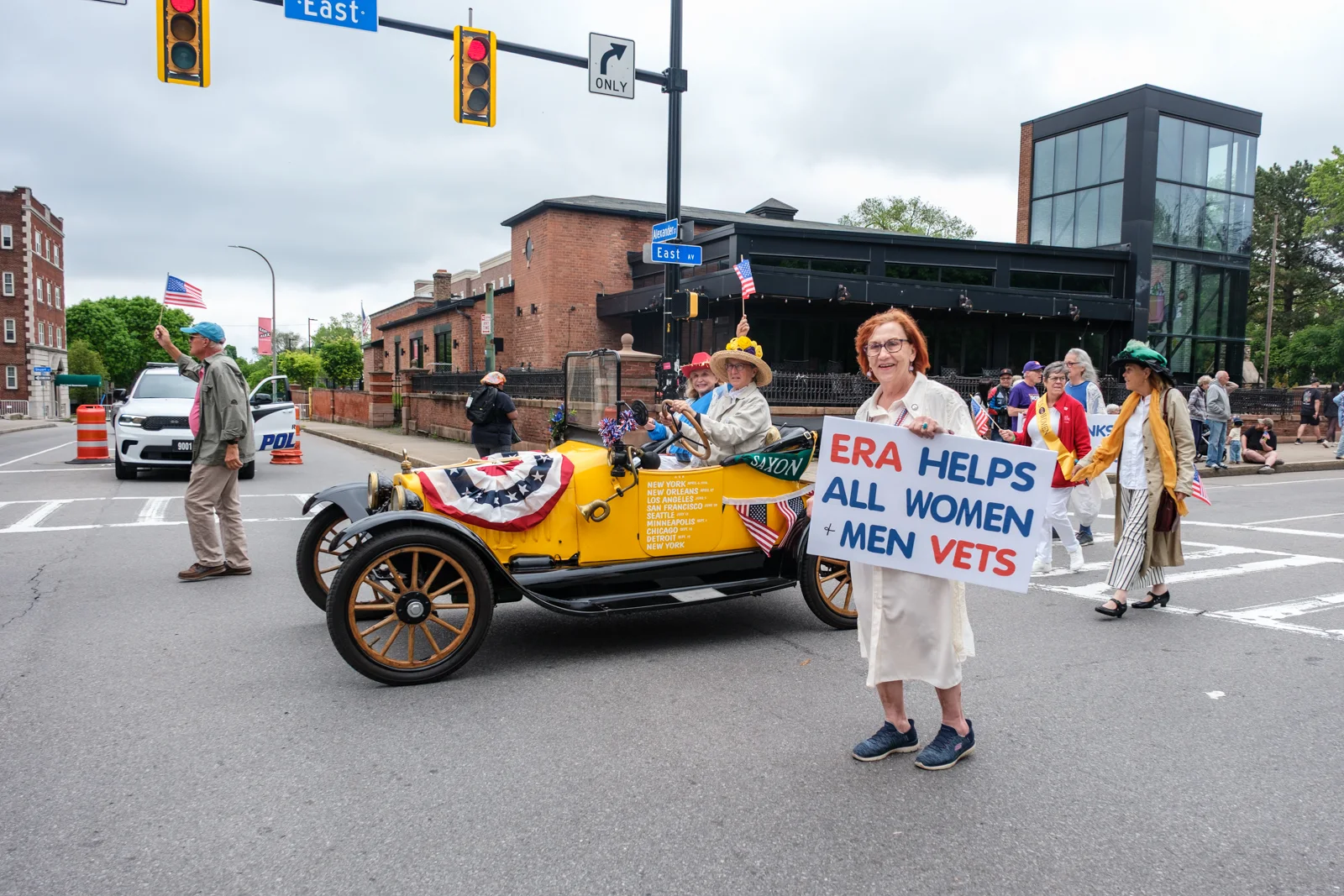
Driving the Vote for Equality Tour members march in Rochester’s Memorial Day Parade with Alex Huppe and Jeryl Schriever, owners of the 1914 Saxon, in front, with Carolyn Maloney, and Susan Nourse in the Golden Flyer II.
Each year, Memorial Day marks a moment for us to remember that democracy is not self-sustaining — it depends on the courage, commitment, and participation of each generation. As we honor those who defended our freedoms, we also recognize our responsibility to continue expanding and protecting the promise of equal rights for all Americans.
The House on Madison Street
After the Memorial Day Parade, Jeryl Schriever and Susan Nourse drove the Golden Flyer II across town to an ERA Rally at the Susan B. Anthony Park just a few steps from the modest home where Susan B. Anthony lived from 1866 until she died in 1906.
Rochester was much more than the home of Susan B (as she is still affectionately known) — it was the center of her life’s work. For 57 years the city became headquarters for the movements to abolish slavery, secure women’s rights, and win woman suffrage.
Leaders including Elizabeth Cady Stanton, Frederick Douglass, Ida B. Wells, Lucretia Mott, and Matilda Joslyn Gage met there to plan campaigns, draft speeches, and organize the movements. During Anthony’s presidency of the National American Woman Suffrage Association, the house essentially functioned as the organization’s national headquarters.
History is often made not in grand palaces, but around dining room tables, in front parlors, and by ordinary people who refuse to accept injustice.
Perhaps the most renowned event associated with her Rochester home took place in November 1872. Along with 12 other women, Susan B. registered and cast her vote in the presidential election, asserting that the newly enacted Fourteenth Amendment granted women the rights of citizenship — including the right to vote. A few days later, a U.S. Marshal arrived at her Madison Street residence and arrested her in the front parlor. Subsequently, she was tried, found guilty by a judge who instructed the jury to convict Susan B, imposed a $100 fine, and she famously declared, “I shall never pay a dollar of your unjust penalty.” Remarkably, she never did.
She also played a pivotal role in transforming the University of Rochester (UR). When the university agreed to admit women only if supporters could raise $50,000, Anthony spearheaded the fundraising campaign. Despite the campaign falling short, she demonstrated unwavering determination by pledging her own life insurance and personal resources to bridge the gap. Thanks to her relentless efforts, a handful of women were able to join the university in 1900. Today, women are 53% of the students at UR.
“I shall never pay a dollar of your unjust penalty.”
— Susan B. Anthony, 1873
One remarkable aspect of Rochester’s history is that both Susan B. Anthony and Frederick Douglass resided there simultaneously. They collaborated for decades in the abolitionist movement and later in the fight for women’s rights. Today, Susan B. Anthony Square Park features a well-known sculpture showing Anthony and Douglass seated together at a table, symbolizing their partnership.
Anthony is buried in Mount Hope Cemetery. In recent election years, thousands of voters have visited her grave after casting their ballots, leaving “I Voted” stickers in tribute to the woman who was arrested for doing exactly that in 1872.
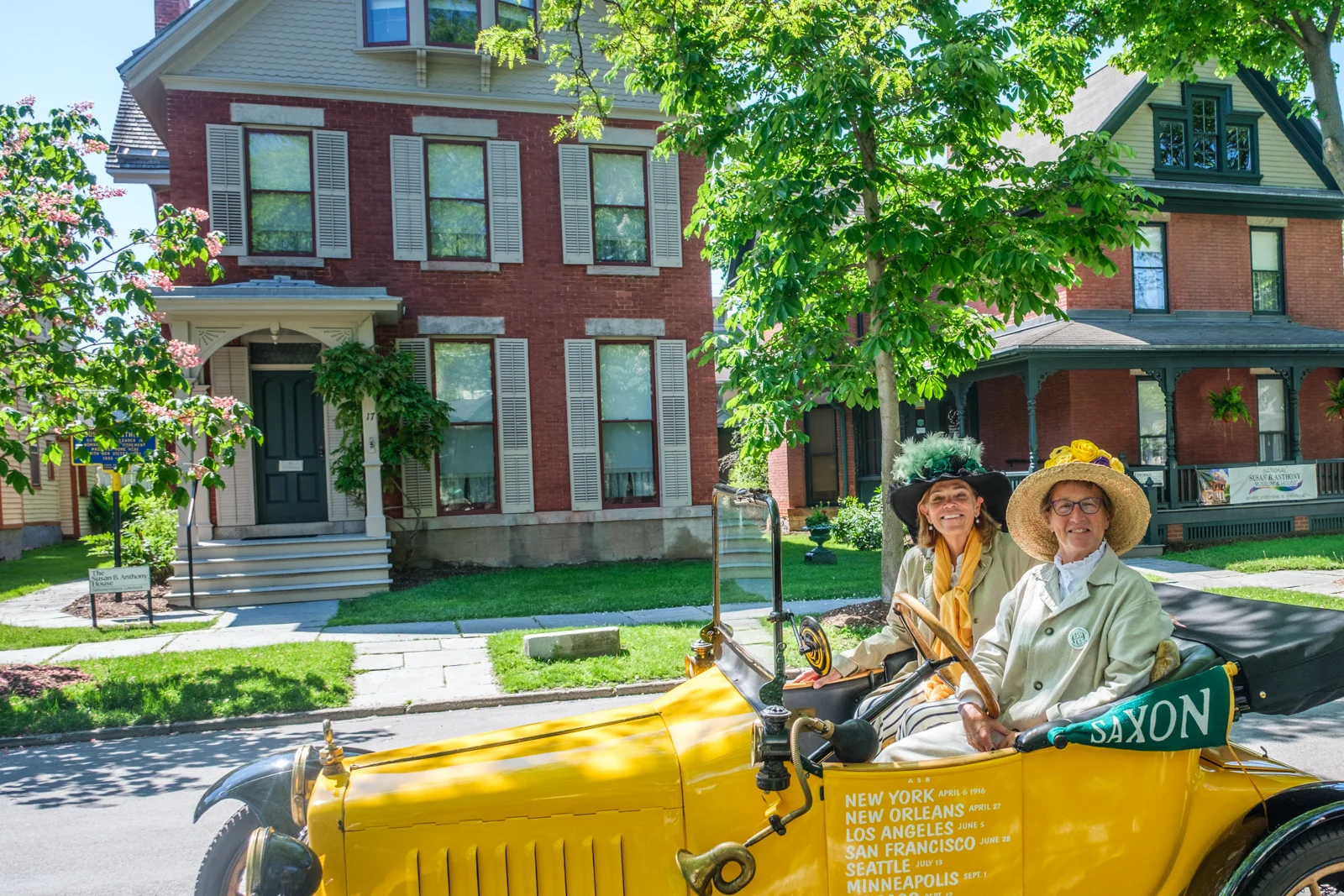
Jeryl Schriever (aka suffragist Nell Richardson) and Susan Nourse (aka Alice Burke) stop in front of the Susan B. Anthony home where leaders of the movements to abolish slavery, secure women’s rights, and win woman suffrage regularly met to plot strategies and campaigns.
ERA Rally at Susan B. Anthony Park
At the afternoon ERA Rally, we were surrounded by the history of suffrage and today’s fights for equality with speeches, people adding their name to the national ERA petition, Sign4ERA and a Mayors for ERA ceremony.
ERA NOW founder Carolyn Maloney opened by reminding the gathering:
“There are too many people who believe that the Equal Rights Amendment is already in the Constitution and many others who think that, even if it isn’t, we no longer need it.”
“Nothing could be further from the truth. Our opposition is not stopping with the reversal of Roe v. Wade. Oh no, they want to take away your right to vote, to give each family only one vote on behalf of the family, cast by the husband. And the so-called SAFE Act is unsafe for women who have changed their name after marriage. It is a modern-day Jim Crow law designed to keep women from voting.” — Carolyn Maloney
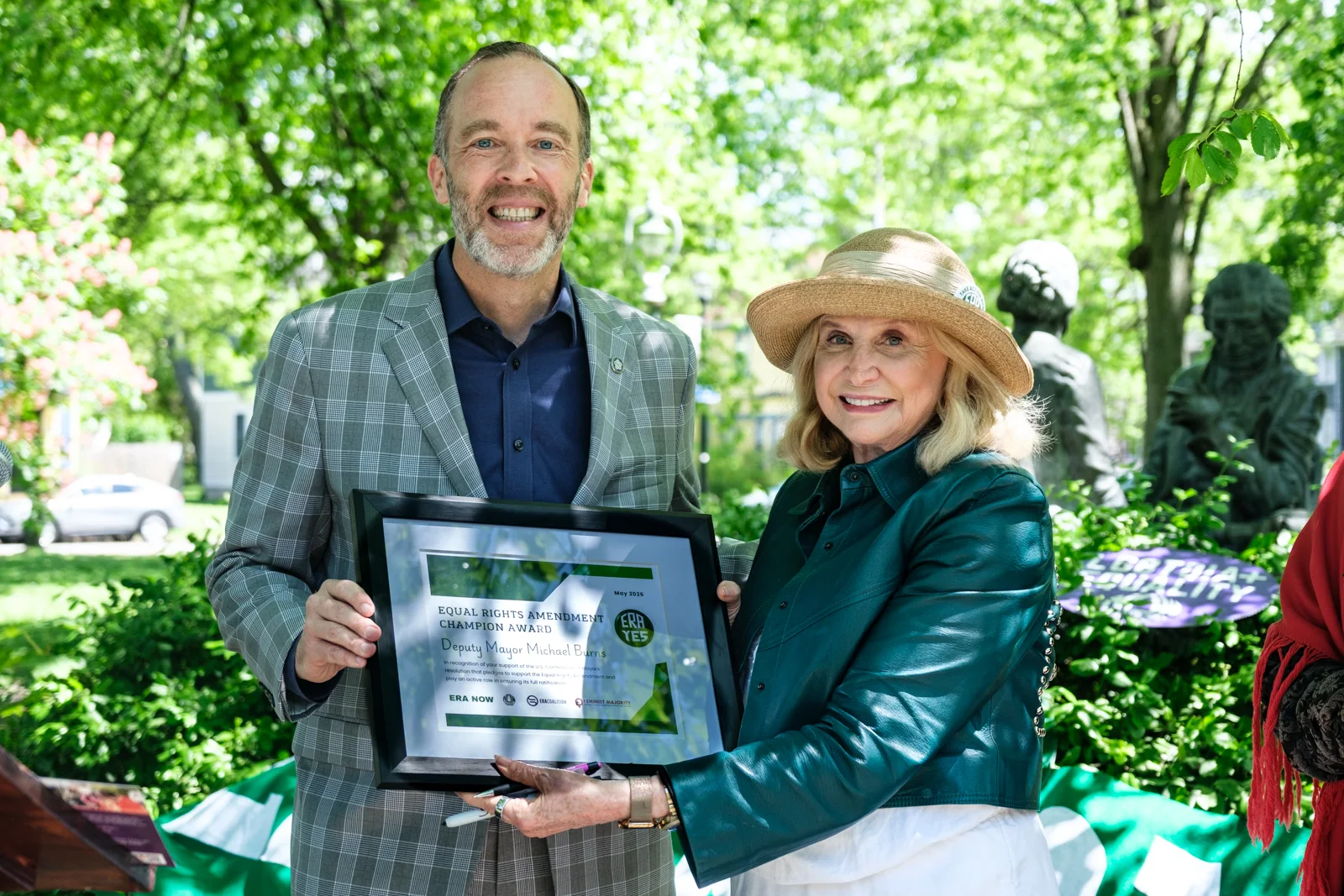
ERA NOW founder and former Member of Congress Carolyn Maloney presents an ERA Champion Award to Deputy Mayor of Rochester Michael Burns for his support for a Congressional Joint Resolution.
Rochester’s Deputy Mayor Michael Burns was awarded an ERA Champions certificate for supporting the U.S. Conference of Mayors ERA resolution and shared remarks about young people:
“The news tells us that our young people are so upset about the way things are going that they are considering moving abroad. We must fix this. Getting the ERA into the Constitution would be a big step toward assuring our young women that they have a future in this country, that their contribution in every walk of life is valued here.” — Deputy Mayor Michael Burns
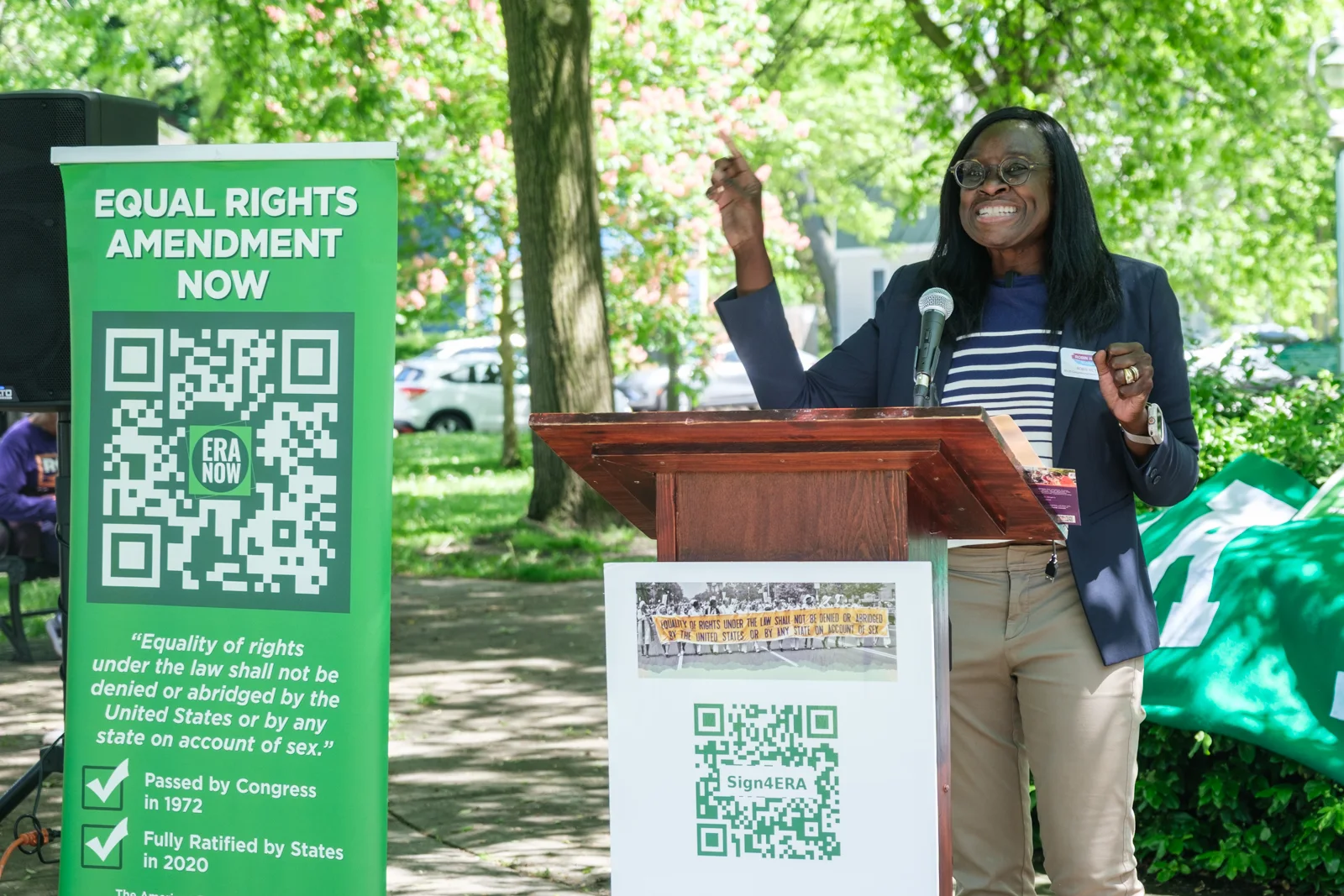
Robin Wilt, NOW Members, Community Organizer, Small Business Owner speaks about the importance of using the vote to support women running for office.
Rochester remains a center of reform, activism, and courage. Here feminists are continuing to challenge the status quo, organize for change, and demonstrate that democracy is strongest when everyone has an equal voice. The city’s legacy reminds us that progress is never inevitable — it is achieved because ordinary people decide to take extraordinary action.
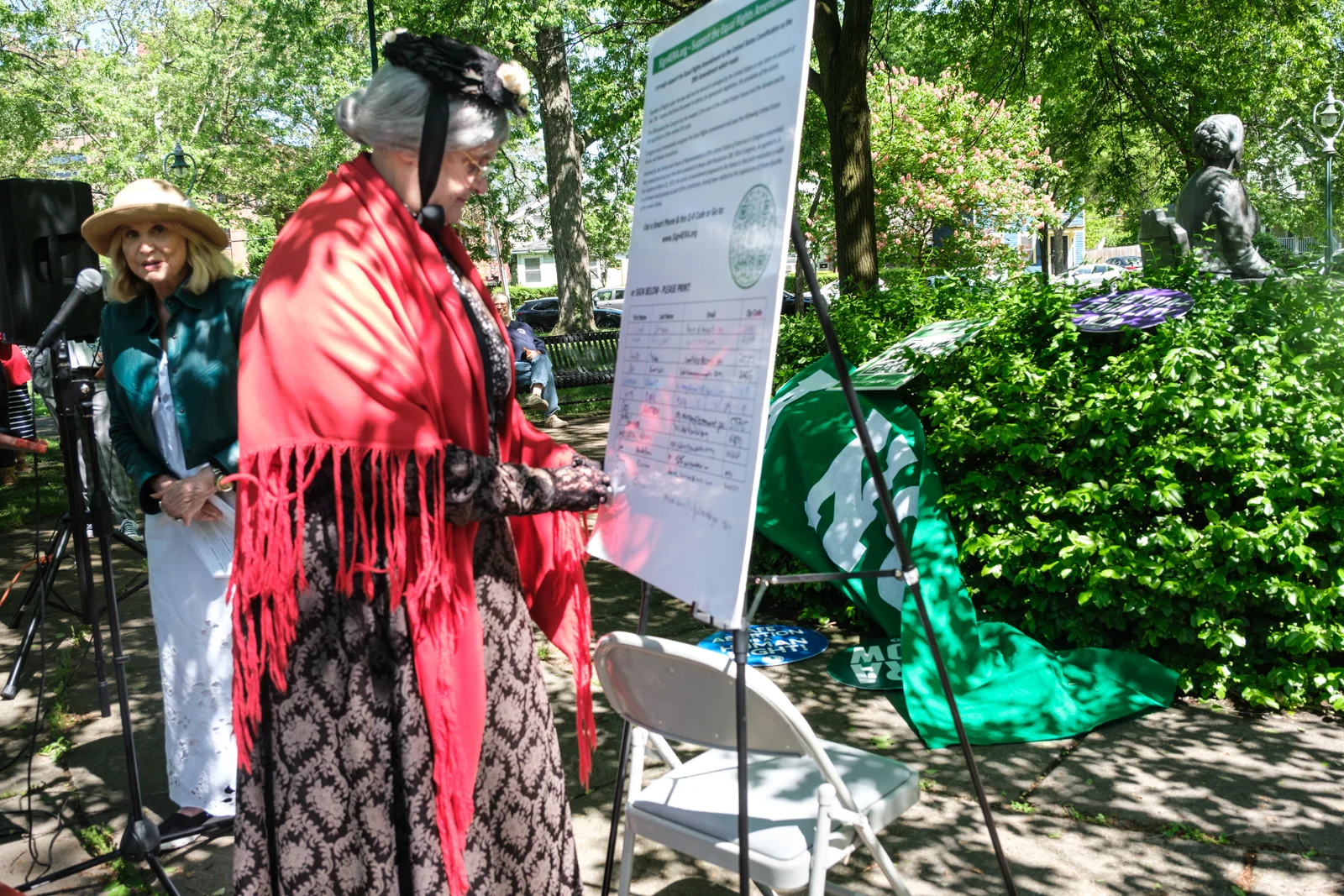
Susan B. Anthony, as portrayed by Barbara Blaisdell, adds her name to the ERA national petition, Sign4ERA — a fitting act of solidarity across 150 years of unfinished work.
While the 19th Amendment secured women’s right to vote, the work of achieving full equality under the law remains unfinished. The Equal Rights Amendment would finally guarantee that equality of rights cannot be denied or abridged on account of sex. Through this Tour and through Sign4ERA.org, we are inviting Americans across the country to join that effort and help write the next chapter in the long story of equality.
As we gathered in Rochester today, we celebrated the pioneers who came before us, honor the activists who continue the struggle, and recommit ourselves to building a future where equality is guaranteed for everyone. Thank you for welcoming the Driving the Vote for Equality Tour to Rochester. Together, let’s continue the journey that began here in western New York and help drive the vote for equality across America.
Add your name to the one million:
Every dollar keeps the Golden Flyer II on the road:
Follow the Journey
Watch history happen. The Golden Flyer II is rolling — New York to the Pacific and back. Track every stop as we drive the ERA fight across 25 states. Real stops. Real people. Real pressure.

