The Golden Flyer II arrives at the historic headquarters of the Rainbow PUSH Coalition — a building that has housed movements for justice, equality, and coalition-building for more than half a century.
We Must Come Together: Chicago, Illinois
As the Golden Flyer II rolled into Chicago, the city’s long legacy of coalition-building, activism, and movements for justice came vividly into focus. Our stop at the historic headquarters of the Rainbow PUSH Coalition connected the 1916 suffrage journey of Alice Burke and Nell Richardson to generations of organizers who understood that lasting change only happens when communities stand together — across lines of race, gender, class, and geography.
Founded by Rev. Jesse Jackson, the Rainbow PUSH Coalition became one of the most influential movements for social and economic justice in modern American history. Rev. Jackson’s vision brought together people from many different backgrounds under the belief that progress depends on unity and shared purpose. That message of building bridges powerfully reflects the same coalition spirit that fueled the women’s suffrage movement more than a century earlier.
This was not simply another stop on the Tour. It was a gathering of voices that reminded everyone in that room — and everyone reading these words — that the fight for the Equal Rights Amendment is inseparable from the fight for voting rights, economic justice, and the full inclusion of all women in the promise of American democracy.
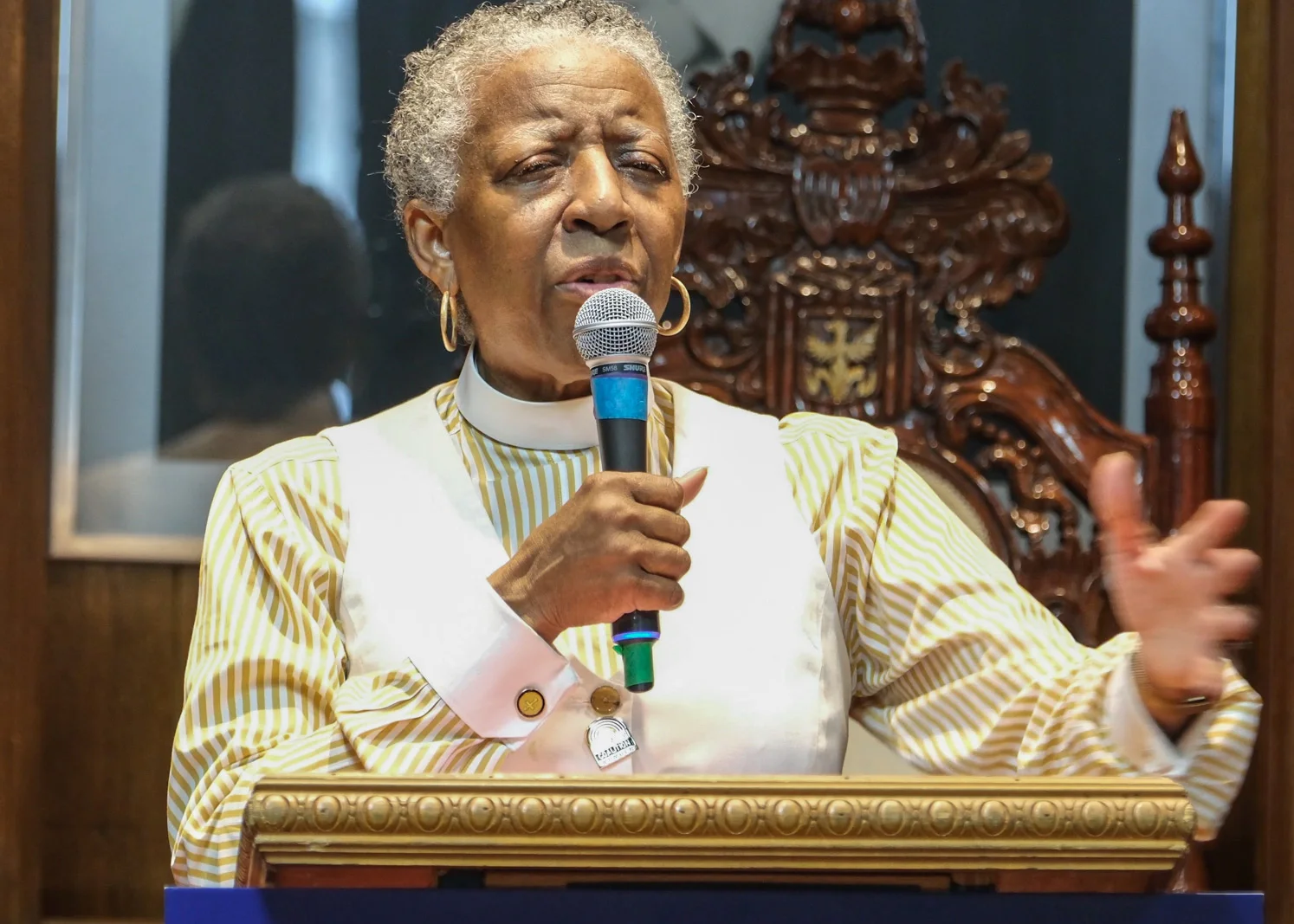
Rev. Dr. Janette C. Wilson-Howard, Esq. — Senior Advisor to the late Rev. Jesse L. Jackson Sr. and National Executive Director of PUSH For Excellence — opens the gathering with a call for women to unite across all lines of race, class, and culture. Photo: Nina Zacuto
The morning opened with a charge from Rev. Dr. Janette C. Wilson-Howard — Senior Advisor to the late Reverend Jesse L. Jackson Sr. and a PUSH leader since 1980 — who welcomed the Tour on behalf of newly elected Rainbow PUSH President Yusef Jackson and the entire Rainbow/PUSH family.
Rev. Wilson-Howard began with the history of Illinois ratifying the ERA in 2017, becoming the 37th state to do so — the result of years of organizing, including many in that very room who pushed legislators in Springfield to secure the votes. But she quickly turned to the threats of the present: the SAVE Act, which she warned could disenfranchise an estimated 69 million women who changed their names at marriage; the gutting of the Civil Rights Act; and the concentrated assault on the rights of women and people of color.
She connected past and present with unflinching clarity. African American women, she said, have never enjoyed equal rights even with white women. It took 100 years after the 19th Amendment for Black women to be fully recognized. She recalled the World’s Fair in Chicago, where white suffragists could not even present their concerns — and had to go to Quinn Chapel, the oldest African American church in the city, to be heard.
“We must move beyond racial barriers. We must move beyond classism and begin to focus on what has happened to the least of these.”
— Rev. Dr. Janette C. Wilson-Howard
Rev. Wilson-Howard’s closing was a call to economic action as much as political action. Women are the majority of the population, she said — and the majority of the power of the vote. They could shut down any company simply by withdrawing their consumer support. They could determine any election outcome if they voted together. “We must decide as women what is in the best interest of ourselves and generations yet unborn,” she said. “Our daughters must be able to look to us and say — what did you do in 2026?”
Jane Ruby, President of the League of Women Voters of Chicago, spoke as a mother — thinking about her young son running in the halls of PUSH as she spoke. She made the argument that equal rights are not a women’s issue but an everybody issue: “When the rights of women are treated as optional, the rights of everyone become more fragile.” She invoked Rev. Jackson’s own words from the 1984 Democratic National Convention: “It is not enough to hope the ERA will pass. We must all come together.”
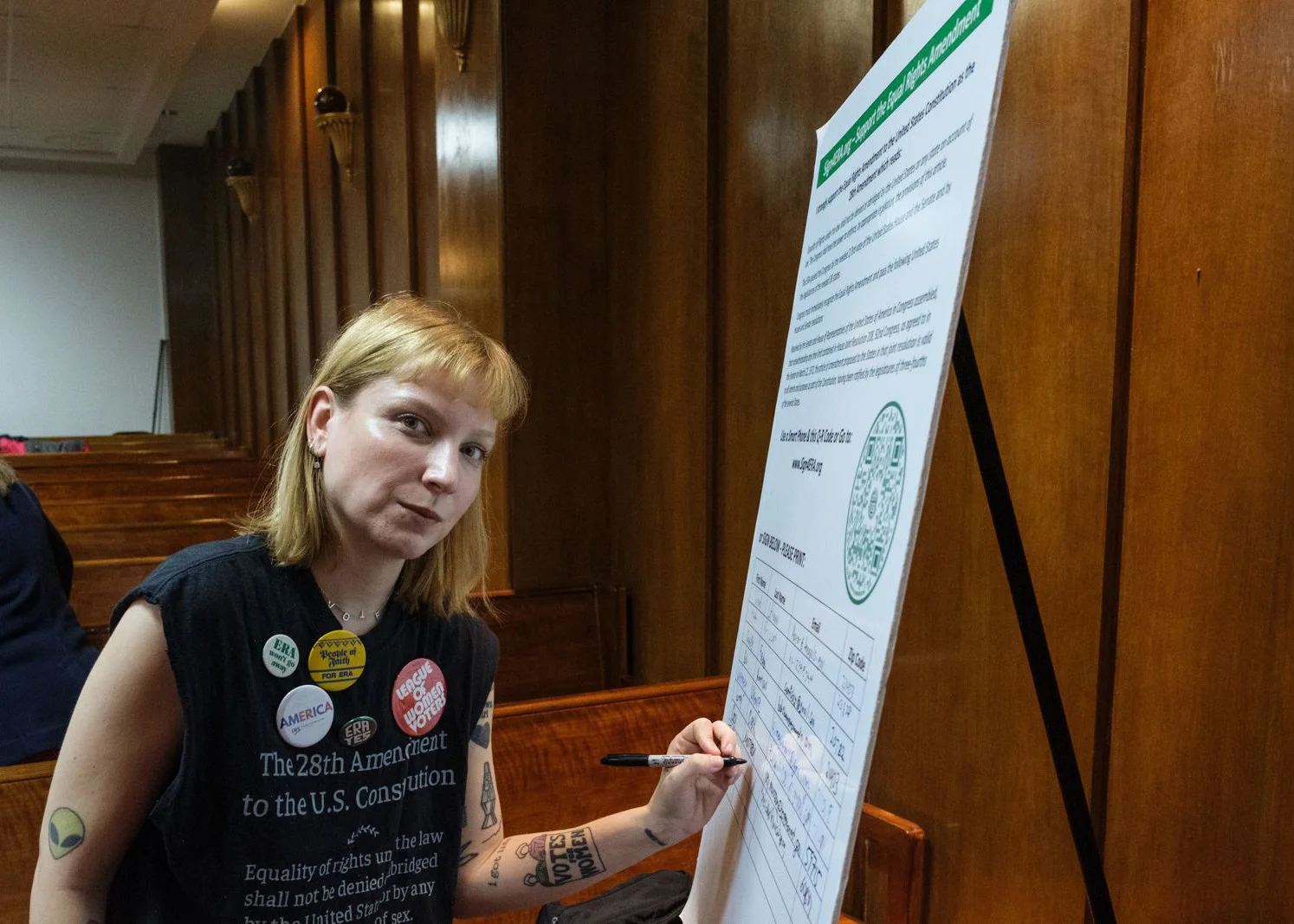
Jane Ruby, President, League of Women Voters of Chicago, adding her name to the Sign4ERA.org Petition at Rainbow PUSH. Photo: Nina Zacuto
Kim Villanueva, National President of NOW — who stood with us in a blizzard at the Tour’s New York launch on March 1, traveled to Arizona in the heat, and now stood in Chicago — delivered the most comprehensive and urgently documented address of the morning.
She opened with the personal: “I never imagined that I would have more rights than my daughter, my nieces, and the generation of young people today.” Then she turned to the political. The recent Supreme Court ruling gutting a core protection of the Voting Rights Act — now requiring proof of discriminatory intent rather than discriminatory effect to challenge gerrymandered maps — she called “not a legal standard. It is a disappearing act.” The Congressional Black Caucus, she noted, grew from 13 members in 1971 to a historic high of 62. It is now being dismantled, district by district. Roughly a third of the majority-minority seats under threat are held by women.
On the SAVE Act, she was direct: an estimated 69 million American women currently use a name that does not match their birth certificate. Under what she called the “Destroy American Democracy Act,” those women could be required to produce a birth certificate, a marriage license, and a divorce decree just to vote.
“The gutting of the Voting Rights Act, the efforts to suppress women’s voter registration, and the fight for the Equal Rights Amendment are not three separate battles. They are one coordinated assault, mounted by the same forces, for the same purpose — to concentrate power permanently in the hands of those who already hold it.” — Kim Villanueva
She put the economic stakes in precise terms: women working full time now earn 81 cents for every dollar paid to men — down from 84 cents. For Black women, that figure falls to 65 cents. For Latinas, 58 cents. Over a lifetime, that gap costs women hundreds of thousands of dollars — and for many women of color, more than a million. “That is not a pay gap,” she said. “That is a denial of power and opportunity.”
She closed where she began — with Alice Burke’s words from a crowd in Alabama in 1916: “All women want is simple justice.” More than a century later, she said, the same reactionary forces are again working to deny that justice. “We will not go back.”
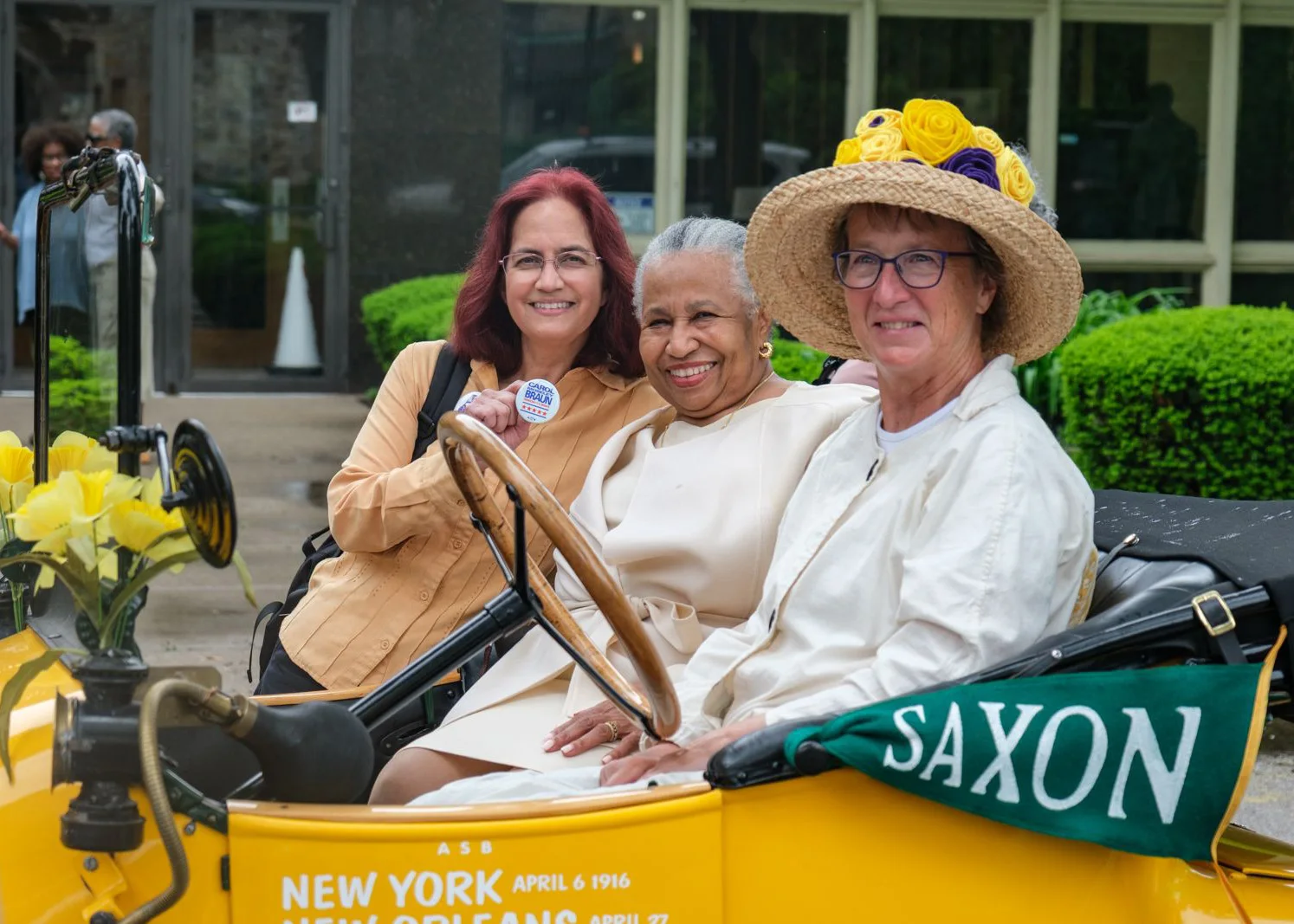
Kim Villanueva, National President of NOW and Ambassador Carol Mosely Braun, former U.S. Senator and the first African American woman elected to the U.S. Senate take a spin in the Golden Flyer II. Photo: Nina Zacuto
David Duster, the great-grandson of Ida B. Wells-Barnett — brought the room face to face with one of the most consequential and least-celebrated figures in the history of American democracy. Born in 1865 in Holly Springs, Mississippi, Wells became a journalist, a fearless investigator of lynchings, and a civil rights organizer whose work reached the world at a time when newspapers either ignored or defended racial terror.
She moved to Chicago in 1893 after threats destroyed her Memphis newspaper office. From Chicago, she continued decades of activism — helping to found the NAACP, organizing against racism at the 1893 World’s Columbian Exposition, and in 1913 founding the Alpha Suffrage Club, the first Black women’s suffrage organization in Illinois. Her legacy is present throughout Chicago: her home at 3624 South King Drive, a 35-foot monument at 3729 South Langley, a Women’s Alpha Suffrage Club marker at 31st and State, and suffrage murals throughout the city.
David closed simply: “Her legacy continues as we are here.”
Ambassador Carol Moseley Braun — former U.S. Senator, former U.S. Ambassador to New Zealand, and the first African American woman ever elected to the United States Senate — took the stage with characteristic directness. She has been fighting for the ERA since her days in the Illinois state legislature in the 1980s. She described drawing maps in her living room, filing redistricting lawsuits, and watching vote after vote fall short through interference and procedural maneuvering. She named the pattern without naming names.
She invoked Ida B. Wells — who, during the early ERA marches, had been relegated to the back of the line, and simply ran to rejoin the Illinois delegation at the front. “She was always on the right side of history.”
“It’s been 100 years, but we can go 100 more if we have to. But hopefully this will be the last shot. Do not give up. Just keep pushing, because it’s not only something that should be done — it has to be done. It’s an imperative for our country.” — Ambassador Carol Moseley Braun
She was blunt about the Supreme Court: “There was a time when we could rely on the Supreme Court to do the right thing. We can’t do that anymore.” The ERA, she said, must be enshrined in the Constitution — and she meant that word literally. “Enshrine is the right word. That’s on us.”
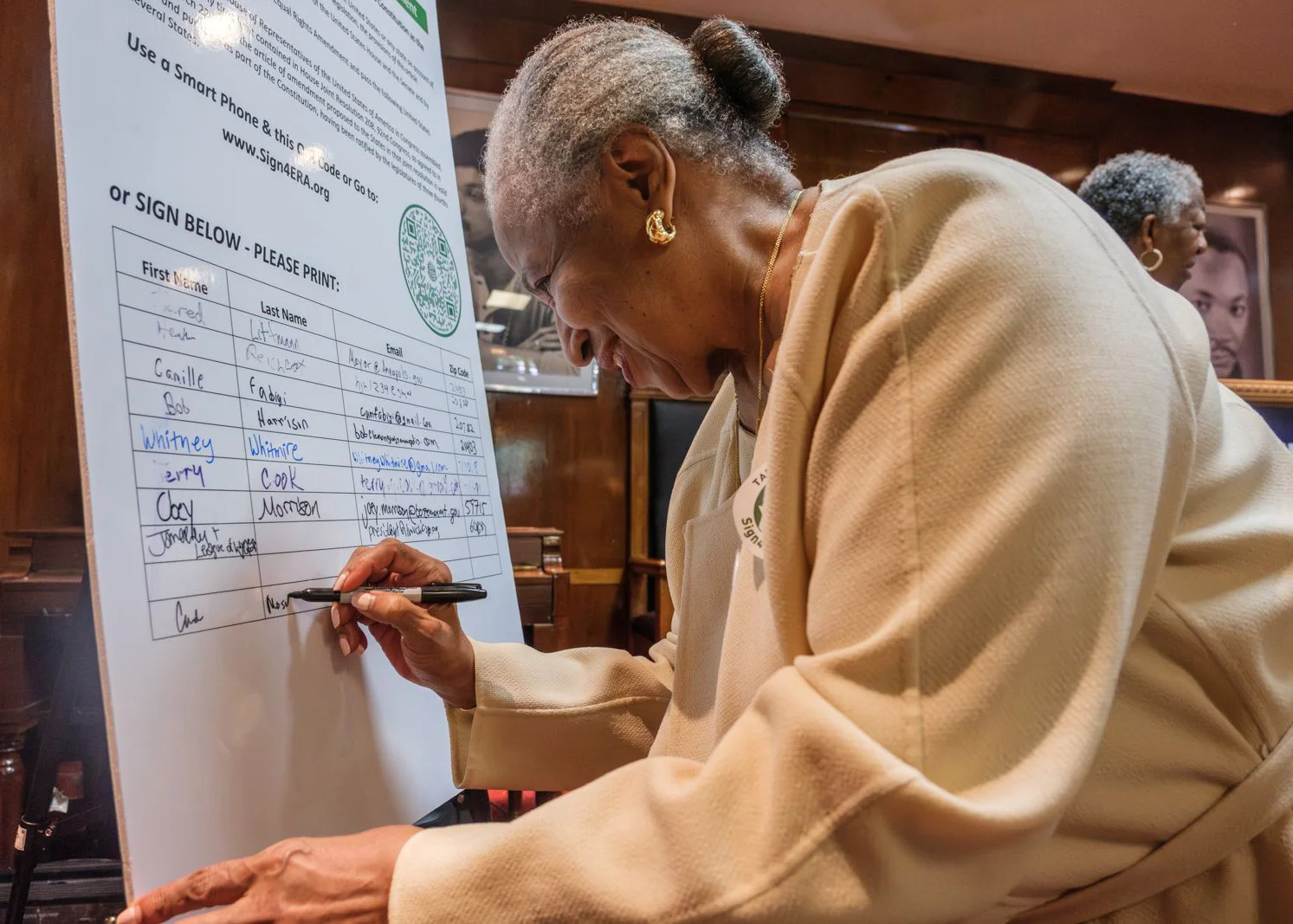
Ambassador Carol Moseley Braun — former U.S. Senator, former U.S. Ambassador to New Zealand, and longtime ERA champion — delivers an impromptu call to keep fighting as she signs the Petition. Photo: Nina Zacuto
Greeting the Tour in the lobby and whose presence was felt throughout the day was Jacqueline Jackson the steady, strategic force beside her husband, civil rights leader, the late Rev. Jesse Jackson. As a senior advisor, she shaped campaigns, counseled coalitions, and quietly brokered relationships across movements and generations, all while grounding the work in an unshakable moral vision of justice and democracy.
Far from a ceremonial spouse, Jacqueline Jackson has been a disciplined organizer, a trusted strategist, and a fierce advocate for those pushed to the margins, reminding power brokers—often in private, sometimes in public—that movements are built not on moments or messiahs, but on communities, care, and relentless, everyday courage.
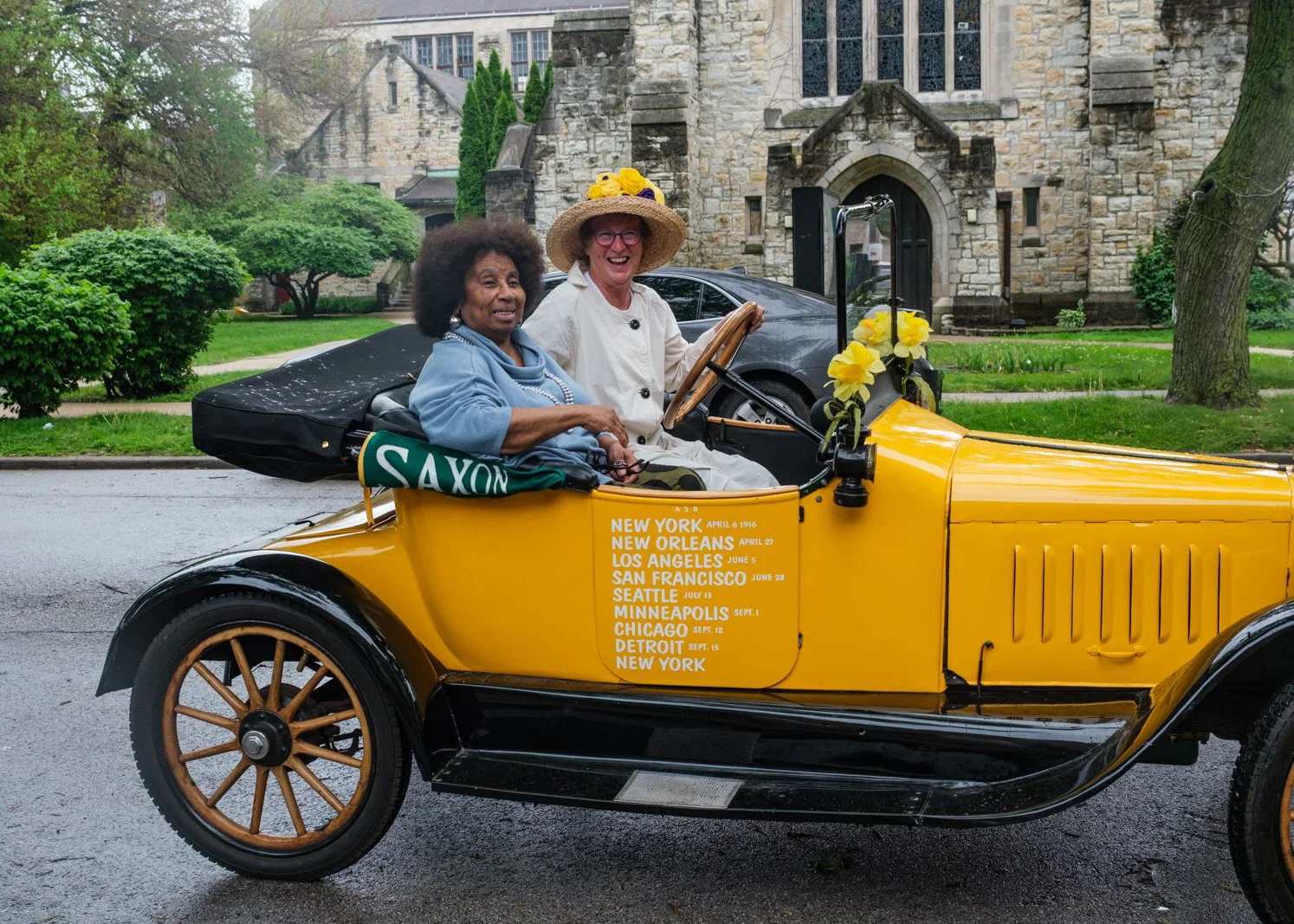
Jacqueline Jackson, author and strategic force in the civil rights and peace movements welcomed the Tour in the lobby and joined driver Susan Nourse, aka Alice Burke, in the Golden Flyer II. Photo: Nina Zacuto
Jeryl Schriever — author of Driving the Vote for Women and the woman who portrays Nell Richardson on this Tour — brought the 1916 story home in a building that Alice and Nell passed through on their cross-country route in early September of that year. She described two determined women in a small car, with terrible maps, no air conditioning, and a cat — who chose to leave Manhattan because they’d already talked to everyone in New York. They had seven prepared speeches, adapted for whatever state they were in. They got stuck in snow in July in the Snohomish Valley. They got lost in the desert between Phoenix and California. They persisted.
She drew the straight line from then to now: “If those ladies could do it 110 years ago — with no GPS, no air conditioning, terrible maps — we can contact our friends, our family, our MAGA cousin in North Carolina, and ask them to sign the petition. It’s not political. It’s just fair.”
Throughout the morning, Betty Magness of the Rainbow PUSH Coalition — who organized the event, arranged the venue, and coordinated the extraordinary gathering of organizations and voices that filled that room — worked quietly and without much recognition. At the close, she received a well-deserved standing ovation.
Also in the room: Dr. Walter Wilson of Rainbow PUSH Coalition; leaders from the League of Women Voters, Illinois NOW, and the Panhellenic Greek organizations; and a assembly of advocates who have been fighting this fight for decades. The energy was that of a reunion — and a call to arms.
“Justice and political power are inseparable. We cannot protect our paychecks if we cannot protect the ballot. We cannot protect the ballot if we cannot protect the Constitution.”
— Kim Villanueva
Chicago has always been a crossroads for movements that reshaped America — from labor organizing and civil rights to women’s rights and voting rights. The Rainbow PUSH Coalition’s history of uniting diverse communities around justice, opportunity, and political empowerment echoes the determination and optimism that powered the suffragists’ remarkable cross-country journey.
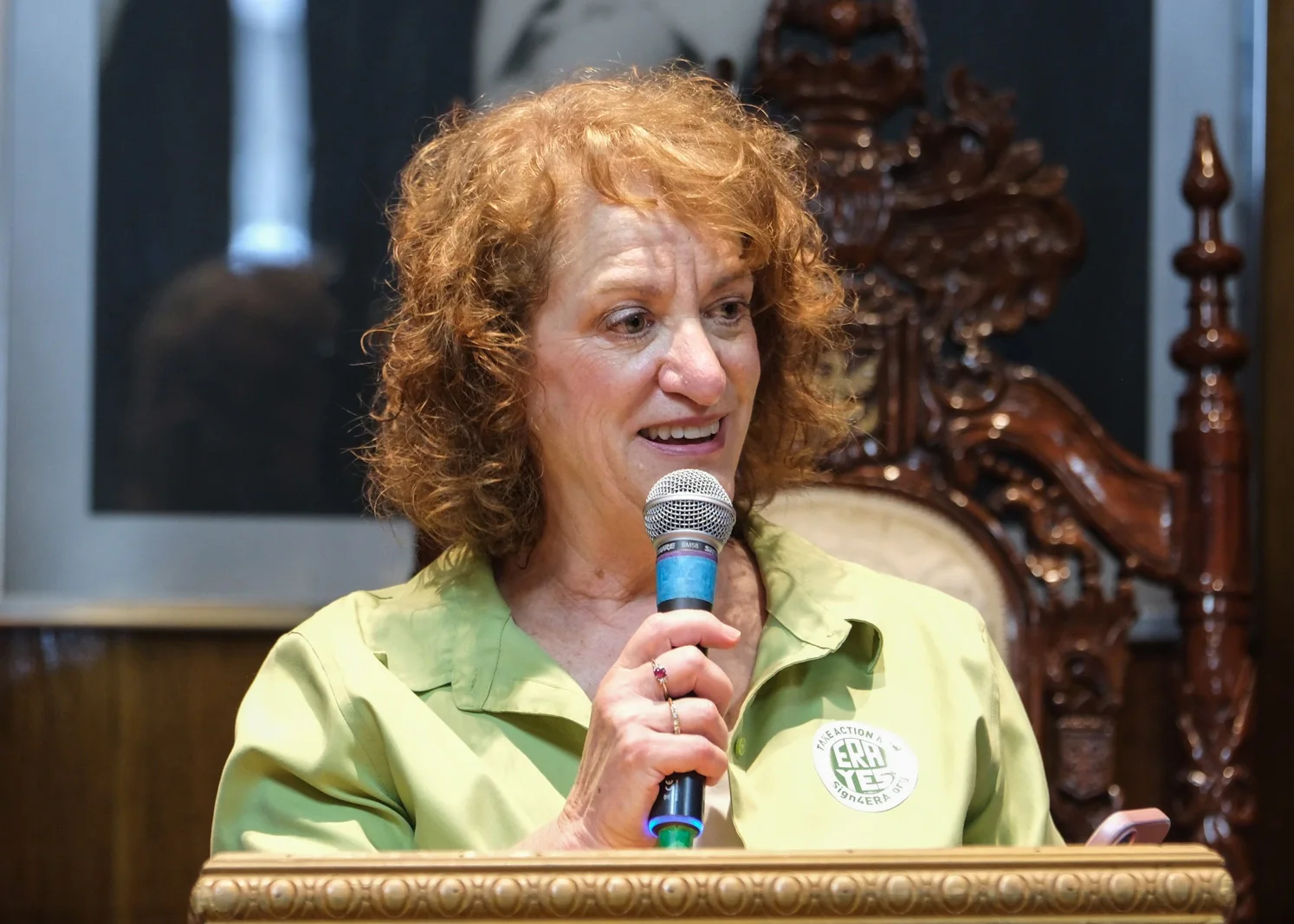
Laura Welch, former Illinois NOW President and lead organizer of the Tour’s visit to Chicago, served as our host and emcee and beautifully wove together the many important messages and actions, including our mission of an ERA Joint Resolution in Congress. Photo: Nina Zacuto
Standing at that podium, under that roof, with those voices — the message was unmistakable. The fight for the Equal Rights Amendment is not a single-issue campaign. It is the convergence of every fight for justice that has defined this country’s long, unfinished arc toward equality. Women of all races, men who understand what is at stake, young people who have inherited a country still making up its mind — all of them are needed now.
As Rev. Jackson would say: “Keep Hope Alive”. As Rev. Wilson-Howard said: We must decide what is in the best interest of ourselves and generations yet unborn. As Ambassador Moseley Braun said: “Do not give up. Just keep pushing”.
The Golden Flyer II drives on.
Add your name to the one million:
Every dollar keeps the Golden Flyer II on the road:
Follow the Journey
Watch history happen. The Golden Flyer II is rolling — New York to the Pacific and back. Track every stop as we drive the ERA fight across 25 states. Real stops. Real people. Real pressure.

