Ellie Smeal, President of the Feminist Majority, and Madeline Amos of the Feminist Campus Initiative. Photo: Nina Zacuto
Washington, D.C. Day 2: Labor, Lunch, and a Bookstore on the Wharf
Some days on this journey are about momentum. Day Six was about roots — the deep, tangled, mutually reinforcing roots and needs of the labor movement and the fight for women's equality. Then two more events — one luncheon and one bookstore parking spot later, Washington had heard the message loud and clear.
Morning: The AFL-CIO — Where Labor and the ERA Meet
The Golden Flyer II arrived outside AFL-CIO headquarters at 815 16th Street NW at 9:30 in the morning, gleaming in suffrage yellow on a street that has seen a century of workers marching for their rights. It was exactly the right car in exactly the right place.
Inside, the Women's History Month panel brought together some of the most powerful voices in the labor and women's rights movements — and they didn't pull punches. The moderator, Peggy Simpson — a retired AP reporter with decades of frontline experience — opened by making something clear: the current rollback of civil rights is not accidental. It is a well-planned, coordinated assault by conservative groups. The room knew it. The room was ready.
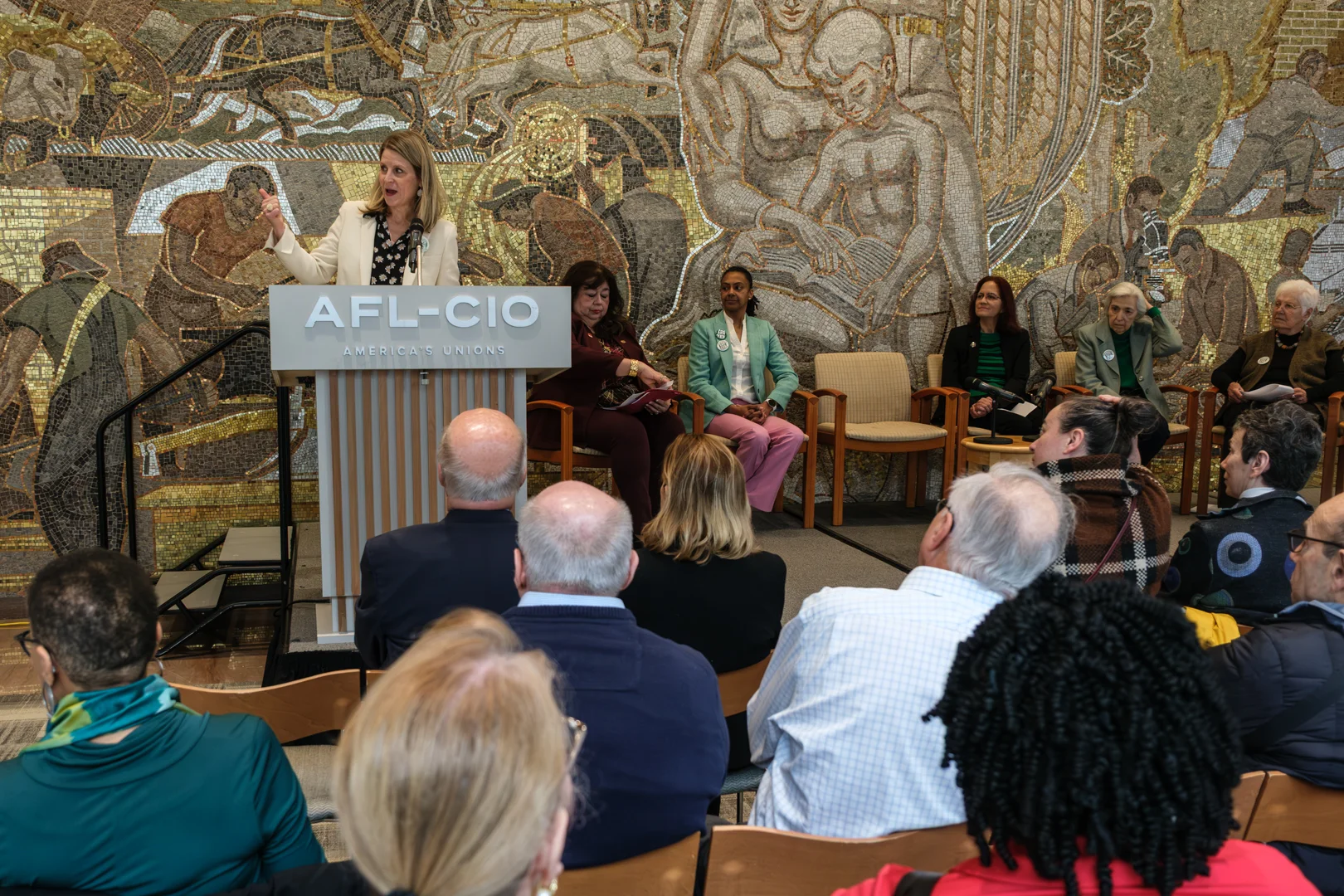
Elizabeth Shuler, President, AFL-CIO. Photo: Nina Zacuto
Congresswoman Carolyn Maloney, and founder of ERA NOW and ourDriving the Vote for Equality joined by Zoom and celebrated a milestone that deserves more attention than it gets: for the first time in its history, the AFL-CIO is led by a woman — Elizabeth Shuler. Maloney then named what's at stake: the right to choose, Title VII, Title IX — hard-won protections that are now under direct attack. The ERA, she argued, is not a luxury or a symbol. It is the constitutional foundation that would make those protections permanent. She pointed attendees to Sign4ERA.org and the campaign's drive for one million petition signatures by Election Day.
Elizabeth Shuler, the first woman ever to lead the AFL-CIO, welcomed the panelists and the audience with the warmth of someone who understands exactly what this moment demands — and exactly where she's standing while she says it. The reception room is one of the most celebrated spaces in the building, its walls graced by a mosaic mural tracing the early history of the American labor movement — the strikes, the marches, the hard-won dignity of working people across generations. In that room, surrounded by that history, Shuler made the case with clarity and conviction: more women need to be elected to power — women who understand the full weight of what working women carry as caregivers, mothers, and heads of households. The demands are real. The stakes are high. And the path forward, she said, is possible — if working women unite right now.
Zakiya Thomas, President and CEO of the ERA Coalition, followed with a clear-eyed diagnosis: fair pay, pregnancy discrimination, restricted reproductive healthcare — every one of these fights comes back to the same missing piece. The Equal Rights Amendment. She urged the room to mobilize voters and elect officials who understand that gender equality is not a political position. It's a constitutional obligation.
Sylvia Ramos brought history and fire in equal measure. In 1998 she received the AFL-CIO's "A Woman's Place Is in Her Union" award. In 2023 she made history again as the first Latina Chief of Staff at the Communications Workers of America. She celebrated the installation of Roxanne Brown as the first Black woman to lead the United Steelworkers — and then turned her attention to what the current administration is doing: firing thousands of Black women from the federal government, attacking the LGBTQ+ community, rolling back civil rights across the board. Her closing call was unambiguous. Working women need to mobilize. Now.
Ellie Smeal, president of the Feminist Majority Foundation, zeroed in on young people — noting that a vast majority of young women are voting for equality and that the effort to defund women's studies programs is not coincidental. It is part of the same war. Her goal, stated plainly: to have gender-based oppression recognized globally as a crime against humanity. A sentence that would have seemed extraordinary in another era. In this one, it landed as simple truth.
Kim Villanueva, President of NOW, and Ellie Smeal together honored Dorothy Haener — a welder during World War II who fought within the United Auto Workers for equal pay and against workplace harassment decades before those words entered the mainstream. Haener was, they said, a bridge builder between the labor movement and the feminist movement. Standing in the AFL-CIO in 2026, you could feel that bridge holding.
One final speaker — a man, a union supporter — took a moment of personal privilege to say that his mother was in a nurses association, his daughter is a delegate for the NEA, and his wife is a retired police sergeant who was once the only woman sergeant on the Supreme Court Police Force. He wasn't there to make a speech. He was there to say: this fight belongs to all of us.
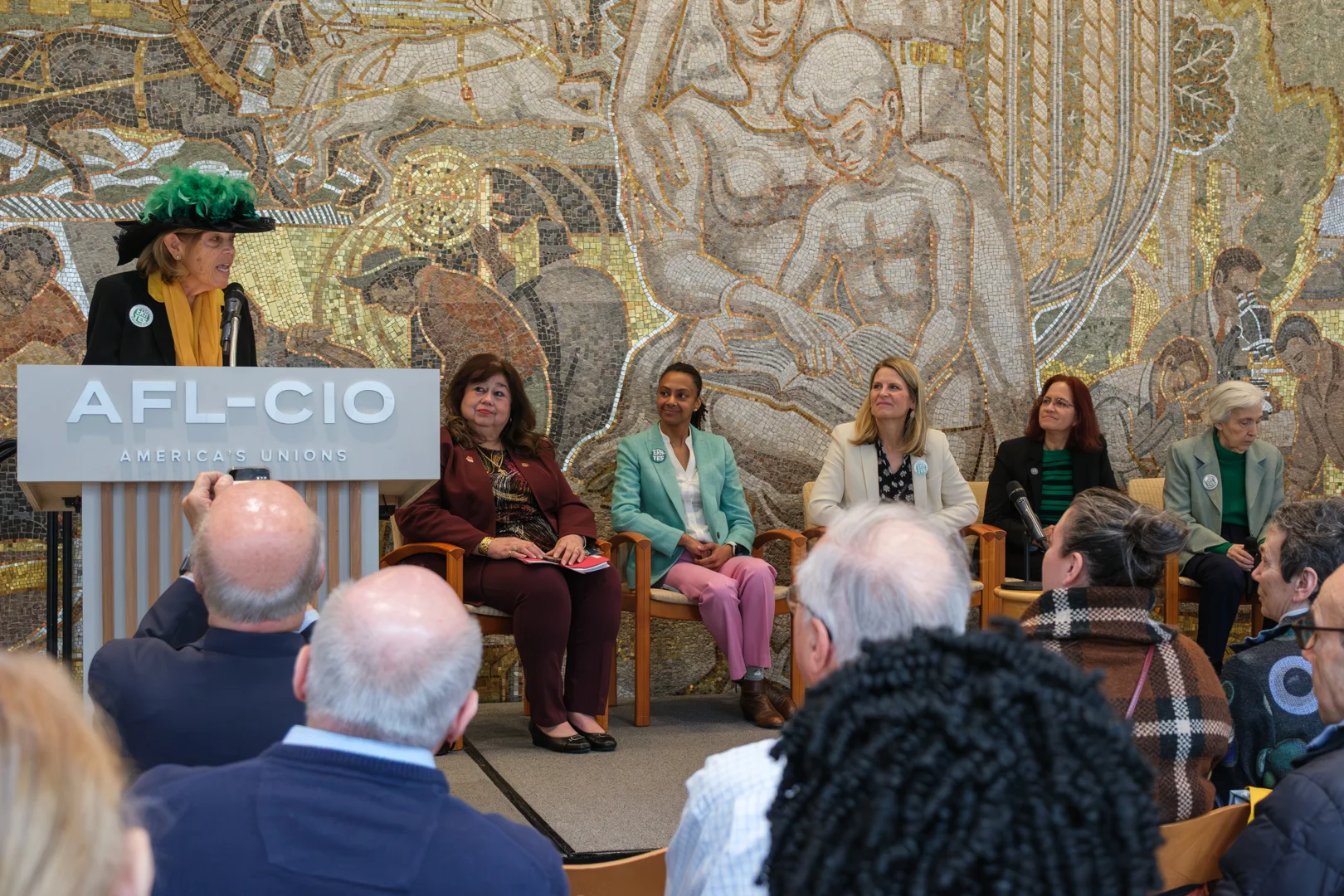
Author Jeryl Schriever brings the 1916 suffrage road trip to life for labor and feminist leaders at the AFL-CIO — Alice and Nell's century-old journey for women's votes echoing off one of Washington's most iconic union murals. Photo: Nina Zacuto
Noon: The Woman's National Democratic Club
From the AFL-CIO the team moved to the Woman's National Democratic Club near Embassy Row — a grand old mansion that has hosted a century of political conversation — for a Women's History Month luncheon that drew more than 100 people. Many had spent their entire careers fighting for equality, in their own lives and in the lives of others.
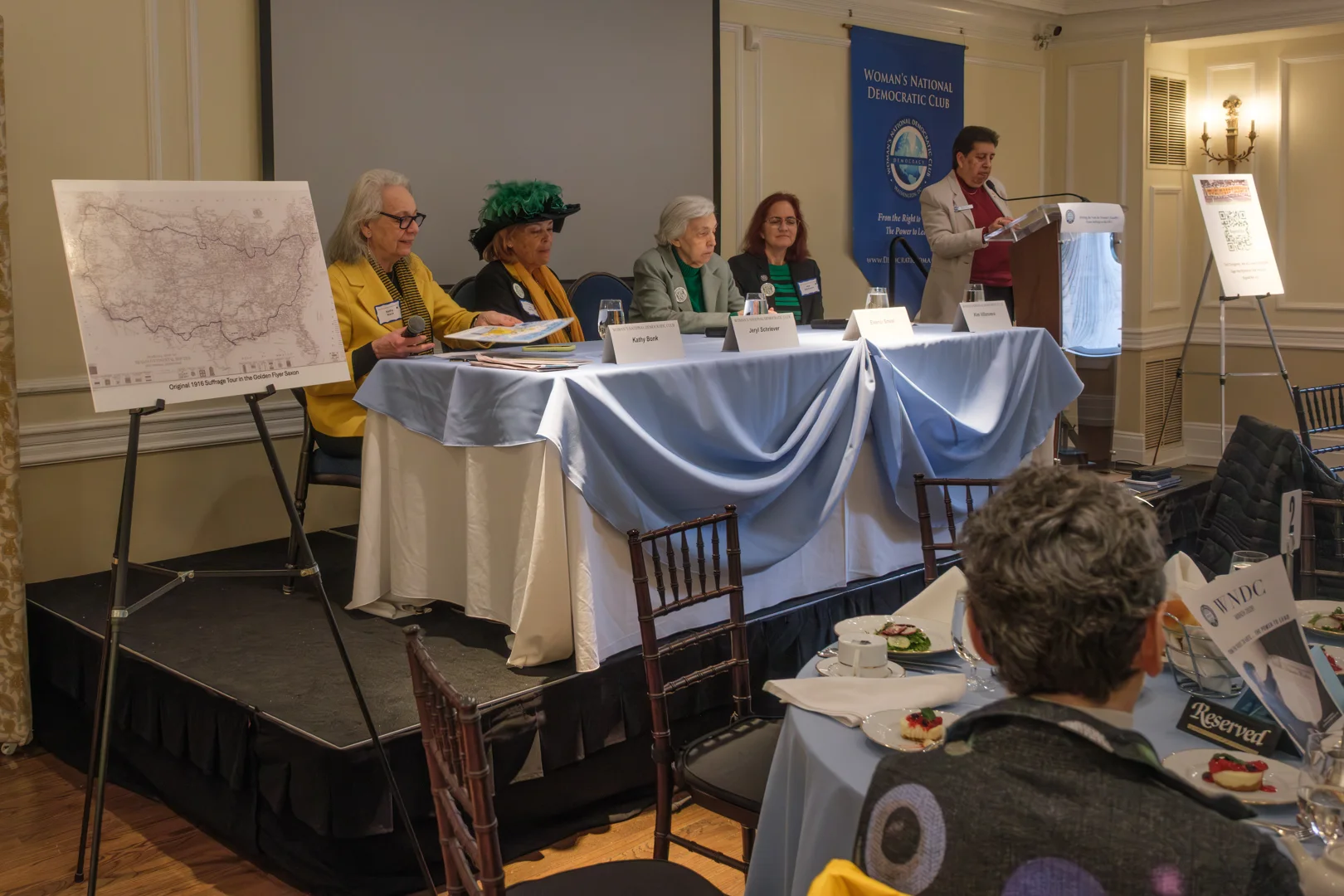
Long-time ERA activists and feminist leaders gather at the Woman's National Democratic Club in Washington for a Women's History Month luncheon — united behind the ERA and the constitutional finish line that is finally within reach. Photo: Nina Zacuto
Ellie Smeal, Kathy Bonk, and Kim Villanueva spoke. Carolyn Maloney joined again by Zoom. The room was full of people who know exactly what this campaign is about — because they've been living it. The ERA. The tour. The petition. The constitutional finish line that keeps moving. In a room like that, you don't need to explain the urgency. You just need to remind each other that this time, we're going to cross it.
Evening: Politics and Prose — Stories on the Wharf
The day ended at Politics and Prose Bookstore at the Wharf — Washington's quintessential civic bookstore, the kind of place where writers, journalists, staffers, and ordinary readers have argued amiably in the aisles for decades. The Golden Flyer II parked outside at 5:30 and immediately did what it always does: drew a crowd.
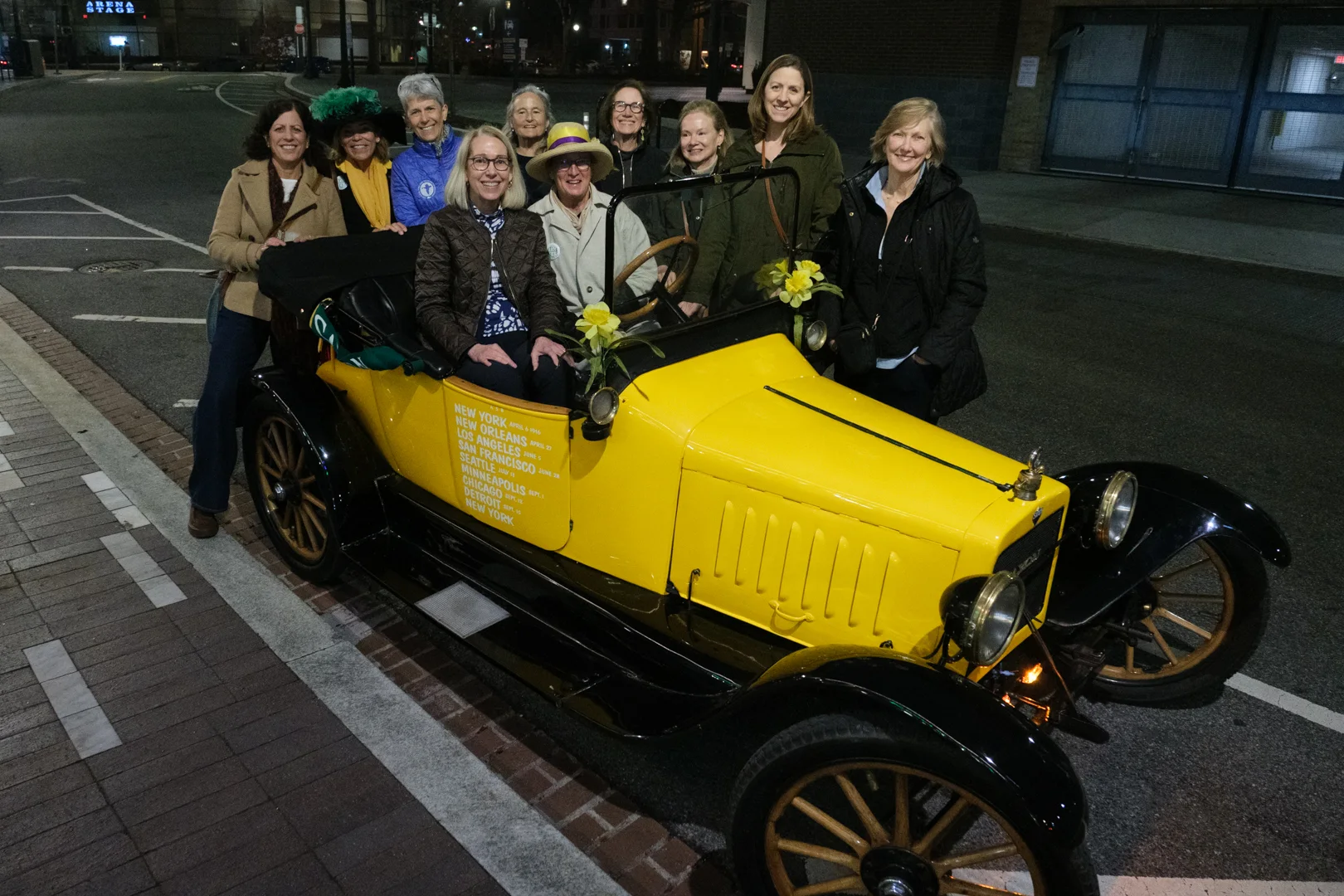
History buffs and ERA activists pack Politics and Prose for an evening with Jeryl Schriever — where Alice and Nell's 1916 road trip met the 2026 fight for the 28th Amendment. Photo: Nina Zacuto
Inside, Jeryl Schriever — author of Driving the Vote for Women and the woman who has spent years recovering Alice and Nell's nearly forgotten story — told the crowd about the 1916 journey. About two women who climbed into a small golden Saxon roadster with no highways, no guarantees, and a cause that everyone told them would never succeed. About the speeches they gave in snowstorms. About the crowds that cheered and the ones that didn't. About why the story matters now more than it ever has.
Outside, the Golden Flyer II kept doing its work. Four National Guardsmen from South Carolina were walking up the street when they spotted the car. They stopped. They came over. They asked questions. All four signed the petition. One of them started the engine. You couldn't have written it better.
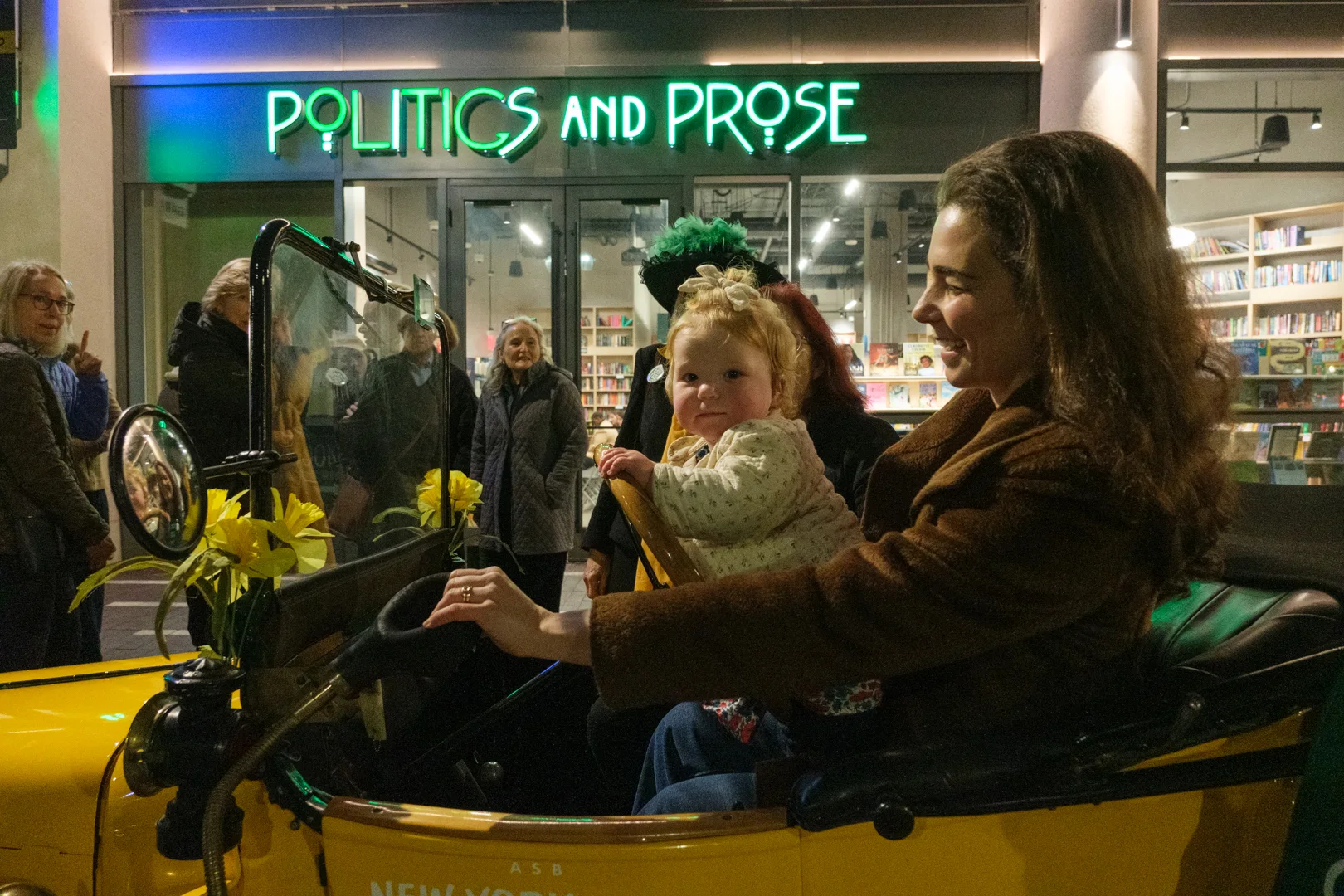
A mother and her baby girl take a turn in the Golden Flyer II outside Politics and Prose — two generations of the future the ERA is meant to protect, guaranteed by the Constitution. Photo: Nina Zacuto
The ERA fight, it turns out, doesn't need an invitation. It just needs a suffrage-yellow Saxon and a good story. Washington gave us both in these two days.
Follow the Journey
Watch history happen. The Golden Flyer II is rolling — New York to the Pacific and back. Track every stop as we drive the ERA fight across 25 states. Real stops. Real people. Real pressure.

