Photo: Nina Zacuto
Sacred Ground in Lorton, VA — and Sunshine in Fredericksburg, VA
There are stops on this journey that are about energy and momentum — crowds, signatures, selfies, the Golden Flyer II drawing people in off the street. And then there are stops that ask something different of you. That ask you to be still for a moment. To look at the ground beneath your feet and understand what happened there.
Lorton, Virginia was that kind of stop.
Morning: The Turning Point Suffragist Memorial, Occoquan Regional Park
The Turning Point Suffragist Memorial sits on the grounds of the old Occoquan Workhouse — and that location is not incidental. It is the whole point.
In 1917, suffragists — women ranging in age from 19 to 73 — were arrested for the crime of standing silently outside the White House holding banners that asked for democracy. They were brought here, to Occoquan, where they were humiliated, kept in filthy and inhumane conditions, denied contact with family and lawyers, thrown into solitary confinement, and in many cases severely beaten.
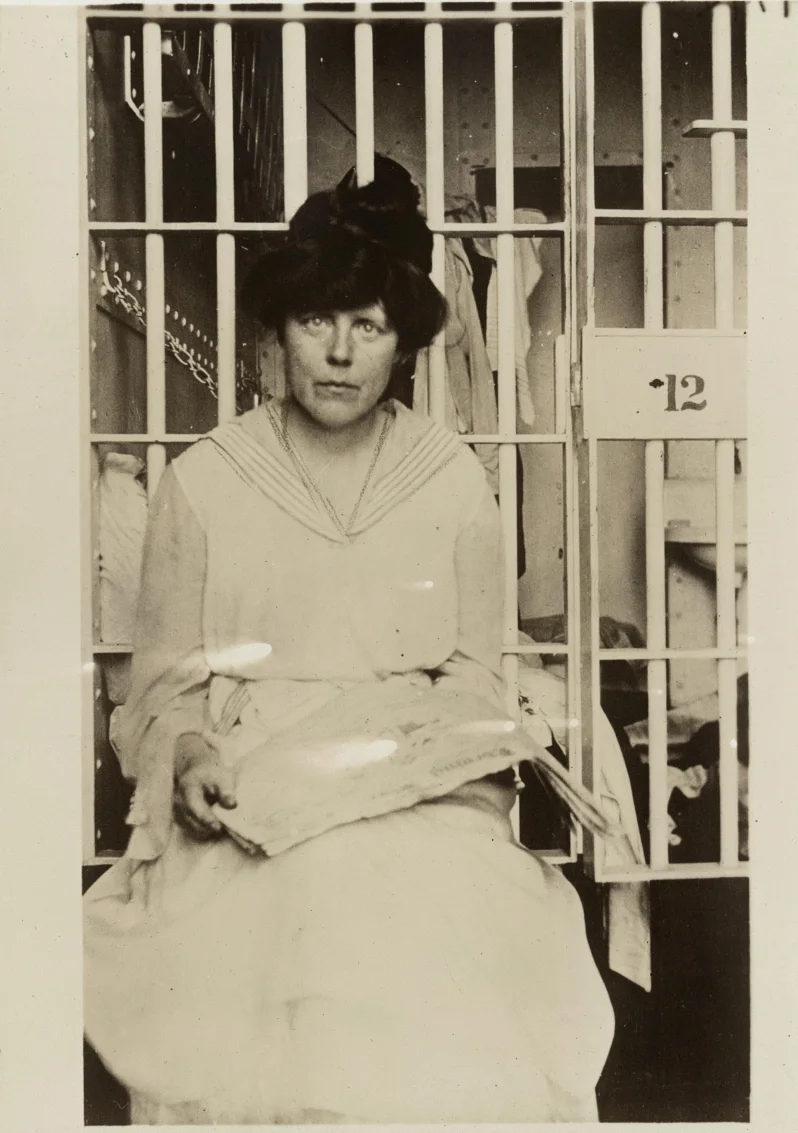
Lucy Burns in Occoquan Workhouse. Credit: Library of Congress Manuscripts Division
Lucy Burns and Alice Paul — the very woman who would go on to author the Equal Rights Amendment — led the resistance from inside those walls. When the women went on hunger strikes to protest their treatment, they were force-fed. When they refused to be broken, the guards broke them physically instead.
On the night of November 14, 1917 — the Night of Terror — guards went further still.
Women were stripped, beaten, and handcuffed with their arms raised over their heads, forced to stand through the night. The brutality was so extreme, and accounts so harrowing once they leaked to the press, that public opinion began to shift. The very cruelty meant to silence them became the turning point the memorial is named for. The government's attempt to crush dissent accelerated the democratic reform it was trying to stop.
That is the ground the Golden Flyer II pulled into on the morning of March 7.
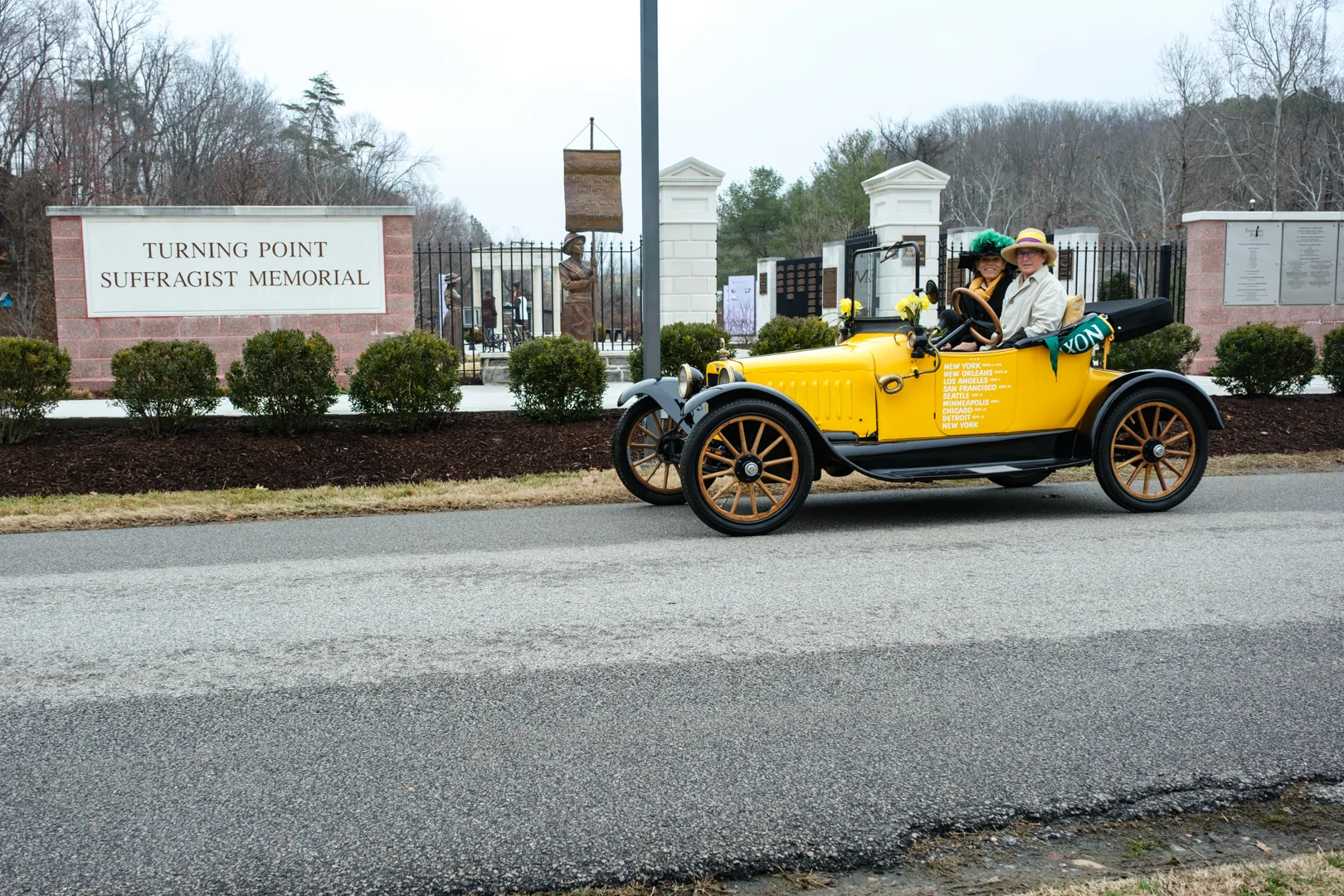
Jeryl Schriever and Susan Nourse — as Alice Burke and Nell Richardson — pause at the Turning Point Memorial's Circle of Plaques, where the names and sacrifices of the women who won the vote are etched in stone. A century later, their successors are still finishing the work. Photo: Nina Zacuto
The memorial itself is breathtaking — a rotunda with pillars of democracy, a garden planted in the movement's colors of purple, gold, and white, statues of key leaders, and nineteen educational stations that walk visitors through the full seventy-two-year struggle for suffrage, including the often-overlooked contributions of African American suffragists.
A commemorative wall lists by name the women who were jailed here in 1917. Not abstractions. Not "the suffragists." Specific human beings who paid a specific price so that their daughters and granddaughters and great-granddaughters could vote.
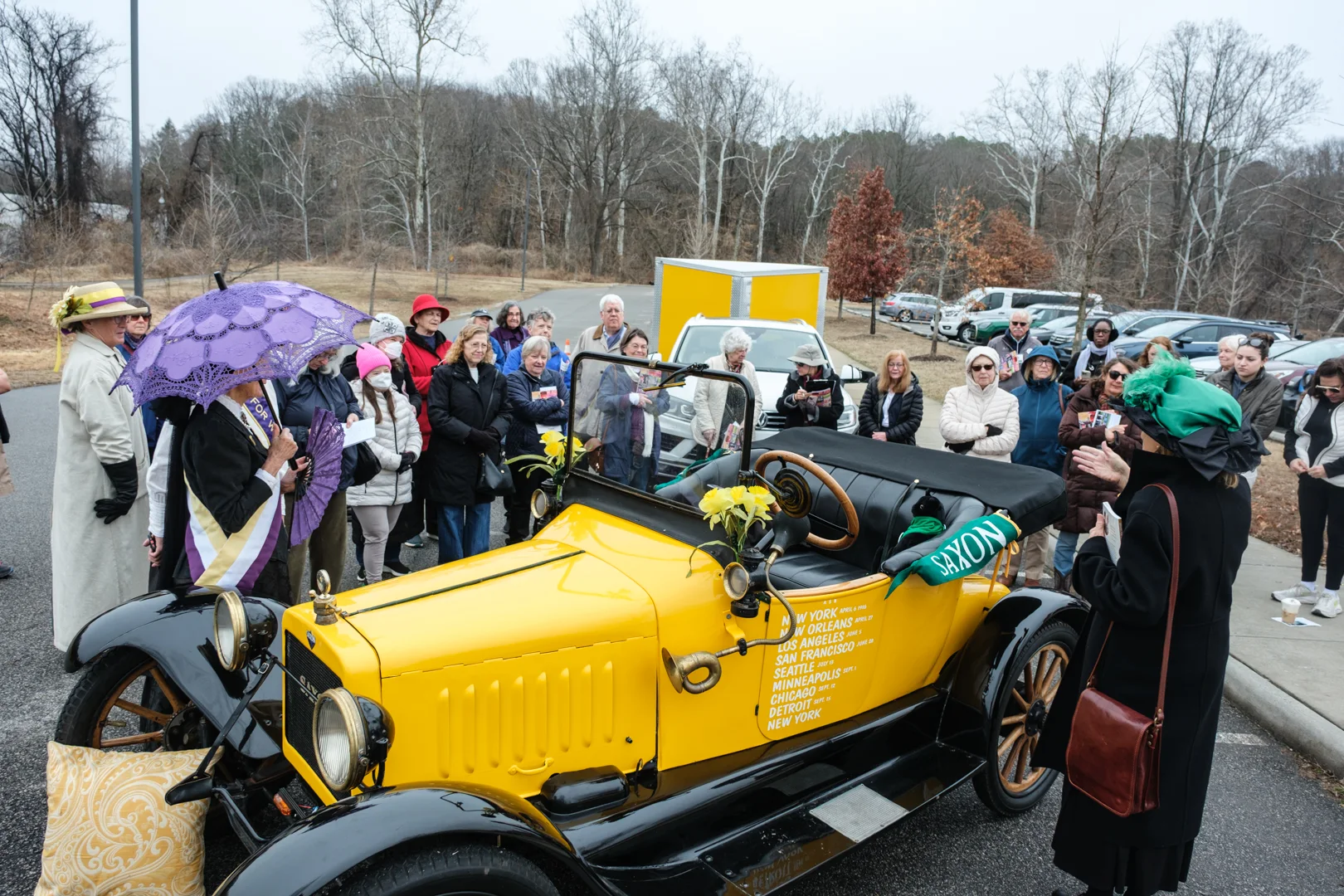
A crowd gathers at the Turning Point Suffragist Memorial to engage with living history — hearing the story of Alice Burke and Nell Richardson's courageous 1916 journey and discovering how they can carry that fight for constitutional equality forward today. Photo: Nina Zacuto
We arrived to a crowd already gathered in the parking lot — and it grew steadily over the next hour. Jeryl Schriever spoke about Alice and Nell's 1916 journey and about the ERA's long march toward constitutional recognition.
The crowd listened. Then they got to work. Many left carrying petitions — not just signed, but committed to collecting signatures in their own communities. That's the multiplier effect this campaign is built on. You don't just sign. You carry it forward.
Standing on this ground, surrounded by the names of women who were beaten for asking to vote, the urgency of the ERA doesn't require explanation. It requires action.
Afternoon: Fredericksburg Area Museum — Sun, a Mayor, and Some Very Inspired Teenagers
From Lorton the Golden Flyer II headed south to Fredericksburg, and the weather made a decision: the sun came out. After days of overcast skies, it felt like a signal.
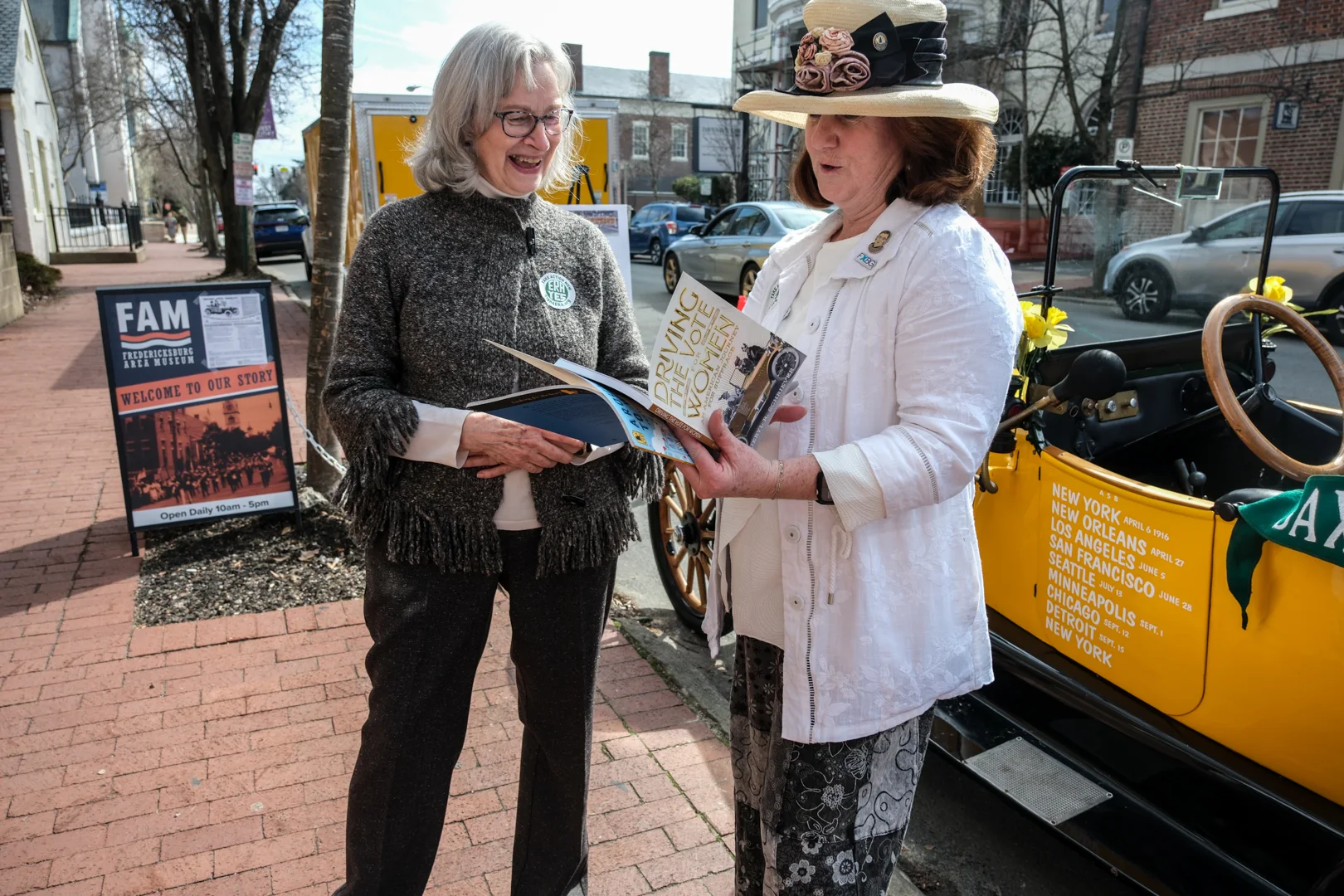
Fredericksburg Mayor Kerry Devine and Charlotte Gibson, President of Charlottesville NOW, share the Golden Flyer II with Saxon the cat — three ERA champions ready to drive the cause forward. Photo: Nina Zacuto
The stop at the Fredericksburg Area Museum was designed as an informal gathering — ERA supporters from the region, conversation in the Council Chambers meeting room, the Golden Flyer II outside for photos. What it became was something better.
Fredericksburg Mayor Kerry Devine signed the petition right there beside the car — carside, in the sunshine — and then did something that speaks volumes about the kind of elected official this campaign needs more of. She stayed. For the entire two hours. Not for a photo op. Not for a press hit. She engaged in genuine conversation about how she, as mayor, and other local officials in the region can mobilize to help push the Joint Resolution through Congress. That's a partner, not a politician.
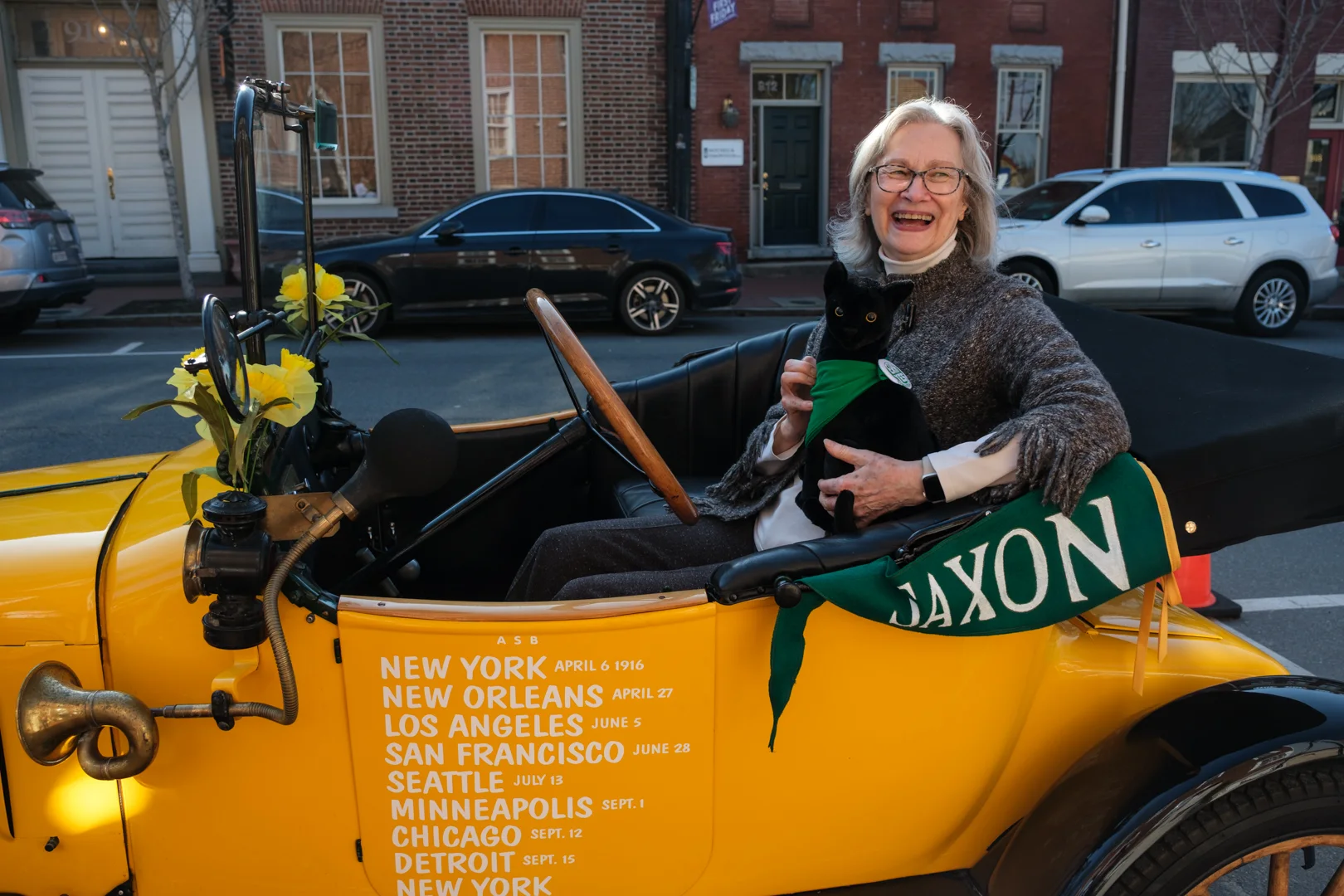
Charlotte Gibson, President of Charlottesville NOW, takes a turn in the Golden Flyer II with Saxon the cat — organizers come in all forms on this journey. Photo: Nina Zacuto
The visit was also an occasion for recognition. Virginia NOW President, Kobby Hoffman presented Mayor Devine with the campaign's ERA Champion Award — honoring her committed support for the Equal Rights Amendment and her willingness to use the platform of elected office to push the cause forward. It was a moment that captured exactly what this campaign is looking for: local leaders who don't just sign a petition and move on, but who see the ERA as part of their own civic mission.
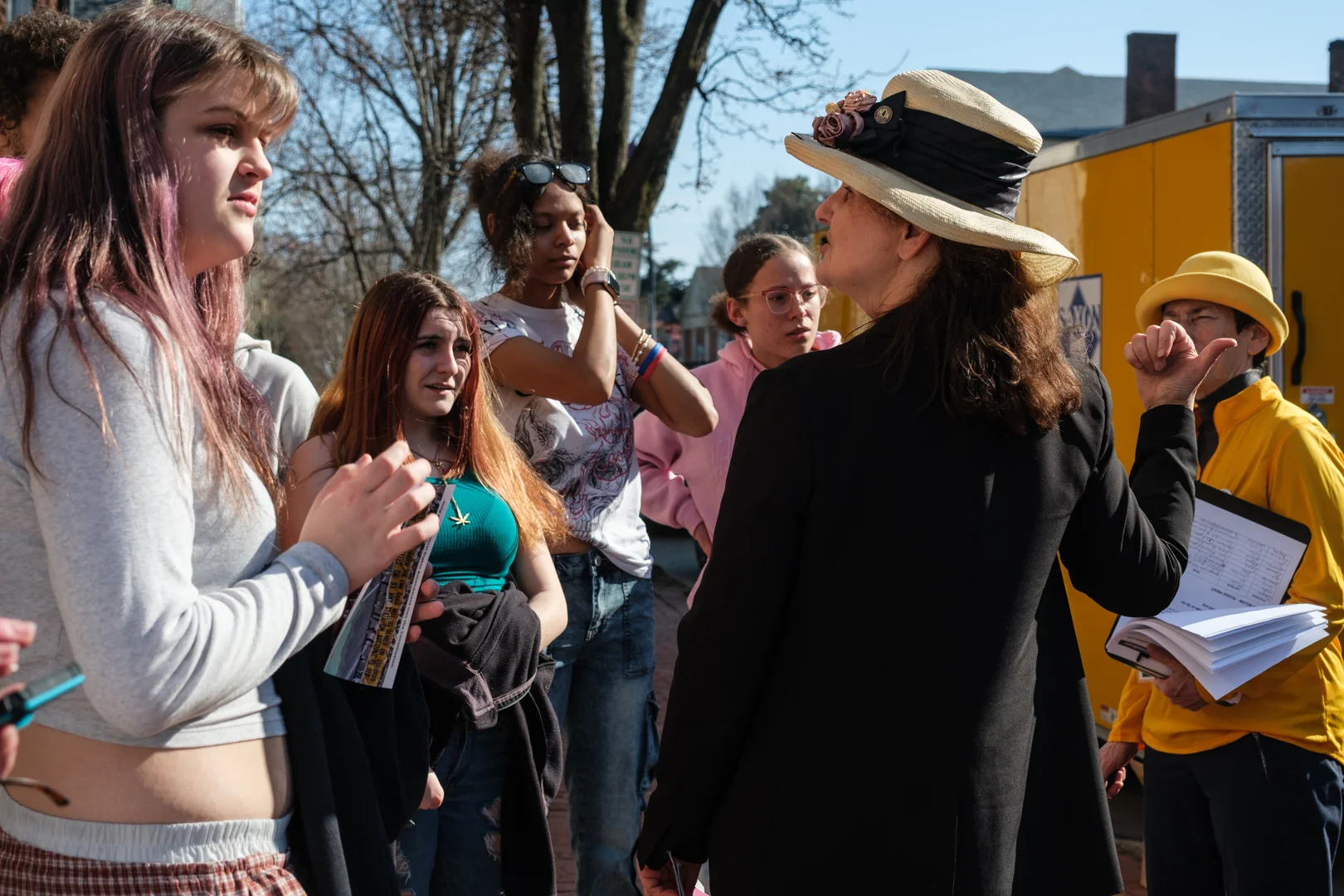
Virginia NOW President Kobby Hoffman engages the next generation — talking with teens about the Driving the Vote for Equality tour and why the fight for the ERA is very much their fight too. Photo: Nina Zacuto
And then came the teenagers.
A group of teenage girls out for a walk around town spotted the Golden Flyer II and stopped — captivated, the way young people invariably are by this car and its story. They climbed in for selfies. They heard about Alice and Nell. They heard about the ERA. And they left energized, committed to promoting the Sign4ERA petition on social media to their networks of friends. In 1916, Alice and Nell stood on the seats of their car to give speeches. In 2026, a group of teenage girls with smartphones can reach more people in an afternoon than Alice and Nell reached in a week. The tools are different. The mission is the same.
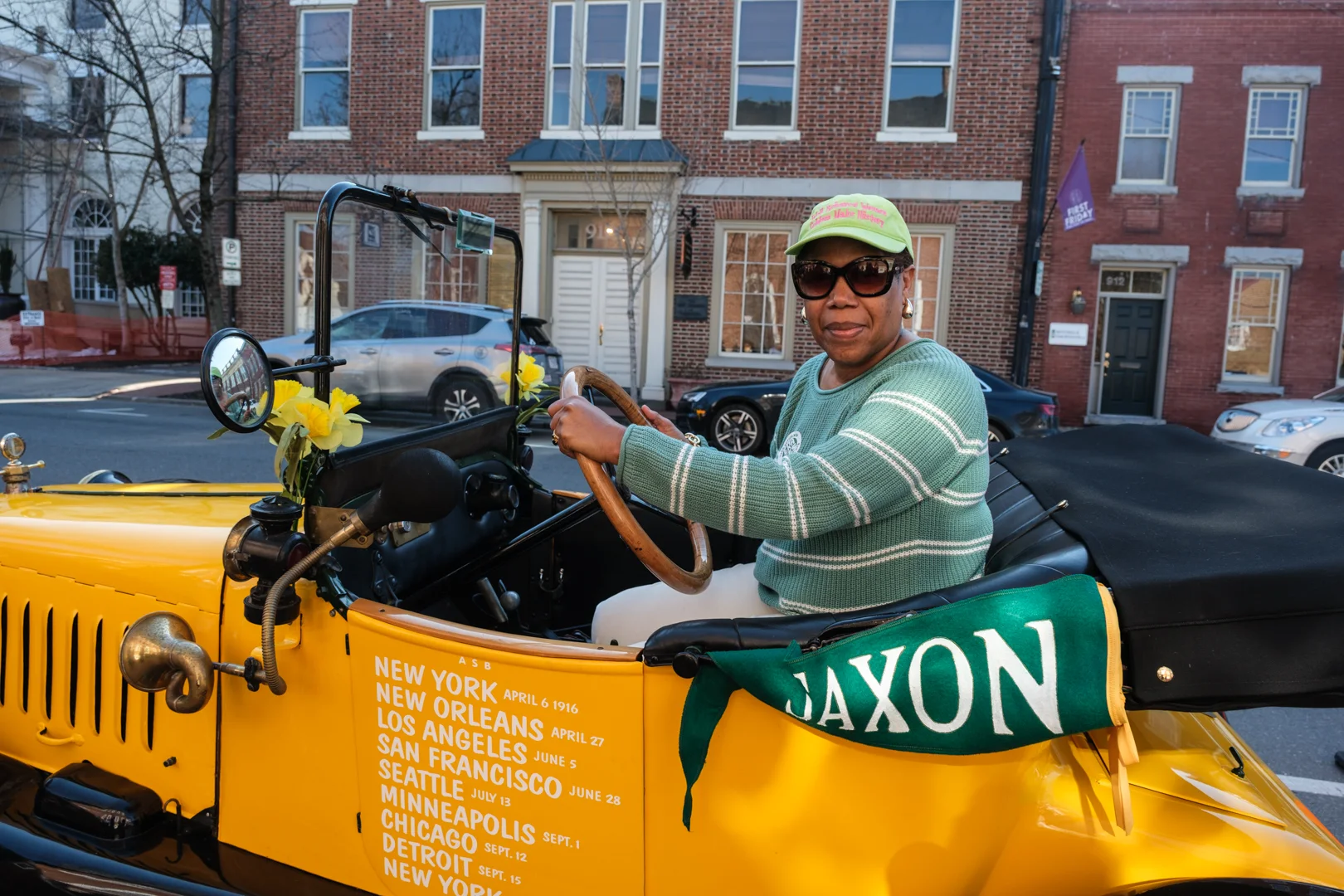
A passerby whose ball cap says it all — "Well Behaved Women Seldom Make History" — takes the Golden Flyer II for a spin. Alice and Nell would approve. Photo: Nina Zacuto
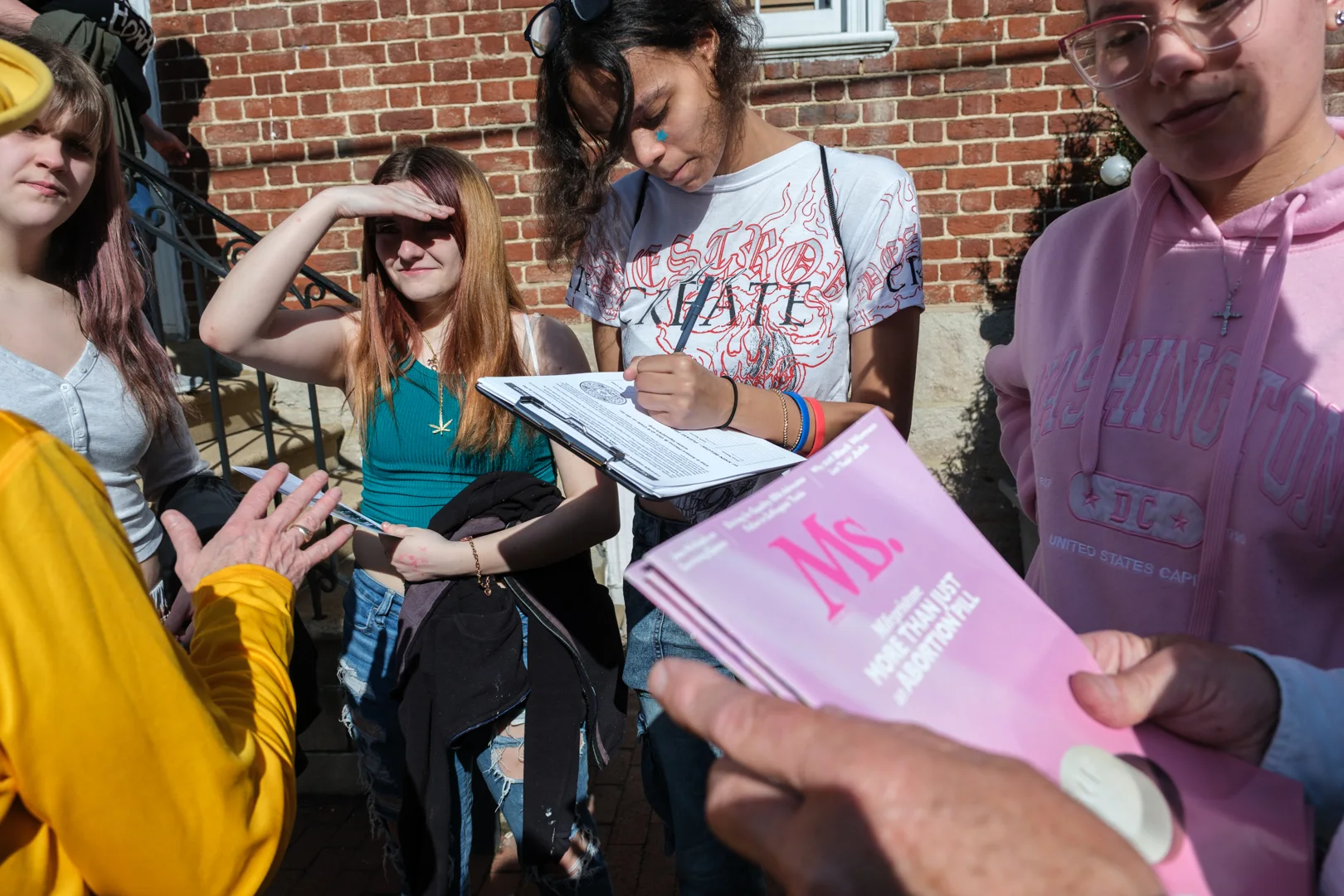
Teens sign the Sign4ERA.org petition and snap up copies of the Ms. Magazine article on the 1916 suffrage journey and today's tour — pledging to spread the word on social media. In 1916, Alice and Nell passed out literature. In 2026, the literature goes viral. Photo: Nina Zacuto
By the time the Golden Flyer II rolled out of Fredericksburg, the sun was still out, the petition sheets were fuller, and tomorrow's stop — Richmond, International Women's Day — was waiting.
The suffragists at Occoquan didn't give up on the worst night of their lives. We can certainly keep driving.
Follow the Journey
Watch history happen. The Golden Flyer II is rolling — New York to the Pacific and back. Track every stop as we drive the ERA fight across 25 states. Real stops. Real people. Real pressure.

