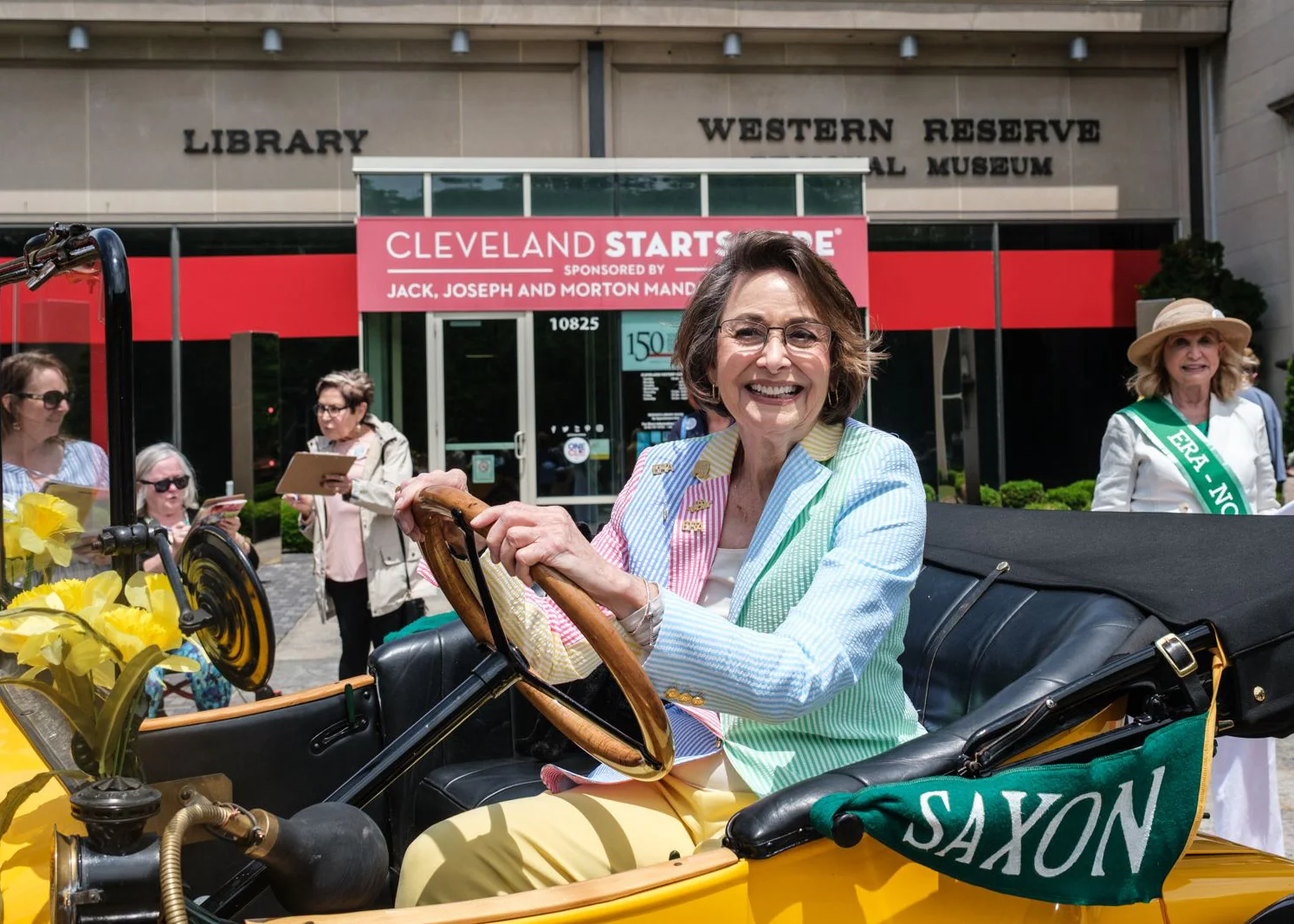
ERA NOW Founder Carolyn Maloney at the wheel surrounded by Mayor Annette Blackwell of Maple Heights, Mayor Erica Nicolic of Oakwood Village, former Cleveland Mayor Jane Campbell, and Mayor Kim Thomas of Richmond Heights in front of the Cleveland History Center. Photo: Nina Zacuto
Cleveland: Where Innovation Meets Equality
Today, the Driving the Vote for Equality Tour arrived in Cleveland, a city where innovation, industry, and the fight for justice have long traveled together. It was a fitting place to celebrate the remarkable journey of the 1916 Golden Flyer and to continue our own mission to secure full constitutional equality through recognition of the Equal Rights Amendment.
Our destination this Memorial Day weekend was the Crawford Auto-Aviation Museum, part of the Cleveland History Center, where the history of transportation and American ingenuity provided the perfect backdrop for the next chapter of our journey. Just as automobiles once expanded freedom of movement for women, we are traveling the country to help expand the promise of equal rights for everyone.
As cars became more reliable and affordable, women gained new independence, being able to travel farther for work, education, civic engagement, and adventure. Throughout its exhibits, the museum recognizes the evolving role of women behind the wheel and the ways mobility helped reshape American society.
The Golden Flyer II was parked on the steps of the Crawford Museum — again a magnet for tourists, weekend visitors, and ERA supporters who came to a special program inside its doors.
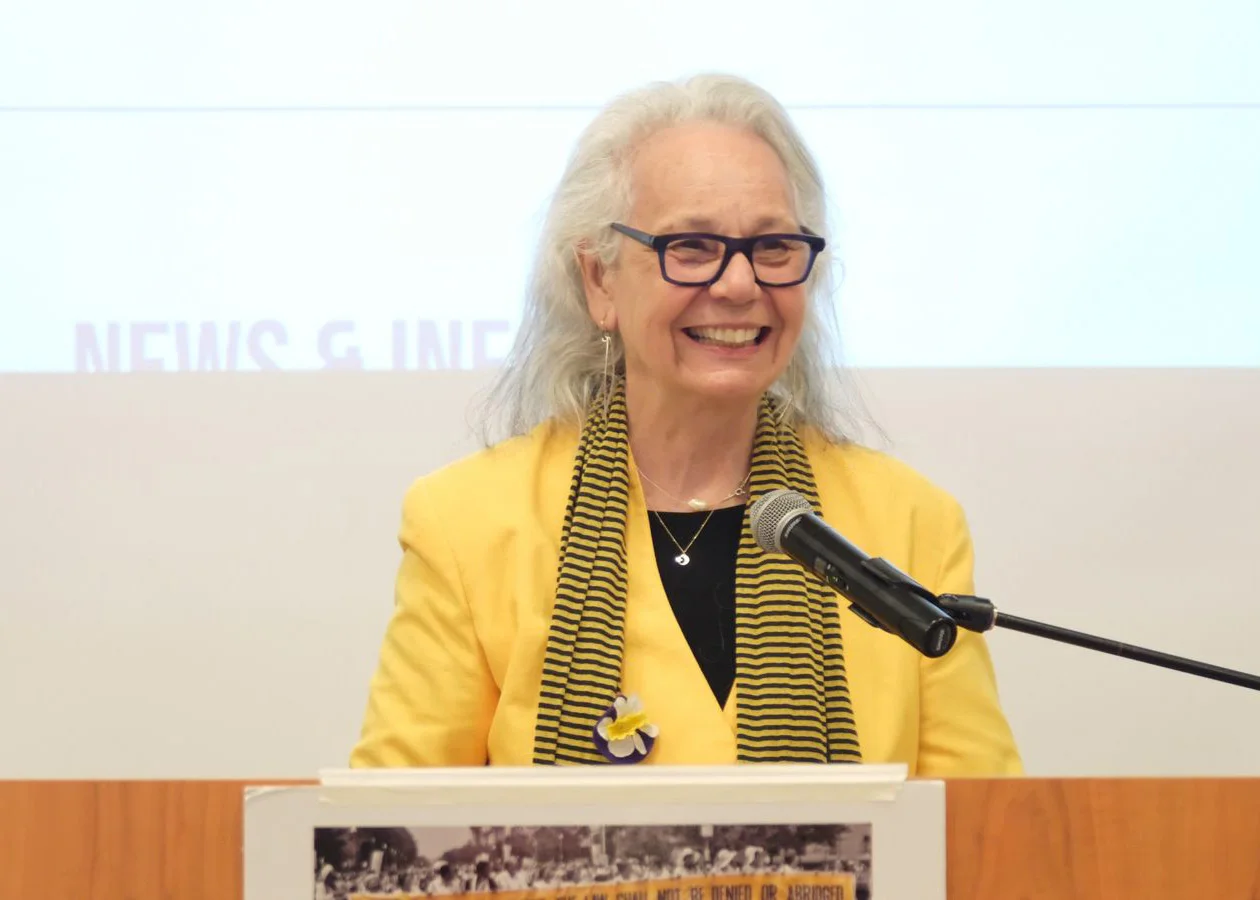
Kathy Bonk, ERA NOW Treasurer and Driving the Vote for Equality Tour leader, returns to her hometown and welcomes family, friends, and political leaders to hear about the suffrage drive and an ERA strategy for Congressional recognition. Photo: Nina Zacuto
The Driving the Vote for Equality event opened with ERA NOW Treasurer and Cleveland native Kathy Bonk welcoming former Congresswoman Carolyn Maloney back to the Tour as we headed to New York City, Carolyn’s hometown. She described Carolyn as our “North Star” and the inspirational driving force behind the national ERA petition, Sign4ERA, and Mayors for ERA.
Congresswoman Maloney is the founder and President of ERA NOW with a single, focused agenda — the passage of a 2027 ERA United States Senate and House Joint Resolution in the first 100 days of the next Congress.
As the ERA lead sponsor during her thirty years in Congress, Carolyn fought vigorously for the ERA and calls it “her biggest disappointment after leading the passage of more than 80 pieces of legislation. I never thought that my two daughters would have fewer rights than I did at their age,” Maloney told the packed room. She then introduced several Cleveland area mayors who joined Mayors for ERA.
Mayor Kim Thomas
Richmond Heights Mayor Kim Thomas served as a leader in the African American Mayors Association, fully supports the U.S. Conference of Mayors ERA resolution, and pledged to fight for Congress to recognize the ERA.
“As every woman in this room knows, we’re up against the fight of our life. And it’s going to take each and every one of us to continue to carry this torch. I’m ready for the long haul to do whatever I need to do. And if it means eventually the voice will go back out again — this is how important this fight is.” — Mayor Kim Thomas
Mayor Deborah Neale
Lakeline Mayor Deborah Neale brought a 1980 photo with an ERA banner as a “show and tell” to share her story:
“I first met Carolyn Maloney in the 1980s, very early when she was on New York City Council — one of the very few women. I was a young lobbyist, and she was a champion for women back then, all through the years. I remember when you ran for Congress, you said, I’m going to win this. No doubts. And I’ve just been so proud of you over the years.” — Mayor Deborah Neale
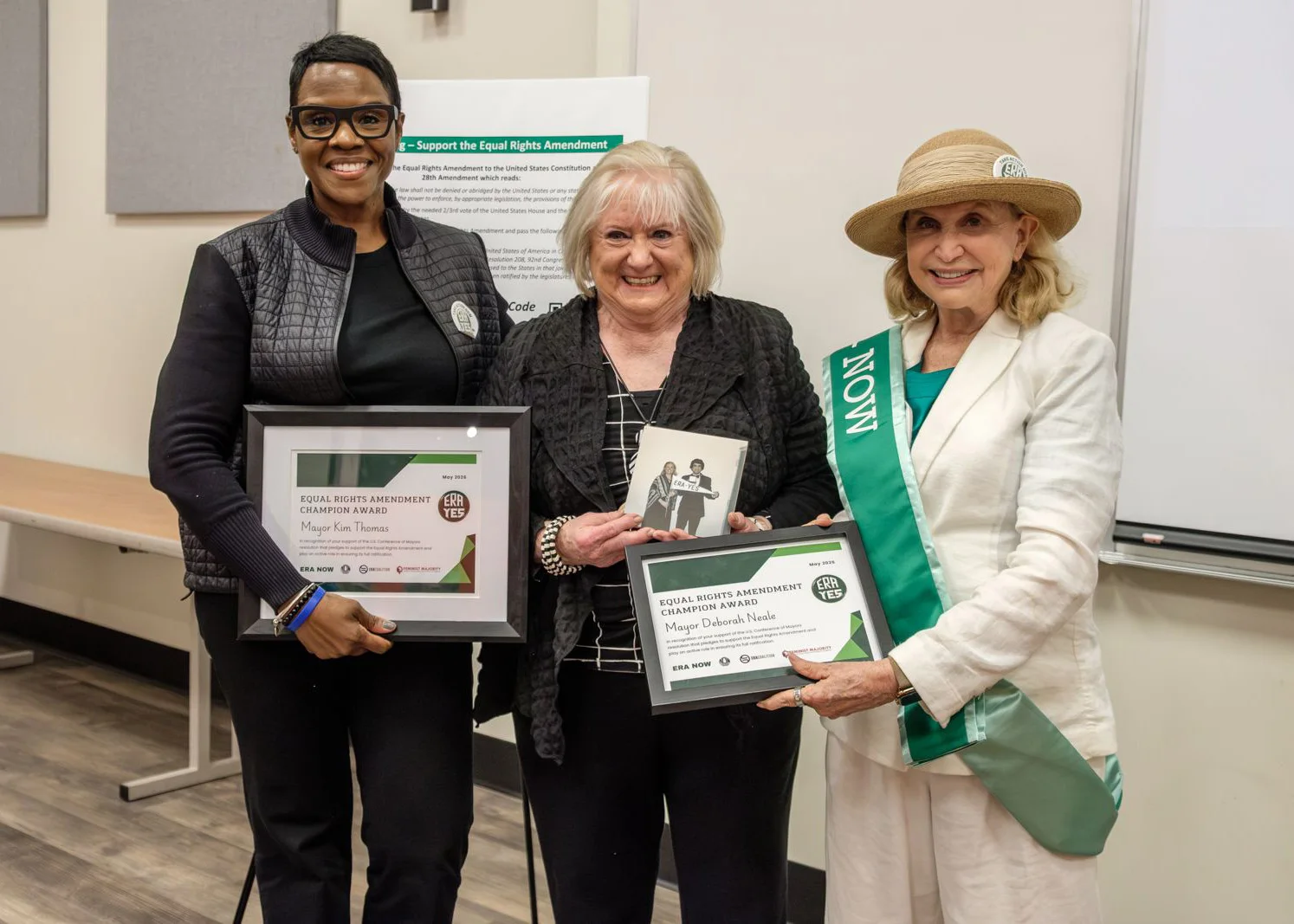
ERA NOW President Carolyn Maloney presents awards to Richmond Heights Mayor Kim Thomas and Lakeline Mayor Deborah Neale. Together with other women who are mayors, they represent decades of public service and a powerful reminder that women are leading cities large and small across Northeast Ohio. Photo: Nina Zacuto
Mayor Annette Blackwell
Mayor Annette Blackwell of Maple Heights thanked the network of women in the room — including Lana Moresky and Cindy Demsey — and especially her fellow African American mayors. She spoke about her own journey:
“I stand here today as the 16th mayor of Maple Heights, as the first female and the first African American. This is my third term. It’s not easy. When you first win, it’s a fluke, they say. Then comes an attempt to recall us. But I have not been defeated. I wanted to relate that to the journey we’re on to get the ERA added to the Constitution. I was able to achieve this success because of the fight and the victory of those women in that car — for what you’ve done in your elected office.” — Mayor Annette Blackwell
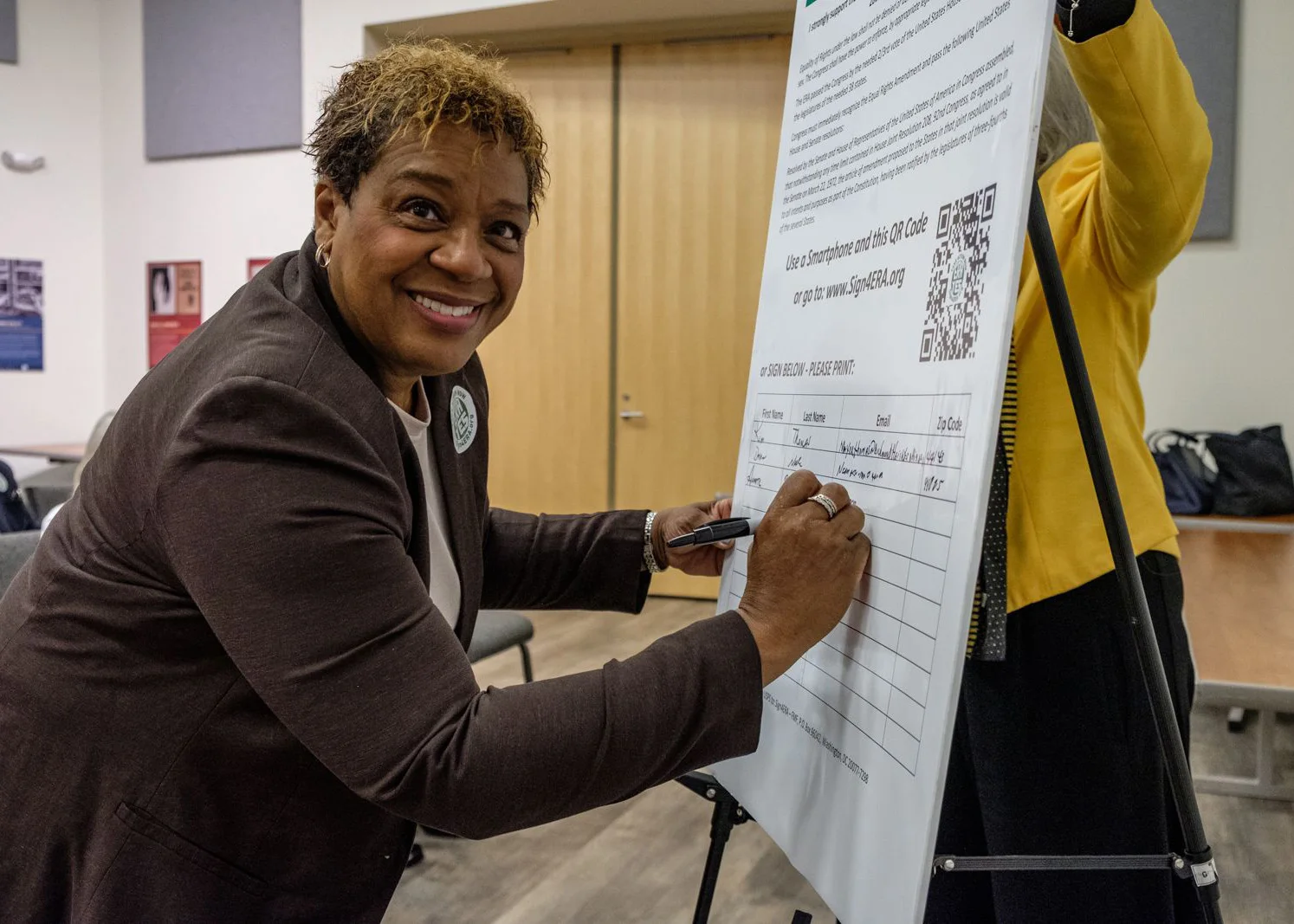
Mayor Annette Blackwell of Maple Heights puts her name on the national ERA petition, Sign4ERA, along with others in Northeast Ohio, showing their leadership is proof of how far America has come — and their support for the Equal Rights Amendment is a reminder of how far we still have to go. Photo: Nina Zacuto
Lana Moresky
Our host and seasoned ERA advocate, Lana Moresky, coordinated an impressive program that included mayors, dozens of organizational leaders, and political activists. Mayor Thomas called Lana “a good friend and a trailblazer for women. She is a star. She’s a worker and helps candidates win. I can’t tell you how much she has done for all of us.”
Lana then introduced the first woman elected mayor of Cleveland, the legendary Mayor Jane Campbell — “a woman who has been working for the Equal Rights Amendment from the 1970s, who had set up Women’s Space in Cleveland, then went to Washington, DC to head up ERAmerica, a national coalition formed just after it passed Congress. She returned to Cleveland to get elected and become a leader in Ohio’s state legislature and Cuyahoga County Commissioner and then became Mayor of Cleveland, taking the city from a major deficit to being solvent again.”
A thank-you shout out to Lana Moresky, a trailblazer who helps candidates win and fights for policies to advance women’s rights. She helped organize the Tour by opening her networks for the ERA. Photo: Nina Zacuto
Mayor Jane Campbell
Jane Campbell brought the full arc of her career in women’s rights advocacy to the podium — from helping establish Cleveland’s second domestic violence shelter in the 1970s, when Ohio law did not yet recognize spousal abuse as a crime, to fighting for ERA ratification in state after state during the extension period. She created the Women in Appointed Office project when she kept hearing there were “no qualified women” for boards and commissions, and spent time in state legislatures across the country watching the ERA fall short by the narrowest of margins.
She placed the current fight in its full historical context: legislation can be repealed, she reminded the room, but the Constitution endures. “We’ve been fighting since the 1970s,” she said. “Although, remember — Alice Paul started it long before then. And the fact that y’all are here, that you’ve pledged to stay involved and stay engaged, says we will win.”
She then read from a speech by Republican Jill Ruckelshaus, delivered at the National Women’s Political Caucus Convention in 1977 — a passage that stopped the room back then and stopped it again this Memorial Day weekend:
“We are in for a very, very long haul. I am asking for everything you have to give. We will never give up.”
— Jill Ruckelshaus, 1977
“You will lose your youth, your sleep, your patience, your sense of humor, and occasionally the understanding and support of people that you love very much.”
“In return, I have nothing to offer you but your pride in being a woman, all your dreams you’ve ever had for your daughters, and nieces, and granddaughters, your future, and the certain knowledge that at the end of your days you will be able to look back and say that once in your life you gave everything you had for justice.” — Jill Ruckelshaus
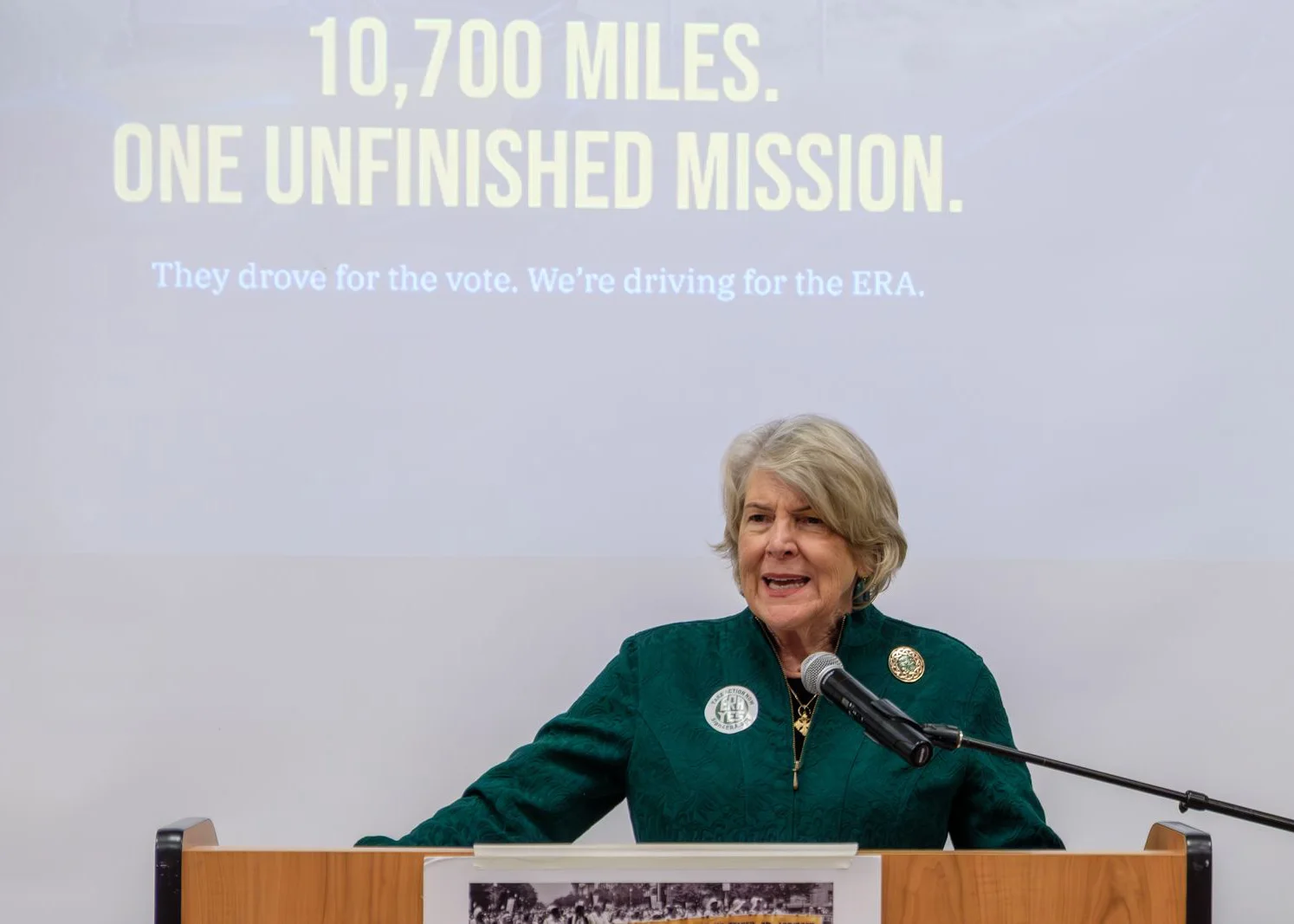
Jane Campbell, the first woman elected mayor of Cleveland and a role model for others, has fought for the ERA over many decades. Standing at the podium, she and all these mayors demonstrated that while women have broken countless political barriers, the work of securing equal rights under the U.S. Constitution remains unfinished. Their presence underscored why the ERA matters — not just as a symbol, but as a lasting guarantee for future generations. Photo: Nina Zacuto
The crowd gave a standing ovation and stayed well beyond when the program ended. People signed petitions, made donations, and took selfies with the speakers.
The Cleveland gathering became a celebration of local leadership as Jane Campbell stood shoulder to shoulder with women mayors from surrounding communities. Walking back through the museum to the outside, the Saxon was still attracting attention from passersby. We realized that the Golden Flyer’s story fits naturally into the history of women getting behind the wheel, taking charge of their lives, becoming leaders, and reminding us that every mile traveled by Nell Richardson and Alice Burke helped challenge assumptions about what women could achieve. Their 1916 cross-country journey proved that women could travel wherever determination could take them.
As we pulled away from Cleveland, we were reminded that history is not something preserved only inside museums — it is something each generation has the opportunity to shape. The women who crossed America in the Golden Flyer more than a century ago challenged expectations about what women could accomplish. Today, thousands of people are joining us in writing the next chapter by signing the petition to recognize the Equal Rights Amendment in the U.S. Constitution.
From Cleveland, we continue eastward carrying their spirit of determination, grateful for every conversation, every new supporter, and every signature that brings us one step closer to equality.
Add your name to the one million:
Every dollar keeps the Golden Flyer II on the road:
Follow the Journey
Watch history happen. The Golden Flyer II is rolling — New York to the Pacific and back. Track every stop as we drive the ERA fight across 25 states. Real stops. Real people. Real pressure.

