Augusta's ERA champions gathered in the rotunda of the Augusta Museum of History. Photo: Nina Zacuto
Augusta — Inside the Rotunda, Outside the Ropes
We left for Augusta, the golfing capital of the United States, perhaps the world, from the mountains of Asheville, North Carolina, the frost still on our windshield, to arrive three hours later on the banks of the Savannah River, in a beautiful, sunny city with flowering trees and blooming azaleas.
When we first learned that the original Golden Flyer team had stopped in Augusta, we reached out to an old friend, retired Air Force four-star Major General Perry Smith. Smith was stationed in nearly 60 countries before returning to the U.S. to serve as Commandant of the National War College. He and his wife, Connor Cleckley Dyess Smith, retired to Augusta. Smith may have retired from active duty in the Air Force, and they might be well into their 90s, but these two people are anything but inactive. When they got our call telling them about our drive to finally get the ERA into the U.S. Constitution, they asked all the right questions, got the answers they needed, signaled their total support and leaped into action.
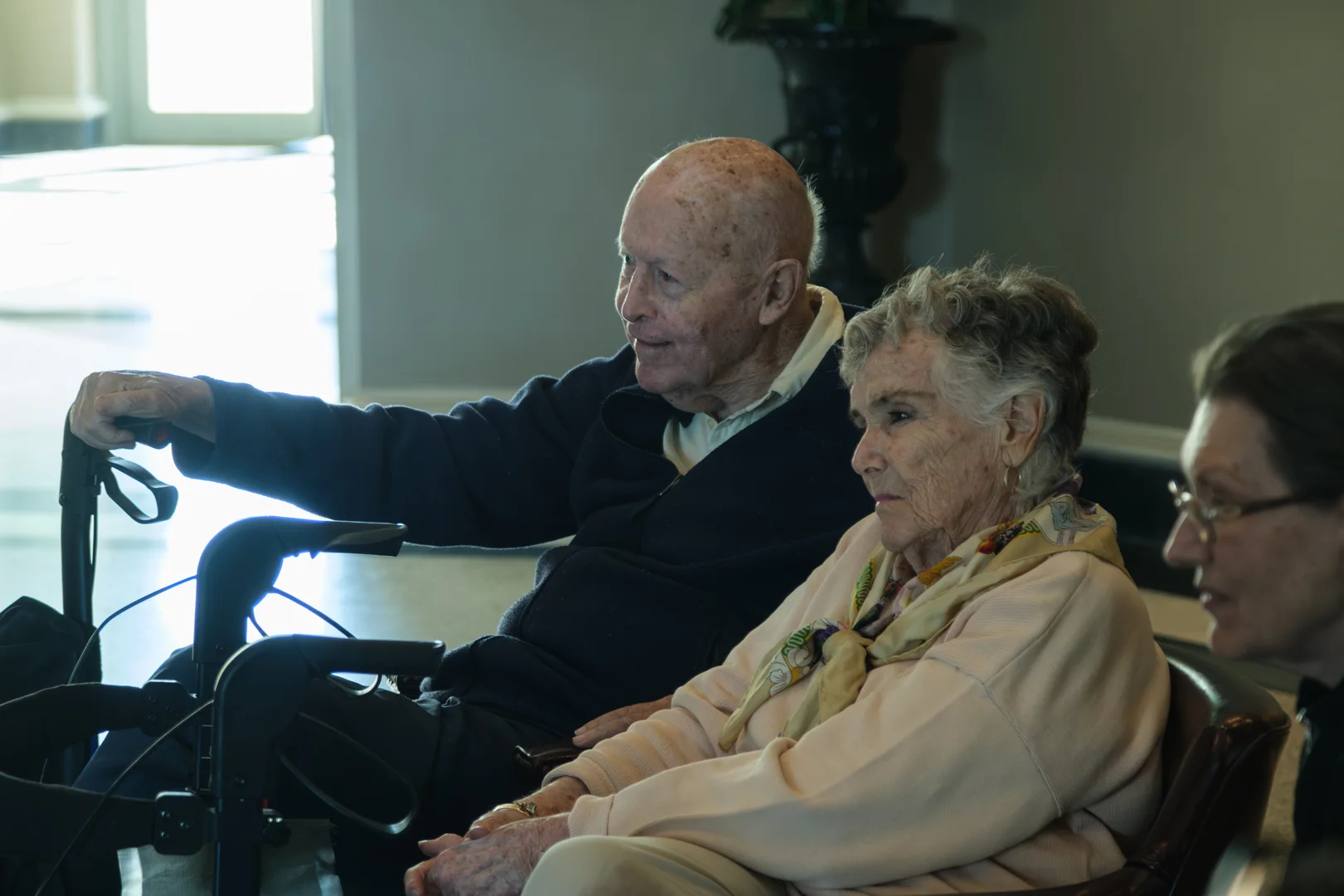
Retired Air Force four-star Major General Perry Smith, President Emeritus of the Augusta Museum of History, and his wife Connor Cleckley Dyess Smith listen as panelists field questions from the audience — the couple who made this Augusta stop possible, still very much in the fight. Photo: Nina Zacuto
General Smith is the Chairman of the Board of the Augusta Museum of History, and museums, as you must know by now, are among our favorite venues for the tour. General Smith called Nancy Glaser, the museum director who immediately saw how an event built around the Golden Flyer II could be a crown jewel for their celebration of Women's History Month.

The Golden Flyer II pulls into the Augusta Museum of History — the first stop on the tour where the Saxon rolled indoors, taking its rightful place as the featured exhibit for Women's History Month.The Golden Flyer II pulls into the Augusta Museum of History. Photo: Nina Zacuto
Everywhere else we had gone, the Golden Flyer II was on display outside the venue. Not here. Glaser offered the opportunity to drive the Saxon inside the rotunda of their beautiful recently restored museum for an event involving leading members of the Augusta community. The Golden Flyer II was the featured exhibit for the whole museum on that day.
For the first time on the tour, the Golden Flyer II rolled indoors — the featured exhibit of Women's History Month.
Before that event began, however, we were treated to a visit from a group of about two dozen school children who were gazing at the car oooing and ahhing. Like so many adults, they were lured by the car and then ready to hear about why it was in Augusta. When we told them about Alice Paul, the original trip and the modern battle, they were very attentive. We are getting them younger now.
The children left and the rotunda was full of key figures in each of the key groups supporting women's rights in the greater Augusta community, from the League of Women Voters to the American Association of University Women and many others.
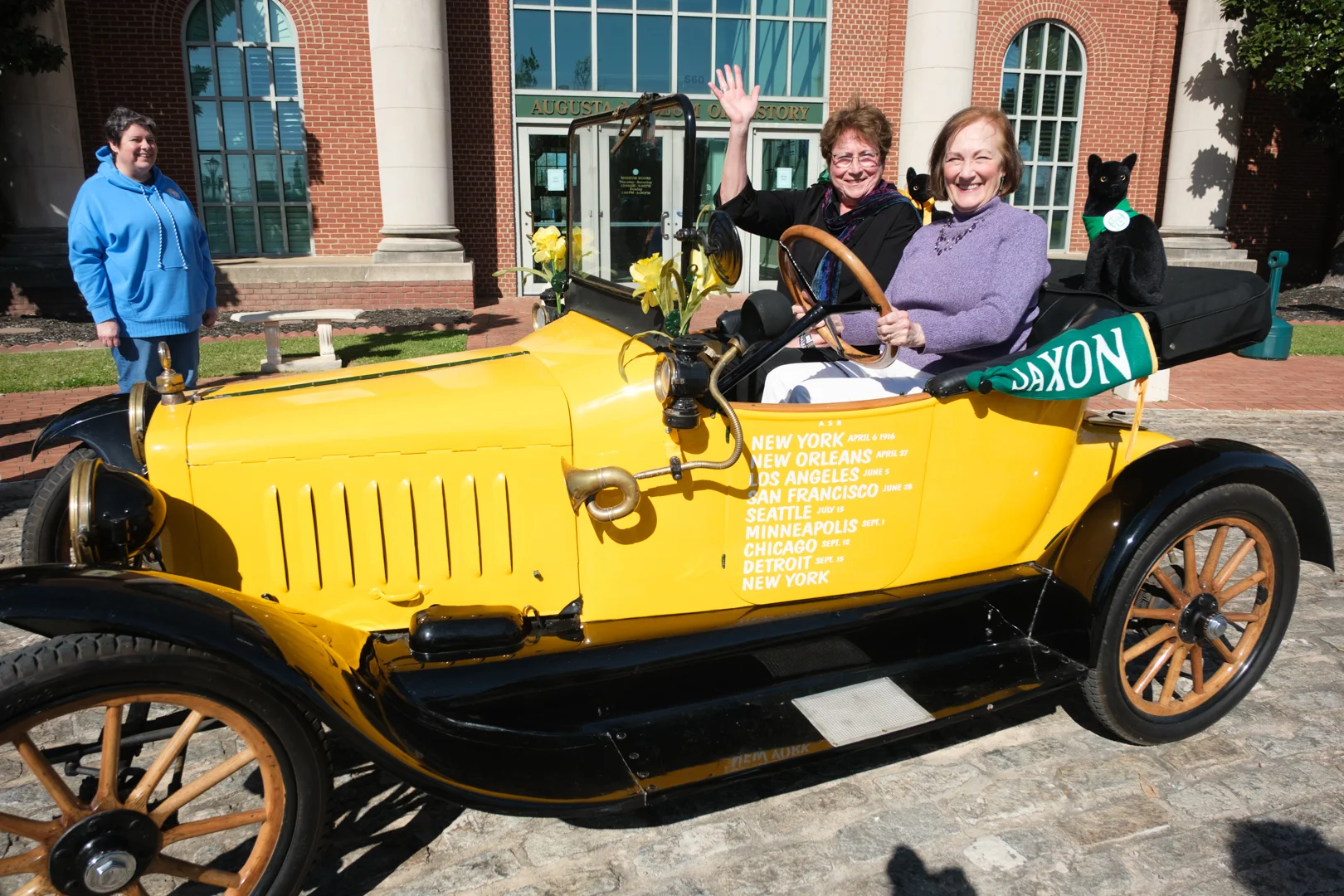
Augusta Museum of History Executive Director Nancy Glaser and Dr. Lee Ann Caldwell, Professor and Director for the Study of Georgia History at Augusta University, get a hands-on taste of the 1916 suffrage journey — the woman who opened the museum doors and the scholar who put the history in context, united in the driver's seat. Photo: Nina Zacuto
It was a very strong panel that did a deep dive on the 1916 suffrage tour connecting to the suffragists in Augusta. We had an unusually long time to engage with the attendees, who were on the edge of their chairs. Because we had more time than usual and a great panel, we were able to engage in a wide-ranging, deep discussion of the history, the issues and the strategy we are pursuing.
The moderator, Lee Ann Caldwell, Professor and Director for the Study of Georgia History at Augusta University, began by paying tribute to one of Connor Smith's forbears, widely regarded as the mother of woman's suffrage in the Augusta area. Caldwell told us that the citizens of Augusta played an unusually important role in getting the state to adopt the amendment for women's right to vote, providing a template that could be used today. She also noted that, back in early 20th century, the automobile foreshadowed increasing independence for women, the ability to go where they wanted, when they wanted, without the permission of the men in their family.
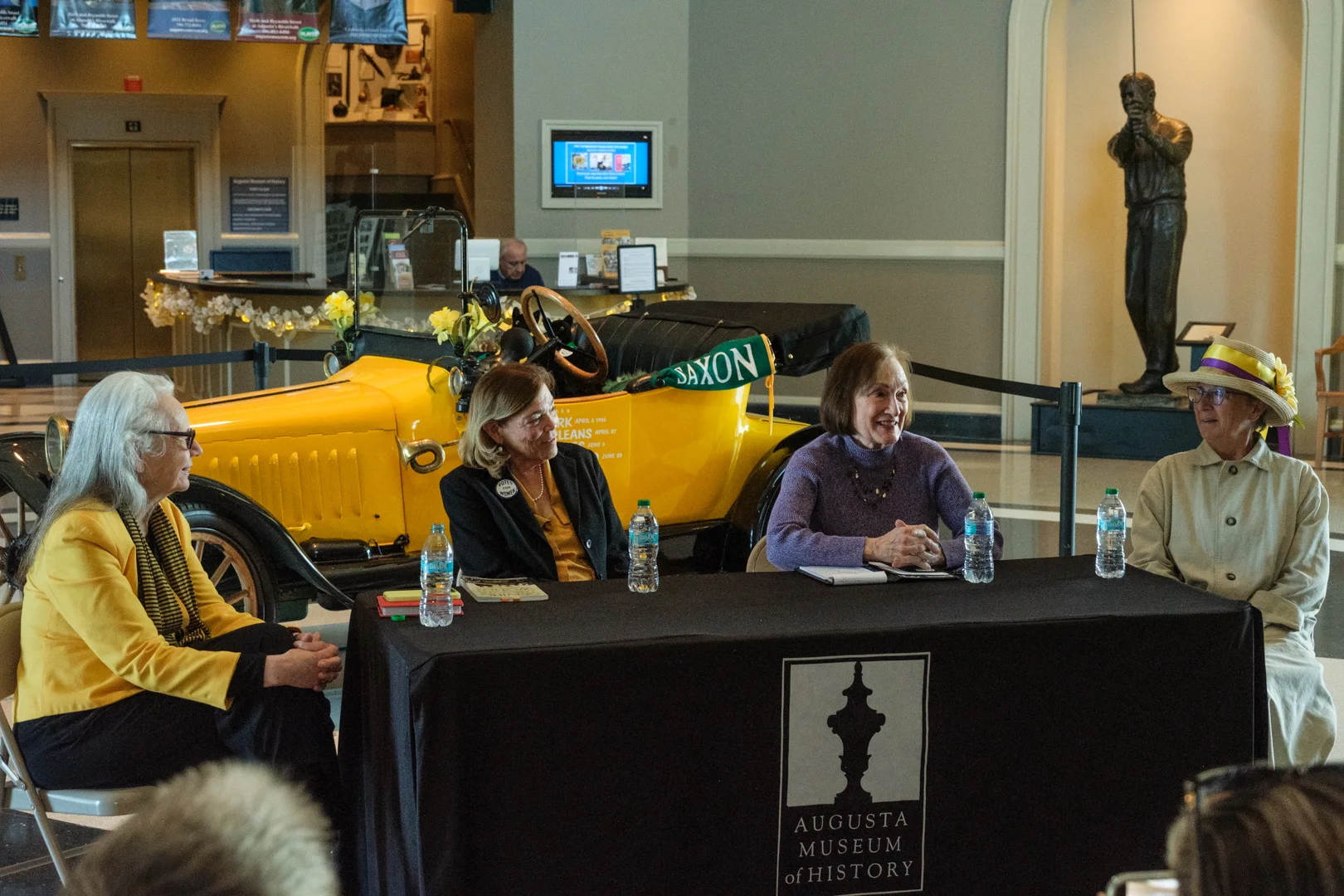
Panel members (left to right): Kathy Bonk; Jeryl Schriever; Dr. Lee Ann Caldwell, Director, Center for the Study of Georgia History and Professor of History, Augusta University; Susan Nourse. Photo: Nina Zacuto
Jeryl Schriever, a member of our team and author of the book describing the original Golden Flyer tour, drew on the research she did for that book to paint a riveting picture of the challenges faced a century ago by the first team to drive a Saxon car around the United States, that time to re-energize the stalled suffrage amendment. She described the unbelievable obstacles. Did you know that they had to crank the engine to start it and fix the engine when it failed by themselves, that the top never went up, even in driving snowstorms? Why tell this story? Because, when it is told, one cannot but ask, if they were willing to work that hard to fight for the vote then, can we do no less now?
The chair asked Kathy Bonk what got her interested in the idea of repeating the first tour to inspire the one now underway, this time to get the ERA over the top. Kathy said it must have been fate. She told us how she and her husband Marc were at the Seal Cove Auto Museum on Mount Desert Island in Maine one day and she came across a book describing the first tour. It dawned on her then that a repeat of that tour might be the key to getting the new constitutional amendment into the constitution. Then she discovered that the author of the history of that adventure had been written by a neighbor — Jeryl Schriever. Schriever told Bonk that she and her husband Alex Huppé not only had a big interest in antique cars, but were also strong feminists and, wonder of wonders, owned not one, but seven Saxons. They loved the idea. But they could not take a real Saxon on the road for a journey like this without a master mechanic. Fortunately, that person was eager to sign up. Peter Brown, master mechanic for the Seal Cove Auto Museum, knows these cars as well as anyone in the world. His partner, Susan Nourse, a former teacher and former Police Chief of Freeport, Maine, who also loves antique cars, and like all the others on this team, thinks it is time to get the ERA in the constitution, signed up as the Saxon's driver. That, as Kathy told the story, is how six Mainers got the ball rolling.
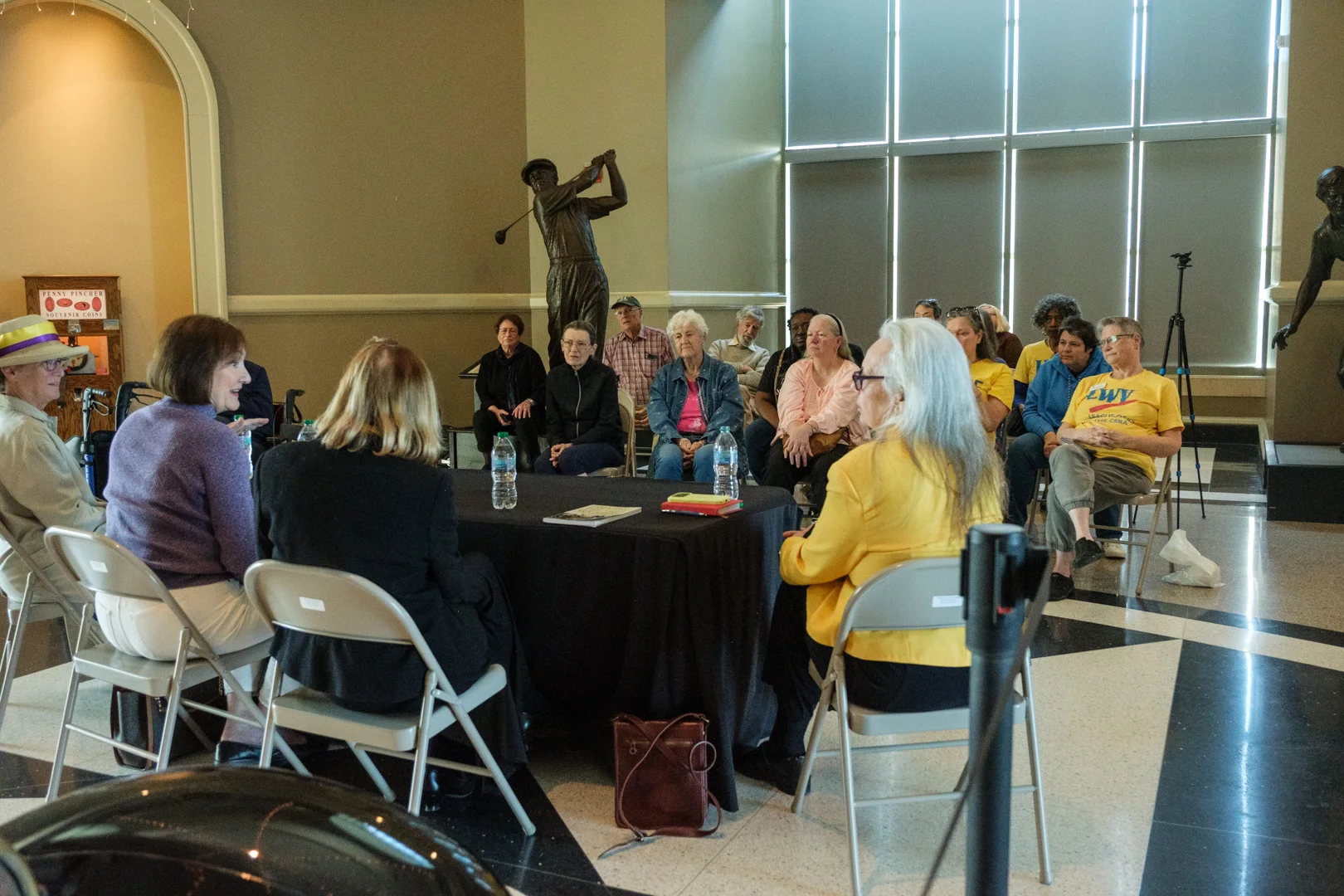
The Augusta Museum of History audience leans in as Dr. Lee Ann Caldwell recounts the city's complicated history with suffrage — late to the movement, but transformed once it arrived. "When Augusta finally got into the movement in 1915 and 1916, they were in it — they really got enthusiastic." Sound familiar? Photo: Nina Zacuto
Susan talked about what it was like to drive the car and why it was so important to her to join this fight. Peter talked about how the Saxon had broken down in Washington and how the fellow antique car owners there had rallied to the crisis, how he, with their help, had taken the engine out of the car, fixed the problem and put the car back together, all in a few hours.
As the meeting came to a close all everyone wanted to know was what they could do to help.
The community leaders who came to this meeting wanted to know how people had reacted to the tour along the way. We could feel the excitement as we told them about the enthusiastic reception we had received everywhere. As we responded to their questions, they clearly got the sense that we were pursuing a well-thought-out, realistic grass roots strategy that could actually put the ERA in the constitution. As the meeting came to a close, all people wanted to know was what they could do to help.
We walked outside. Susan cranked up the Saxon's engine and drove it into the trailer. We were off to Atlanta.
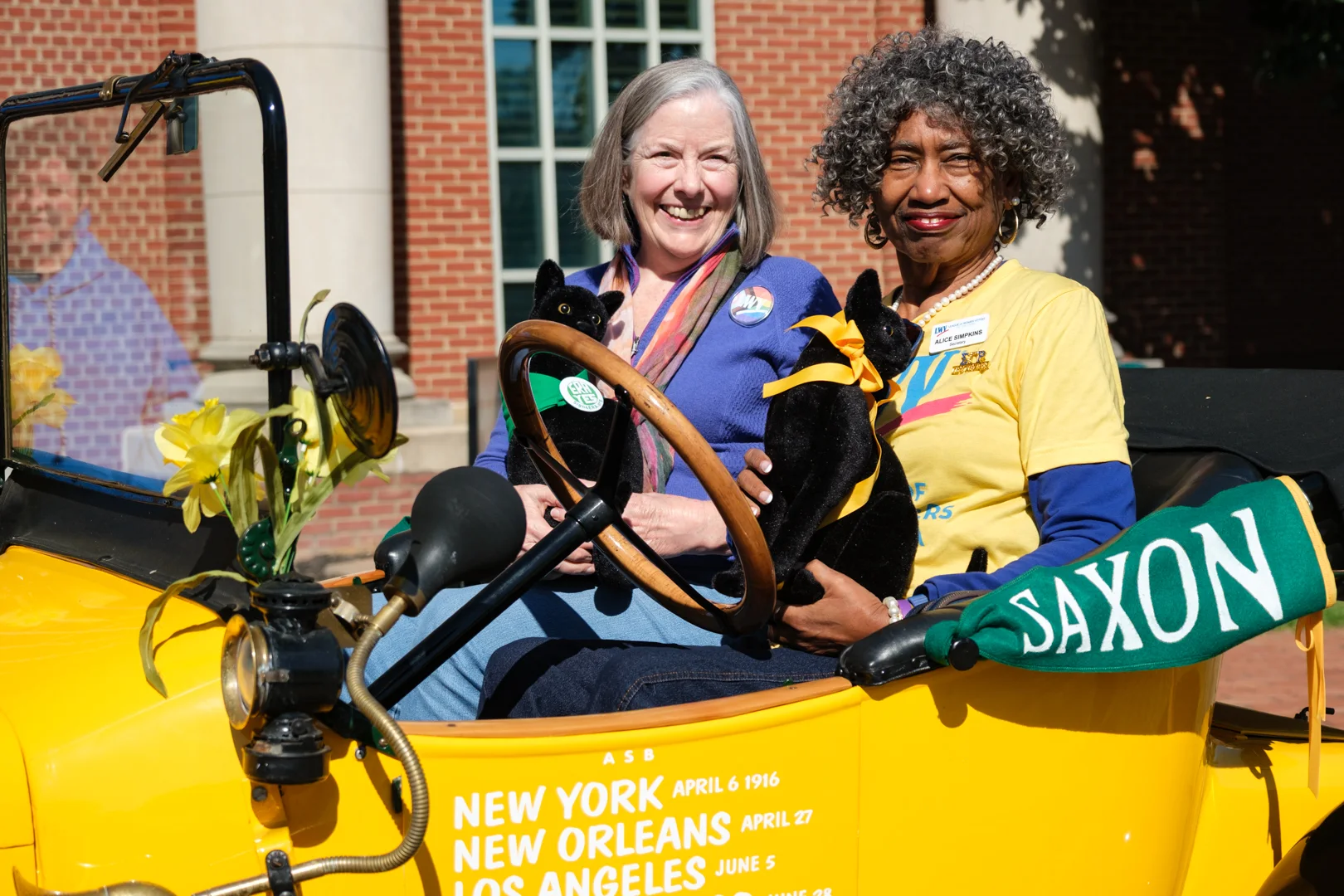
Alice Simpkins of the League of Women Voters of the Central Savannah River Area takes the wheel of the Golden Flyer II — and by the look of it, she's not entirely ready to give it back. Photo: Nina Zacuto
Outside the Ropes: Augusta, the Masters, and the Long Game
As many feminists know, golfing in Augusta also means a history of exclusion that rhymes, uncomfortably, with the fight we are waging every day on this tour.
Augusta National Golf Club — home of the Masters, perhaps the most storied venue in American sport — barred women from membership for 80 years. Not from watching. Not from playing as guests of members. From belonging. When activist Martha Burk led a national campaign against the policy in 2002 and 2003, the club's response was to air the Masters without commercials rather than yield to sponsor pressure. They chose silence over change.
It wasn't until August 2012 — nearly a century after Alice Paul wrote the Equal Rights Amendment — that Augusta National admitted its first two female members: former Secretary of State Condoleezza Rice and business executive Darla Moore. Not because the club had a change of heart. Because the pressure finally became impossible to ignore.
The pattern should sound familiar.

To Augusta National, to the PGA Tour, to every institution that has quietly decided that women can wait — the waiting is over. The ERA is on its way, and the Golden Flyer II is driving it home.
The ERA has met every constitutional requirement for ratification. Thirty-eight states have said yes. And still Congress has not acted — not because the votes aren't there, not because the country doesn't support it, but because the institution has chosen, so far, to wait it out. Augusta National waited 80 years. We do not intend to give Congress that long.
And while we are on the subject of women and golf: the best female professional golfers in the world earn, on average, roughly seven times less than their male counterparts. The top male earner last season took home over $50 million. The top female earner made approximately $7.5 million. Same game. Same skill. Same dedication. Different green jacket.
The ERA will not fix every inequality in professional golf overnight. But a Constitution that explicitly guarantees equal rights regardless of sex sends a message — to Augusta National, to the PGA Tour, to every institution that has quietly decided that women can wait — that the waiting is over.
Sign the petition. The green is right here.
Follow the Journey
Watch history happen. The Golden Flyer II is rolling — New York to the Pacific and back. Track every stop as we drive the ERA fight across 25 states. Real stops. Real people. Real pressure.

