Photo: Nina Zacuto
Annapolis, Maryland: Rain, History, and an Army for Suffrage and the ERA
They said the weather wouldn't cooperate. Rain pelted the brick plaza outside the Annapolis Market House all morning — the kind of cold, gray March day that makes even the most dedicated activist consider staying home. The Golden Flyer II didn't get the memo. Neither did Annapolis.
By the time our little yellow roadster rolled onto the glistening cobblestones of the city's historic waterfront district, a crowd had already gathered. Umbrellas. Scarves. ERA YES buttons. The Golden Flyer II — a restored 1914 Saxon roadster, the same make and model that carried suffragists Alice Burke and Nell Richardson on their legendary 10,700-mile cross-country campaign for women's voting rights in 1916 — had arrived in Maryland's capital. And Annapolis, rain and all, was ready.
This was Day Four of the Driving the Vote for Equality Tour, and already the pattern was becoming clear: wherever the Golden Flyer II goes, history seems to lean in close and take notice.
The First to Arrive: Bob Harrison and a Remarkable Gesture
Before the speeches. Before the petition signing. Before artist Carolyn Adreon Councell set up her easel in the rain and began painting the car in watercolors. Bob Harrison was already there.
Harrison, owner of the Market Street Bar & Grill at the Annapolis Market House, had done something quietly extraordinary — announcing that his restaurant would donate 10 percent of the day's proceeds to the ERA cause. Think about that for a moment. Not a check written in a boardroom. Not a corporate pledge announced through a press release. A local business owner, in the middle of Women's History Month, opening his doors and his register in the most tangible way possible.
When the Golden Flyer II arrived, Harrison was one of the first to walk out and examine it — running his hands along the vintage coachwork, studying the 1916 tour cities painted in white on the golden body. NEW YORK. NEW ORLEANS. LOS ANGELES. SAN FRANCISCO. SEATTLE. MINNEAPOLIS. CHICAGO. DETROIT. NEW YORK. Eight cities. 10,700 miles. One Saxon roadster. One hundred and ten years later, the message is still traveling.
That gesture — a neighborhood restaurant writing the ERA a check out of its daily receipts — is exactly the kind of grassroots solidarity this campaign is built to inspire. The Golden Flyer doesn't just collect signatures. It generates moments. It opens wallets and hearts in equal measure.
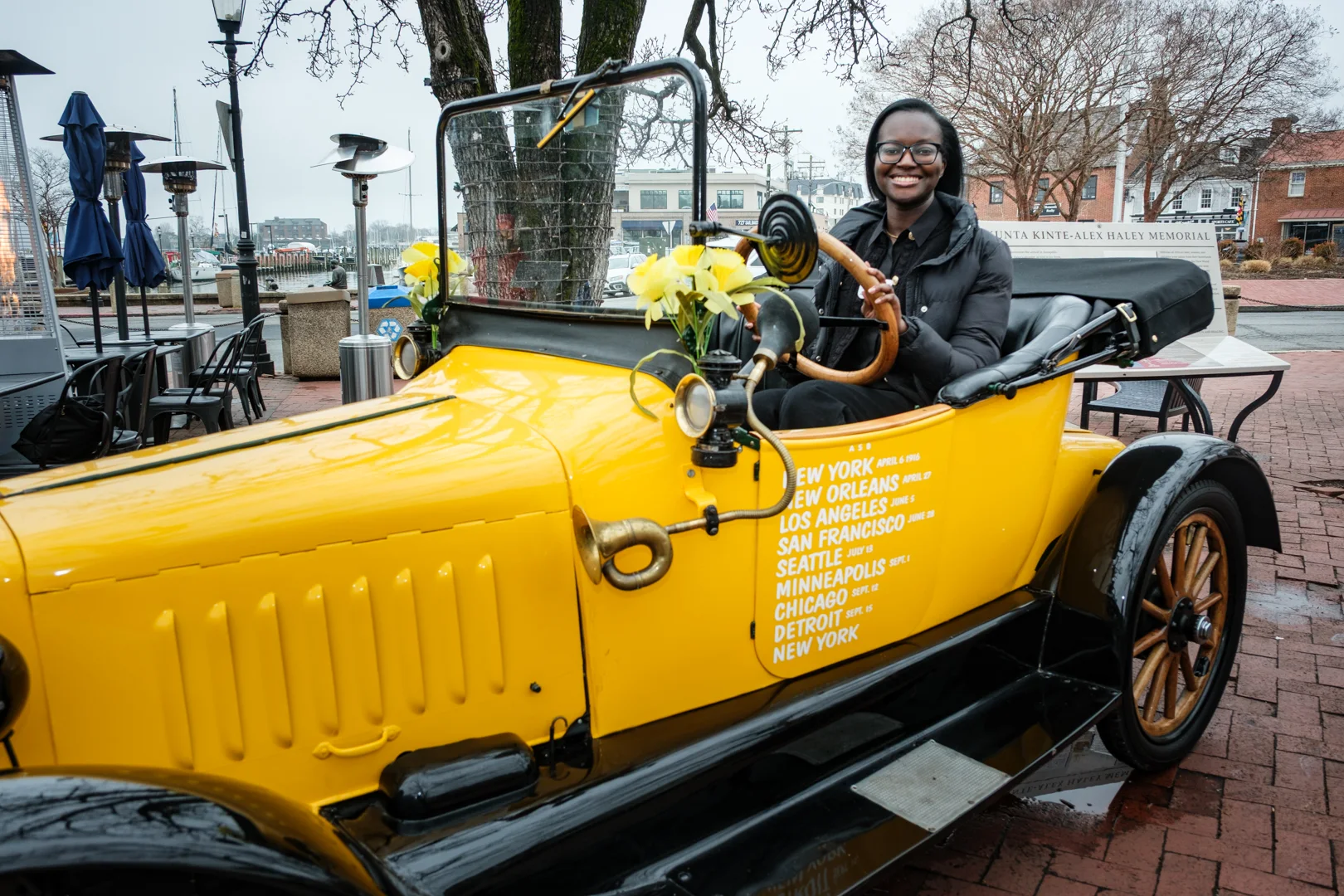
Camille Fabiyi, Maryland Commission for Women, in the driver's seat. Photo: Nina Zacuto
Camille Fabiyi Takes the Wheel
Before the official program began, Camille Fabiyi, Policy and Program Assistant for the Maryland Commission for Women, did what anyone would do when presented with a 112-year-old Saxon roadster at a historic market house on the Chesapeake Bay: she climbed in and took the driver's seat.
There was something deeply right about the image. Fabiyi — whose work focuses on the rights and advancement of women in Maryland — sitting where our own Nell Richardson (played on this tour by retired police chief Susan Nourse) sits every day, coaxing this small, stubborn marvel of mechanical history down the roads of 2026. The suffragists drove because they had something to prove. We drive because we still do.
Fabiyi would later take the microphone to address the gathering crowd, speaking with authority and urgency about recent ERA mobilization efforts in Maryland — a state that has stood firmly in the ERA's corner and whose leaders continue to push for federal recognition of an amendment already ratified by 38 states.
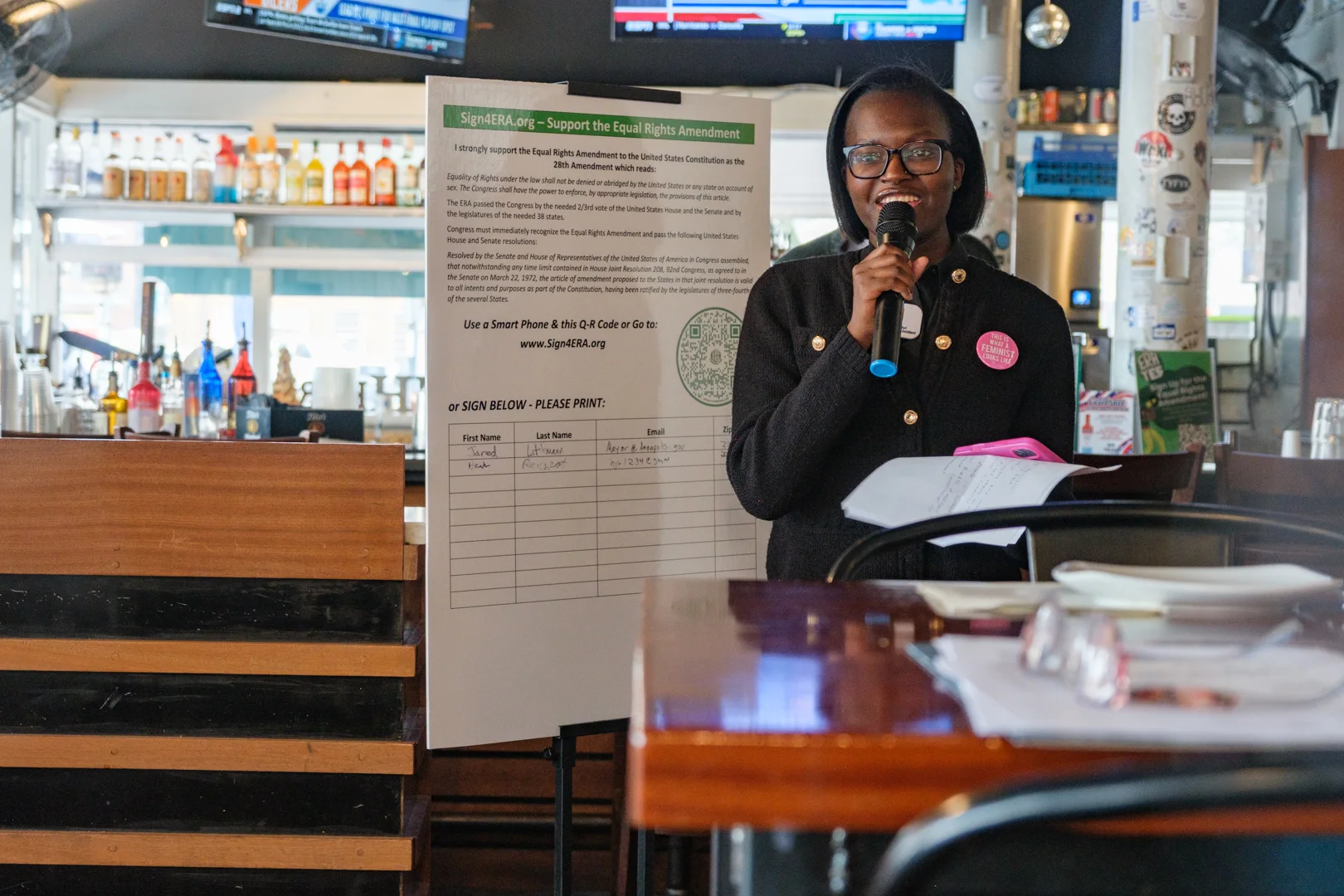
Camille Fabiyi, Maryland Commission for Women, speaking about recent ERA mobilization and actions in Maryland. Photo: Nina Zacuto
Susan Crawford and Tracy Lantz, AAUW Maryland: Organizing in the Rain
No event like this happens without the people who make it happen. Susan Crawford and Tracy Lantz of AAUW Maryland were the key organizers who turned a rainy March morning into a genuine civic moment — coordinating supporters, managing logistics, and ensuring that the Annapolis stop of the Driving the Vote for Equality Tour was more than a photo opportunity. It was a rally.
The American Association of University Women has been a cornerstone of the ERA movement for decades, and their Maryland chapter brought energy and organization to the Annapolis stop that made everything hum. AAUW Maryland President Heather Reichardt was also on hand — and she had a special ceremony to perform.
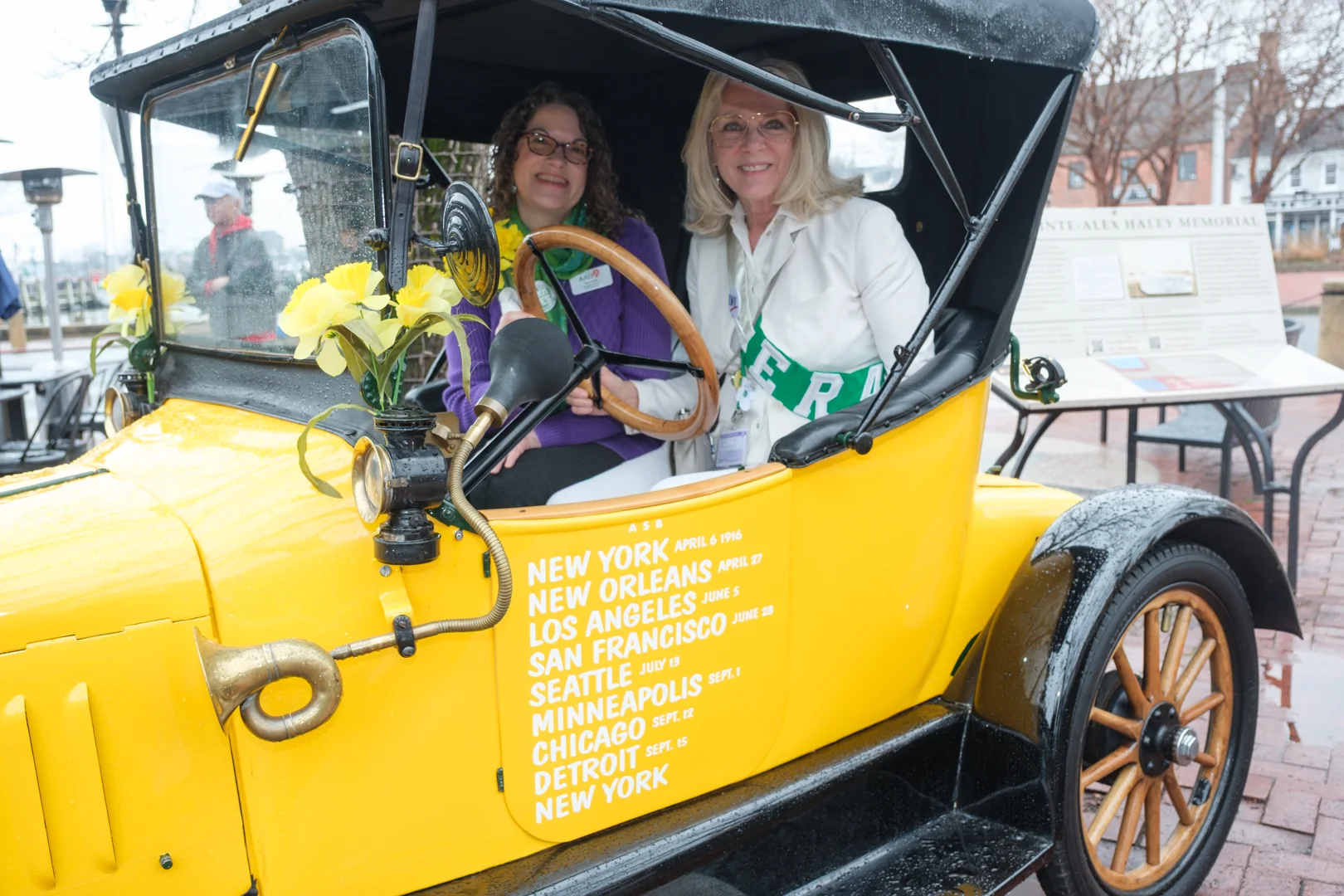
Tracy Lantz and Susan Crawford, AAUW Maryland - Annapolis organizers outside Annapolis Market House. Photo: Nina Zacuto
Mayor Littmann Steps Up
Mayor Jared Littmann didn't just show up. He showed up ready.
Littmann — who has emerged as one of the ERA's most vocal municipal champions — delivered what several attendees described afterward as one of the most moving speeches of the entire tour so far. He spoke about the value of women in government. About what it means for a city — any city — to signal to its women residents that their rights are taken seriously, not as a political talking point, but as a constitutional commitment. He spoke about the generations of women who had fought for every inch of legal ground they occupy today, and about the unfinished business that the ERA represents.
"The ERA isn't just a women's issue. It's a question of what kind of country we want to be."
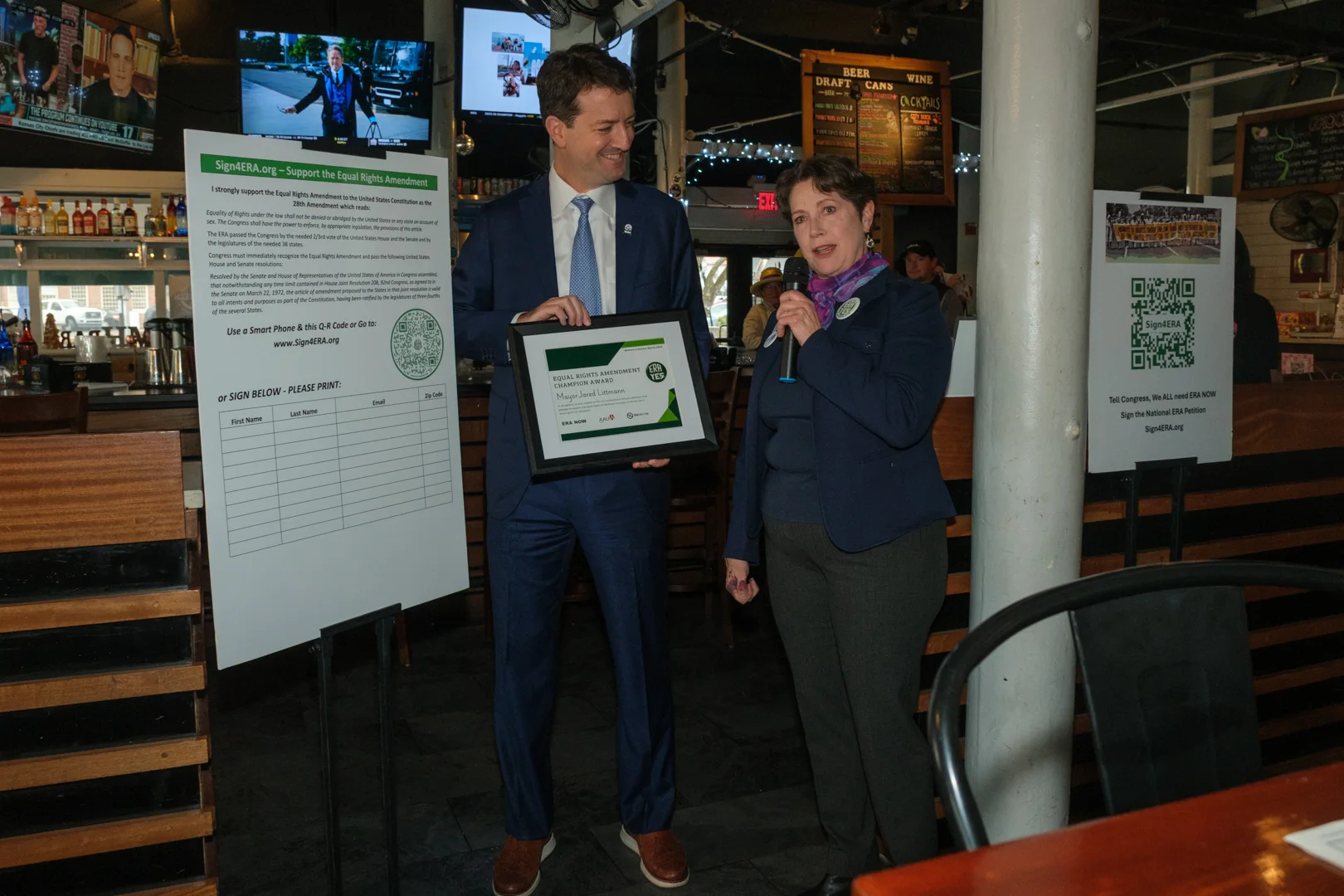
Heather Reichardt, President of AAUW Maryland awards Mayor Jared Littmann for his support of the US Conference of Mayors strong resolution to advance the ERA. Photo: Nina Zacuto
And then — without hesitation, with what can only be described as genuine enthusiasm — Mayor Littmann took the pen and signed the ERA petition.
But Heather Reichardt wasn't finished with him yet. The AAUW Maryland President stepped forward to present Mayor Littmann with a formal recognition award honoring his strong support of the U.S. Conference of Mayors' resolution to advance the ERA. It was a moment that bridged local leadership and national advocacy in exactly the way this campaign is designed to do — a mayor recognized by a citizens' organization, in a market house, in the rain, on behalf of millions of women waiting for Congress to act.
Littmann's commitment matters beyond symbolism. The U.S. Conference of Mayors resolution he helped champion sends a signal from city halls across America to Capitol Hill: local leaders — the officials closest to the people — believe the ERA's moment has come.
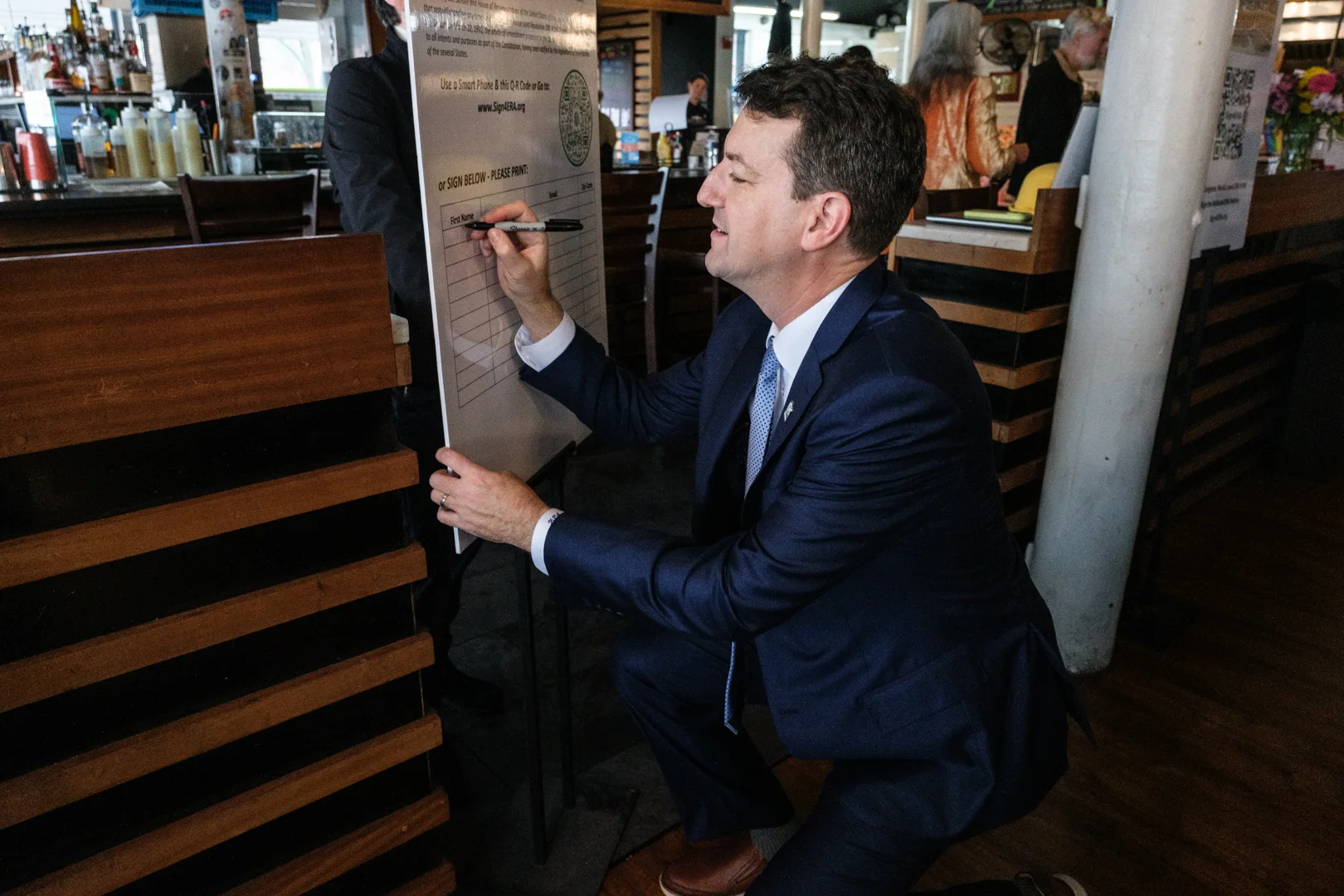
Mayor Jared Littmann signing the petition after an impassioned speech about the value of women in government. Photo: Nina Zacuto
Jeryl Schriever: Author, Activist, Alice Burke
Jeryl Schriever — author of Driving the Vote for Women, the book that unearthed the 1916 suffrage road trip at the heart of this campaign — spent part of the Annapolis morning doing something she does as naturally as breathing: signing books. Janice Holmes of Fox Books was on hand to make it official, and Schriever worked through a stack of copies as supporters queued up in the drizzle.
There is something quietly powerful about a book signing at a suffrage event. Schriever's book is the reason we know the details of Alice Burke and Nell Richardson's journey — the breakdowns, the mud roads, the hostile towns, the moments of unexpected grace. It is the historical spine of this entire campaign. Every time she signs a copy, she's not just selling a book. She's passing the torch.
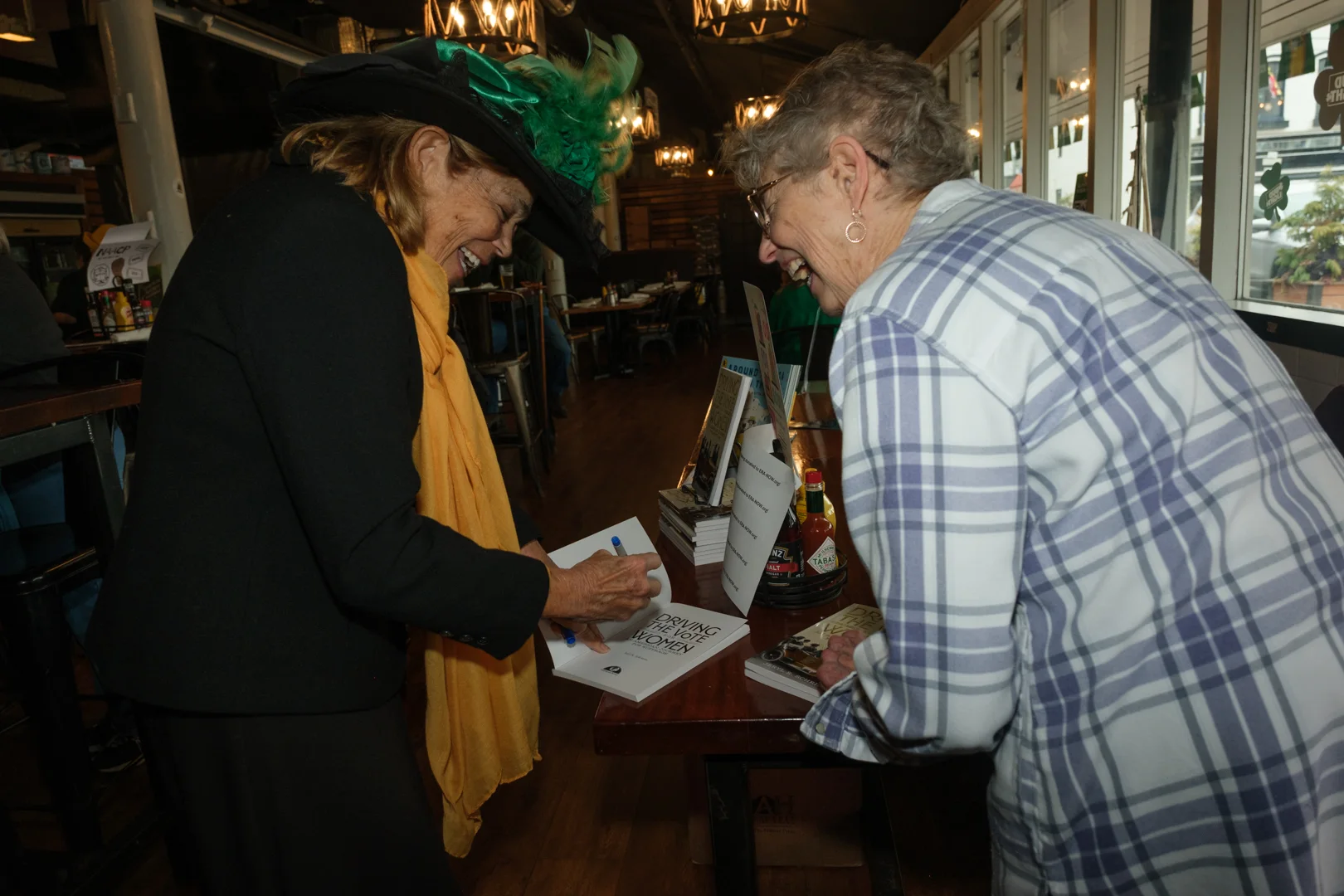
Photo: Nina Zacuto
A Detour Into History: The Army of the Severn
After the Market House program, the Golden Flyer II made its way to State Circle — and to a piece of suffrage history that felt less like a detour and more like a destination.
On the iron fence outside 25 State Circle, just steps from the Maryland State House, hangs a black-and-white photo plaque titled "The Army of the Severn." It honors the members of the Just Government League — Maryland's largest women's suffrage organization — who on January 7, 1914, marched from Baltimore to Annapolis along the Severn River corridor to deliver a suffrage petition to the General Assembly.
The General Assembly rejected it.
Let that land for a moment. Women marched through winter — on foot, from Baltimore, to the steps of their own state capitol — to ask for the right to vote. And the legislature said no.
But the Just Government League, founded in 1909, did not stop. They kept organizing, kept marching, kept building what their contemporaries aptly named an army. When the 19th Amendment was finally adopted nationally in 1920, the League pivoted immediately — and by 1922 had won the right for women to hold public office in Maryland. Victory built on victory, step by stubborn step.
The irony embedded in that plaque is rich and instructive: Maryland didn't actually ratify the 19th Amendment until March 22, 1941 — more than twenty years after it became the law of the land. The state didn't certify that ratification until 1958. The women of the Just Government League won their rights not because their government led the way, but in spite of the fact that it didn't.
The Army of the Severn marched into a legislature that said no — and changed the country anyway.
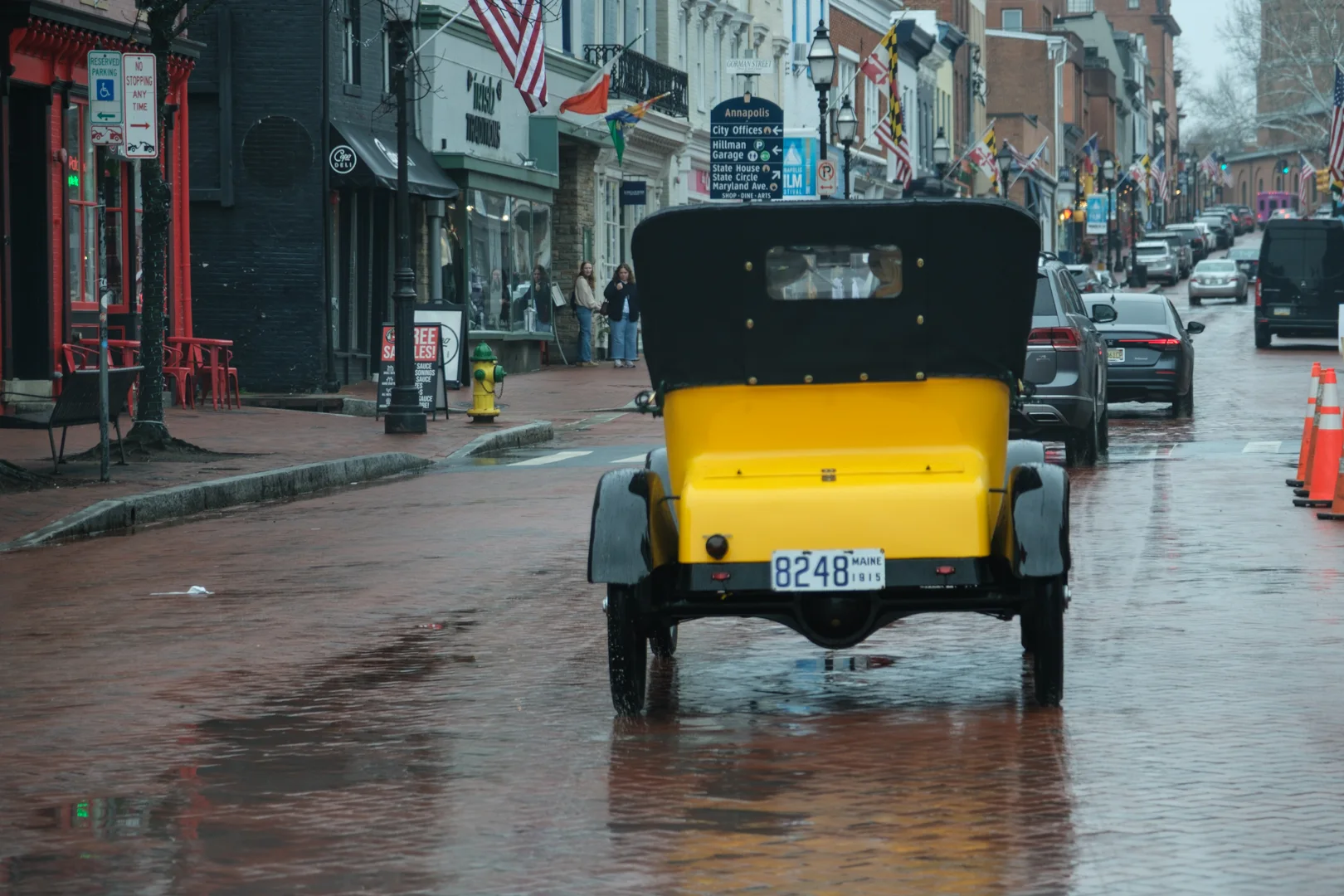
Golden Flyer II makes its way up Main street from Annapolis Market House Restaurant to the Army of the Severn Suffragist Plaque, Annapolis. Photo: Nina Zacuto
Standing at that plaque on State Circle, the parallel to the ERA's current moment is impossible to miss. Thirty-eight states have ratified the ERA. Congress has the constitutional authority to recognize it as the 28th Amendment. And yet, like Maryland in 1920, the federal government has so far declined to act on what the people have already decided.
The women who marched from Baltimore in 1914 knew something that every generation of advocates has had to relearn: the answer is not to wait for permission. It is to march. To petition. To return, and return again, until the answer changes.
That's why the Golden Flyer II is on the road. That's why we're collecting one million signatures at Sign4ERA.org by Election Day. That's why this campaign exists. The Army of the Severn showed us how. We're just picking up where they left off.
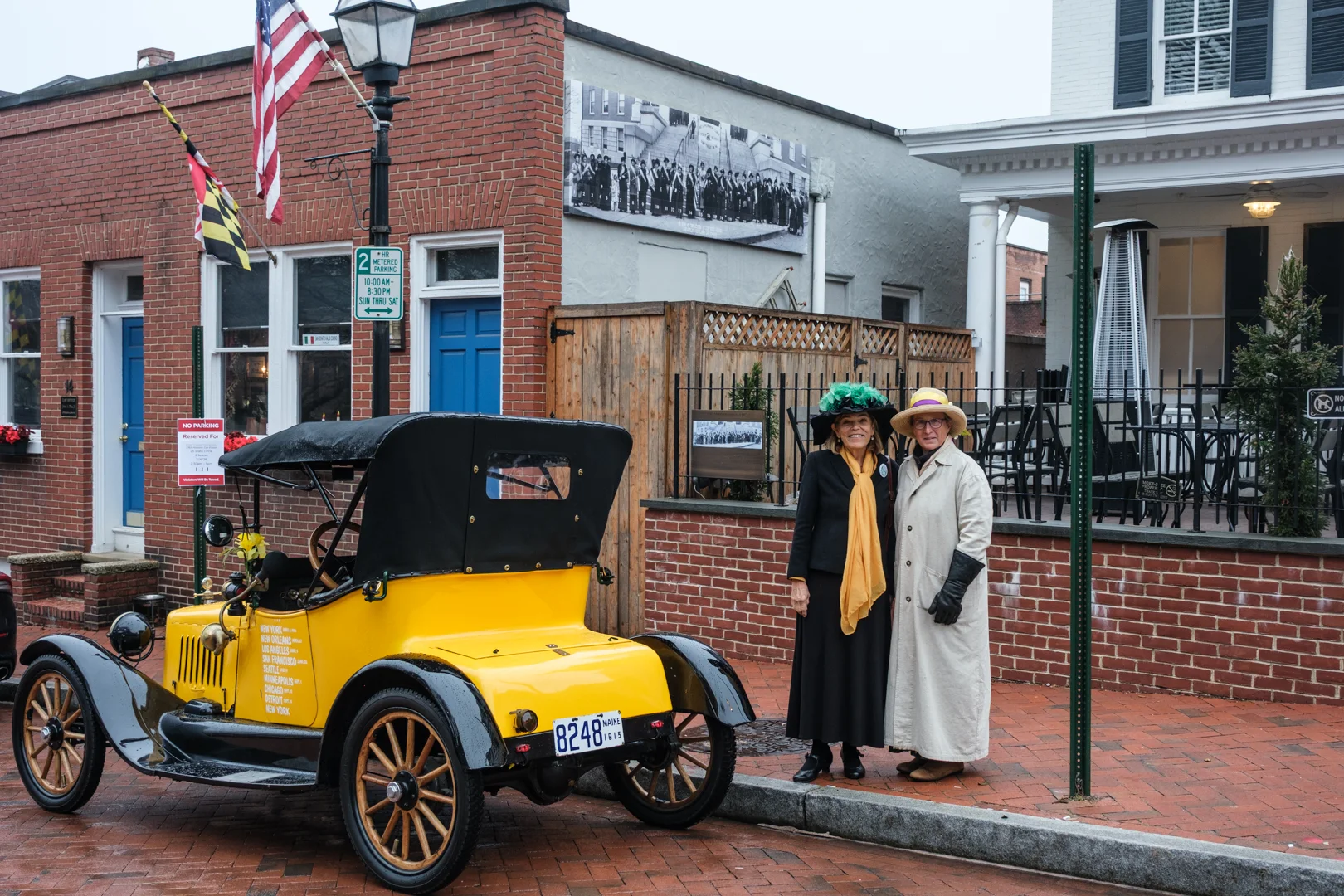
Jeryl and Susan Nourse at the Army of the Severn Plaque with wall mural of unnamed suffragists above. Photo: Nina Zacuto
Getting the Car Out: A Comedy of Cobblestones
History is serious business. Getting a 1914 Saxon roadster off a narrow market house patio, through a gap designed for foot traffic and not automobiles — that is comedy.
Susan Nourse — retired police chief, official Golden Flyer driver, and a woman who has demonstrated she can handle anything — worked the wheel with surgical precision through the tight turn. Peter Brown, our mechanic, crouched in the rain on the cobblestones, moving his hands in the cryptic semaphore of mechanics everywhere. Alex Huppé, co-owner of the car with his wife Jeryl Schriever, watched from the sideline with the expression of a man trying very hard to look calm. Jeryl herself craned her neck to check clearance. Because when you own a 112-year-old car that has already driven from New York to Trenton to Annapolis through Women's History Month, you pay close attention to clearances.
They made it. Of course they made it. The Golden Flyer always makes it.
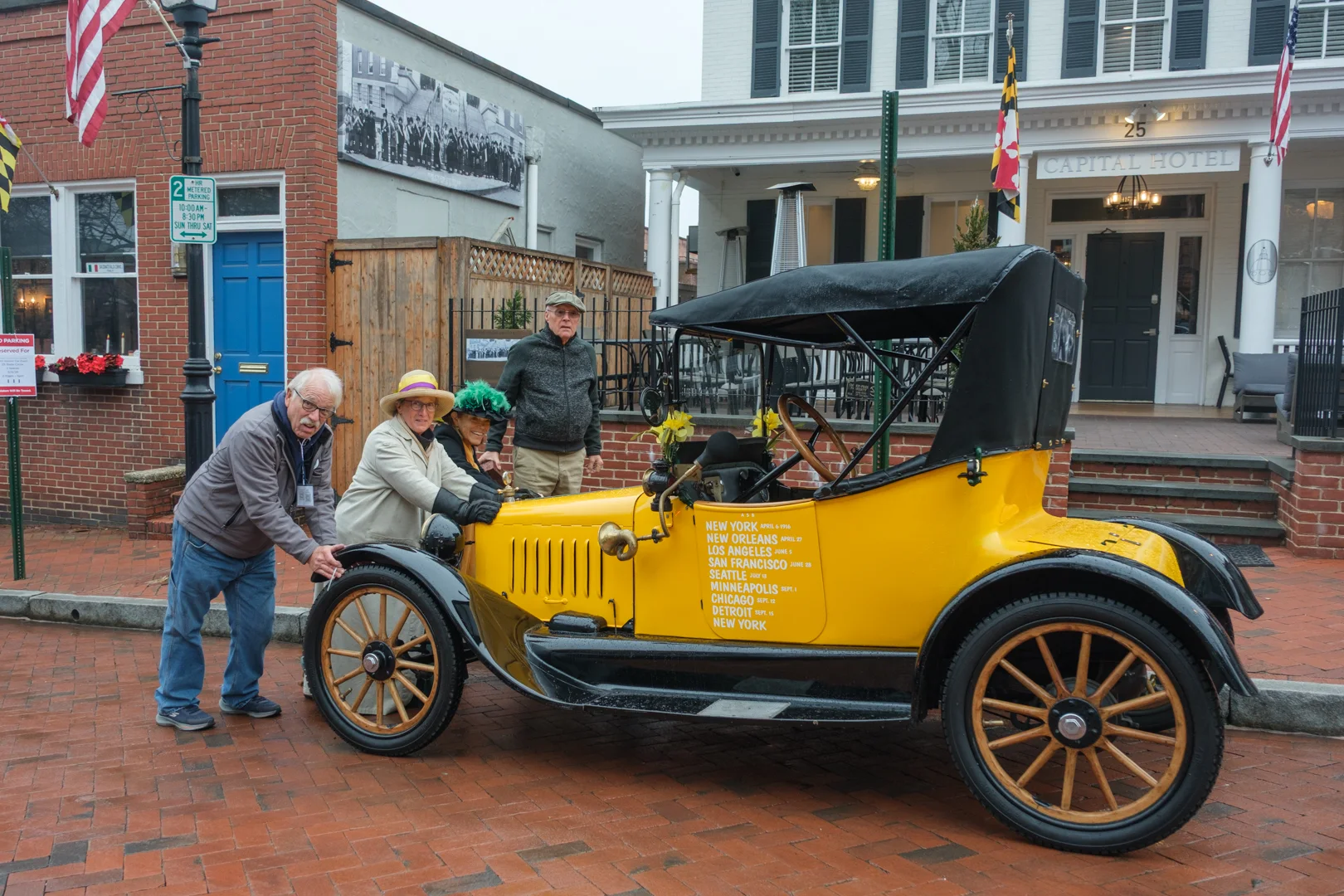
Putting the car in reverse to move it to the right spot in front of the Army of the Severn Plaque. Photo: Nina Zacuto
Not Just a Bookstore, Not Just a Coffee House, But a Community Gathering Place
Jinny Amundson and Janice Holmes not only sold books at the Annapolis Market House, they opened the doors to their shop, Old Fox Books & Coffeehouse, after hours to host an informal question and answer event with Jeryl Schriever, author of Driving the Vote for Women. With the help of Leanne Listman of Maryland NOW, Tracy and Susan laid out a spread of cheese, nuts, candies and even ERA cookies with the Sign4ERA petition code printed in the icing! Old Fox Books is a hidden gem on one of the oldest main streets in America where people gather to shop for literature, read, work, eat, and converse. Guests were full of questions for Jeryl and the team about the experiences of the suffragists, details of the Golden Flyer, and actions they can take to be sure the ERA Joint Resolution in Congress is passed without delay, stating the view of Congress that the ERA is indeed the 28th Amendment.
Day Four. Maryland's capital in the rain. A mayor who signed with enthusiasm. A restaurant owner who opened his register. An artist who showed up with her brushes. A stranger who stopped and stared. And on State Circle, a plaque honoring women who marched into a legislature that rejected them — and changed history anyway.
We took the next step. We're taking it. The Golden Flyer II rolls on.
Follow the Journey
Watch history happen. The Golden Flyer II is rolling — New York to the Pacific and back. Track every stop as we drive the ERA fight across 25 states. Real stops. Real people. Real pressure.

