Modesto was built by families, workers, farmers, organizers, and community leaders who understood the value of persistence — the same spirit that greeted the Golden Flyer II. The same spirit that carried Alice Burke and Nell Richardson across America in 1916 as they too stopped in Modesto for women's suffrage.
Modesto — The Heart of the Central Valley, and the Heart of the Fight for Equality
From the moment we arrived, the Driving the Vote for Equality Tour felt right at home in Modesto, a city built on movement, determination, and the belief that ordinary people can shape extraordinary change.
Long known as the heart of California's Central Valley, Modesto was built by families, workers, farmers, organizers, and community leaders who understood the value of persistence — the same spirit that carried Alice Burke and Nell Richardson across America in 1916 as they too stopped in Modesto for women's suffrage.
More than a century later, their journey still resonates here. In a region where generations of women have helped build communities, lead businesses, organize neighborhoods, teach children, and fight for opportunity, the story of the Golden Flyer II reminds us that progress has always depended on people willing to keep moving forward, even when the road ahead was uncertain.
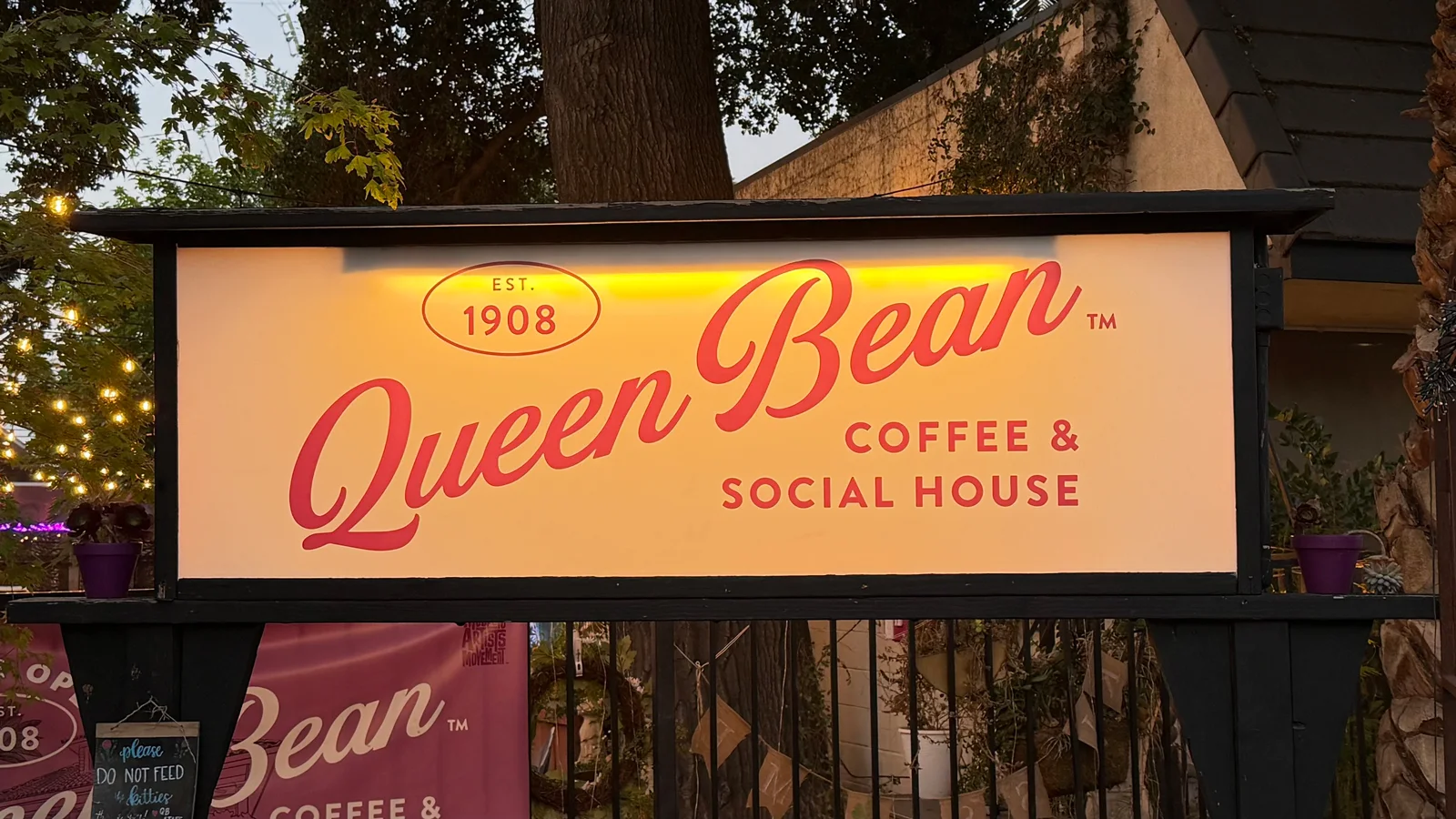
The Queen Bean Coffee House in Modesto — where coffeehouses do what they've always done: bring people together, stir up ideas, and fuel movements.
We were especially grateful to gather in Modesto at the beloved Queen Bean Coffee House for a special community event hosted by the Stanislaus County Commission for Women. Coffeehouses have always been places where ideas are exchanged, movements are nurtured, and communities come together — making it a fitting stop for a tour inspired by women who traveled the country to spark conversations about equality and civic participation more than 100 years ago.
"Our Commission for Women has a long history of supporting and fighting for the Equal Rights Amendment — and I've been in this struggle for decades. We stand proud to welcome the Driving the Vote for Equality Tour back to Modesto," Commission Chair Gillian Wegener told the audience — an audience of all ages and diverse backgrounds.
Jeryl Schriever, author of Driving the Vote for Women: An American Journey for Suffrage, shared details about the journey of Nell and Alice driving the little Saxon through California — and again, we were amazed at how they negotiated the roads and the weather. Kathy Bonk, an ERA NOW board member, shared details about why the Equal Rights Amendment is needed more than ever, emphasizing the economic issues facing women and families today with rising inflation and steady increases for gas, food, housing, health care, and other essential living expenses.
Central Valley poet and historian Linda Scheller joined Jeryl in telling the story about the various tactics used by suffragists to win the vote — agreeing that the century of struggle for women's voting rights altered course when a young Alice Paul decided to abandon pleading and start fighting. Her approach was decidedly not lady-like, even militaristic. She and her colleagues managed to chain themselves to the fence outside the White House and then get dragged by their hair to police vans that took them off to jail. She was a tactical genius. She knew how to get the nation's attention and, when she had it, to make the case for her cause.
After a judge released the women from jail, citing the vagueness of the charges, President Wilson took up the suffrage cause and the amendment was shortly thereafter passed by Congress and sent to the states for ratification. No small part in that victory was played by the two women who, with a decidedly non-militaristic strategy and a more "lady-like" approach, campaigned for what would become the 19th Amendment in their Saxon motorcar — using a grassroots strategy quite unlike Alice Paul's but identical in purpose. Both cases involved virtually unlimited commitment.
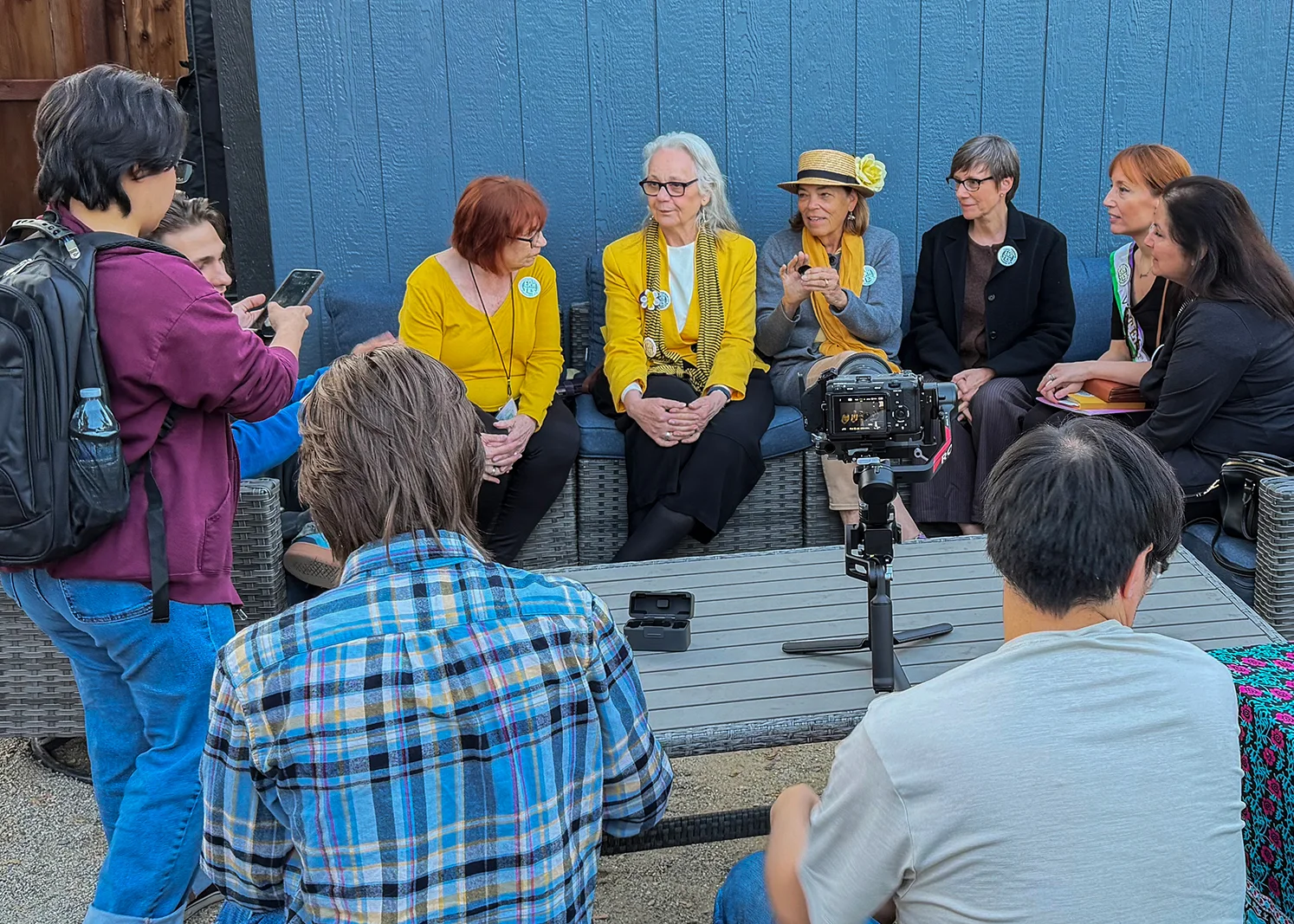
A new generation of filmmakers documents the Driving the Vote for Equality Tour at the Queen Bean Coffee House — because the story of the ERA belongs to every generation, and this one is already telling it.
A newly formed group of young filmmakers came to document the event and make various short pieces for various social platforms. When the program ended, they asked a group of us to stay for a session sharing our various perspectives on the ERA, the state of democracy, and our thoughts about the future for their generation.
"For me, it's about one word — HOPE. I am inspired by young people; my work on campuses has shown me that this generation is more talented, energetic, and full of hope than mine," explained Jeanne Clark, a seasoned organizer from Pittsburgh who retired to work for women's rights full-time. She has been on and off the tour since it started in New York City on March 1.
"It is 110 years since this battle began when another car just like this one came to California to make the case for women's voting rights. How close we are now after another long journey, today making the case for full equality of rights under the law in the United States Constitution," said Amy Wolfe, President of the League of Women Voters of Stanislaus County.
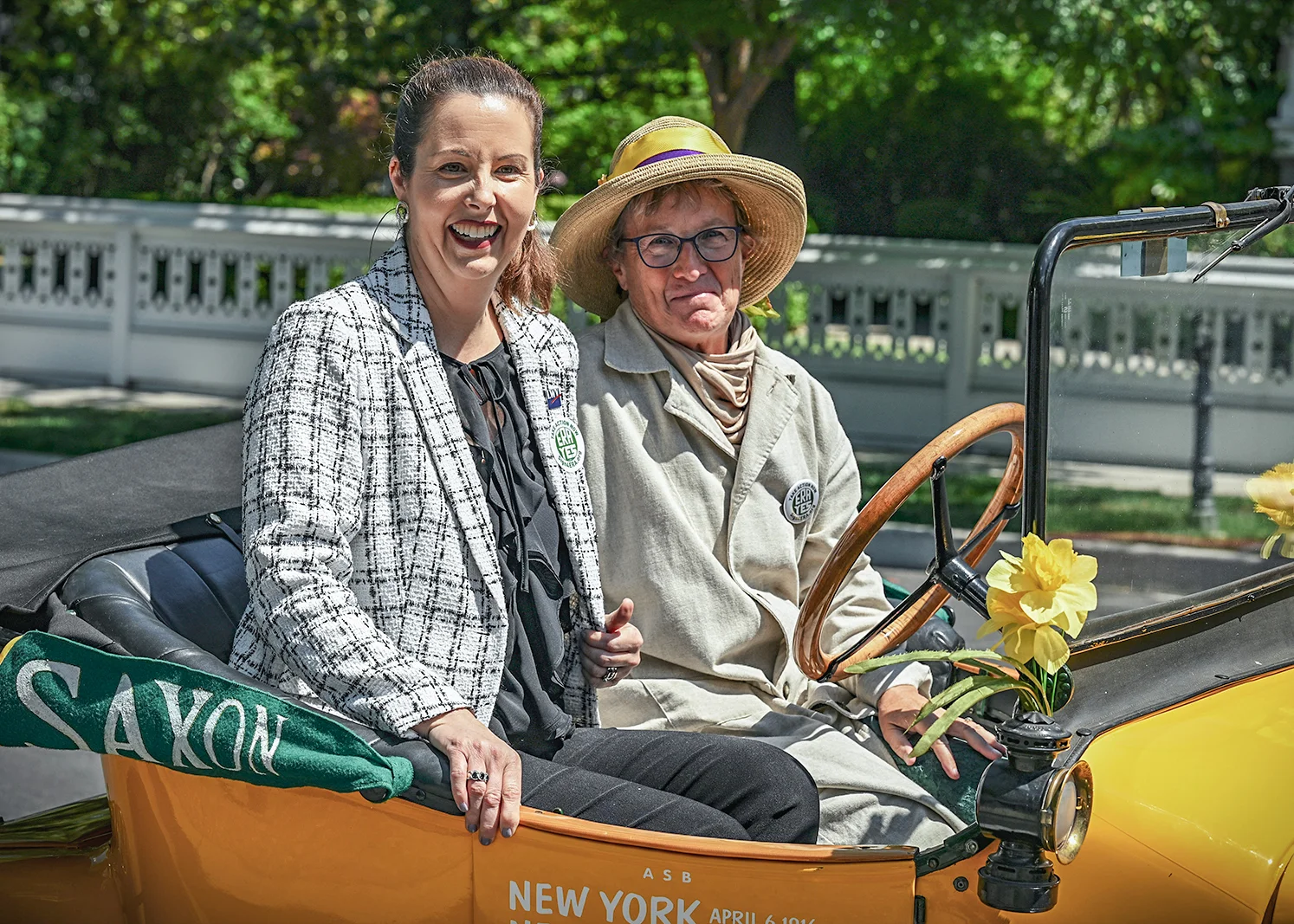
League of Women Voters of Stanislaus County President Amy Wolfe takes a spin in the Golden Flyer II with Susan Nourse — aka Alice — 110 years after another Saxon just like this one came to California to make the case for women's voting rights. How close we are now.
"We are here to celebrate the progress made in the fight for women's rights and to play our part in bringing that fight to a successful conclusion"
Stanislaus Commission for Women Vice President Amanda Hughes
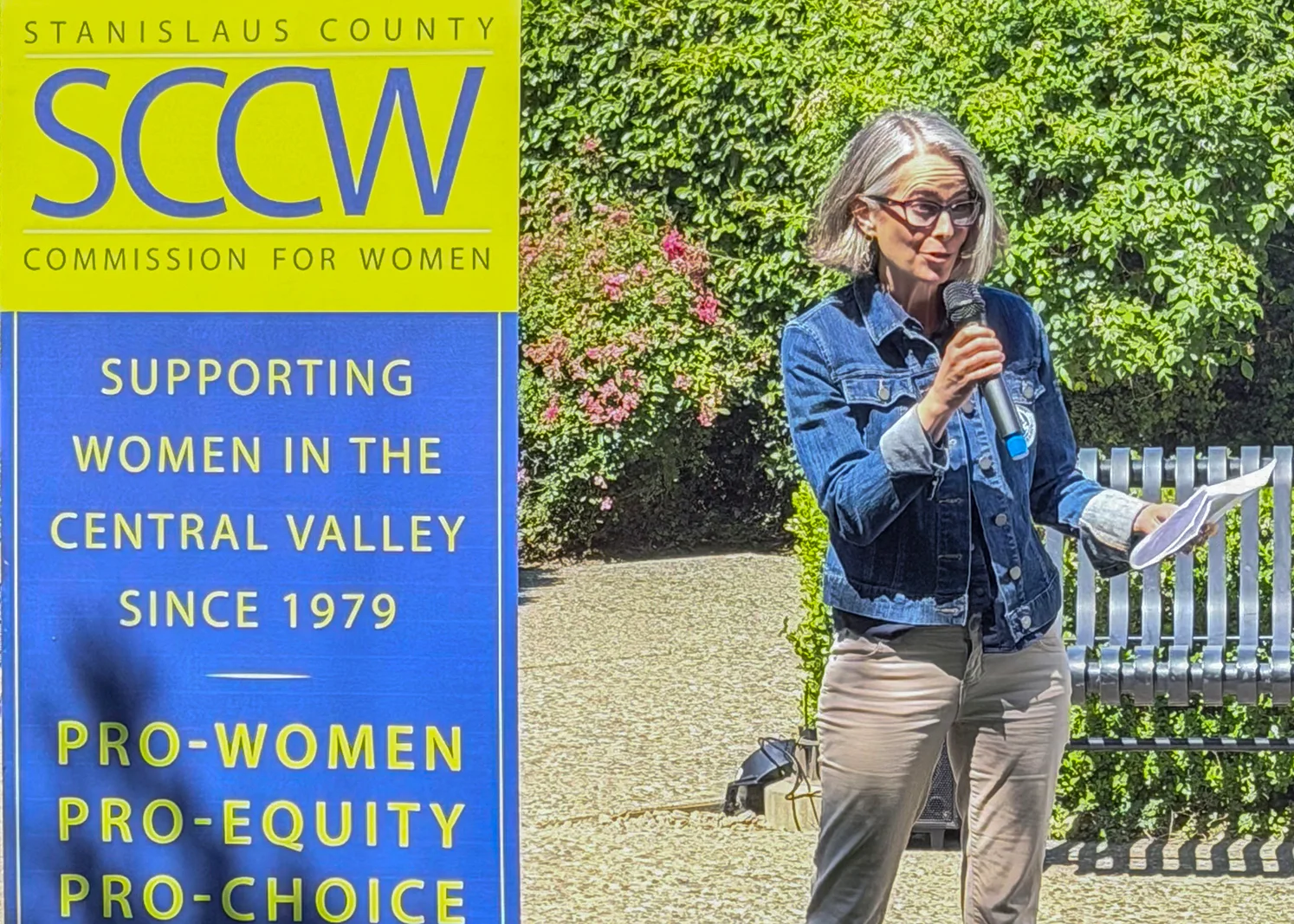
Amanda Hughes, Vice President of the Stanislaus Commission for Women, and Ann Venneman — state, national, and global leader in agriculture and the United Nations — the two women who brought the Driving the Vote for Equality Tour to Modesto. The ERA thanks you. So do we.
Day Two: Mayor Sue Zwahlen and the Champions of Equality
The momentum continued the following day as Modesto's Mayor Sue Zwahlen accepted an Equality Champions Award — a powerful reminder that local leaders across America are helping carry forward the unfinished work of equality. Just as suffrage supporters once relied on mayors, civic leaders, and local communities to help amplify their cause, today's movement for the ERA is once again being strengthened city by city, community by community.
The resilience and leadership of the women of the Central Valley whose resilience and leadership continue to shape California and the nation.
"Much was started when Abigail Adams implored her husband to 'Remember the Ladies' as they crafted the design of the new republic. The fight goes on and much depends on women going to the polls. This is a chance for all your voices to be heard," Mayor Zwahlen told the gathering.
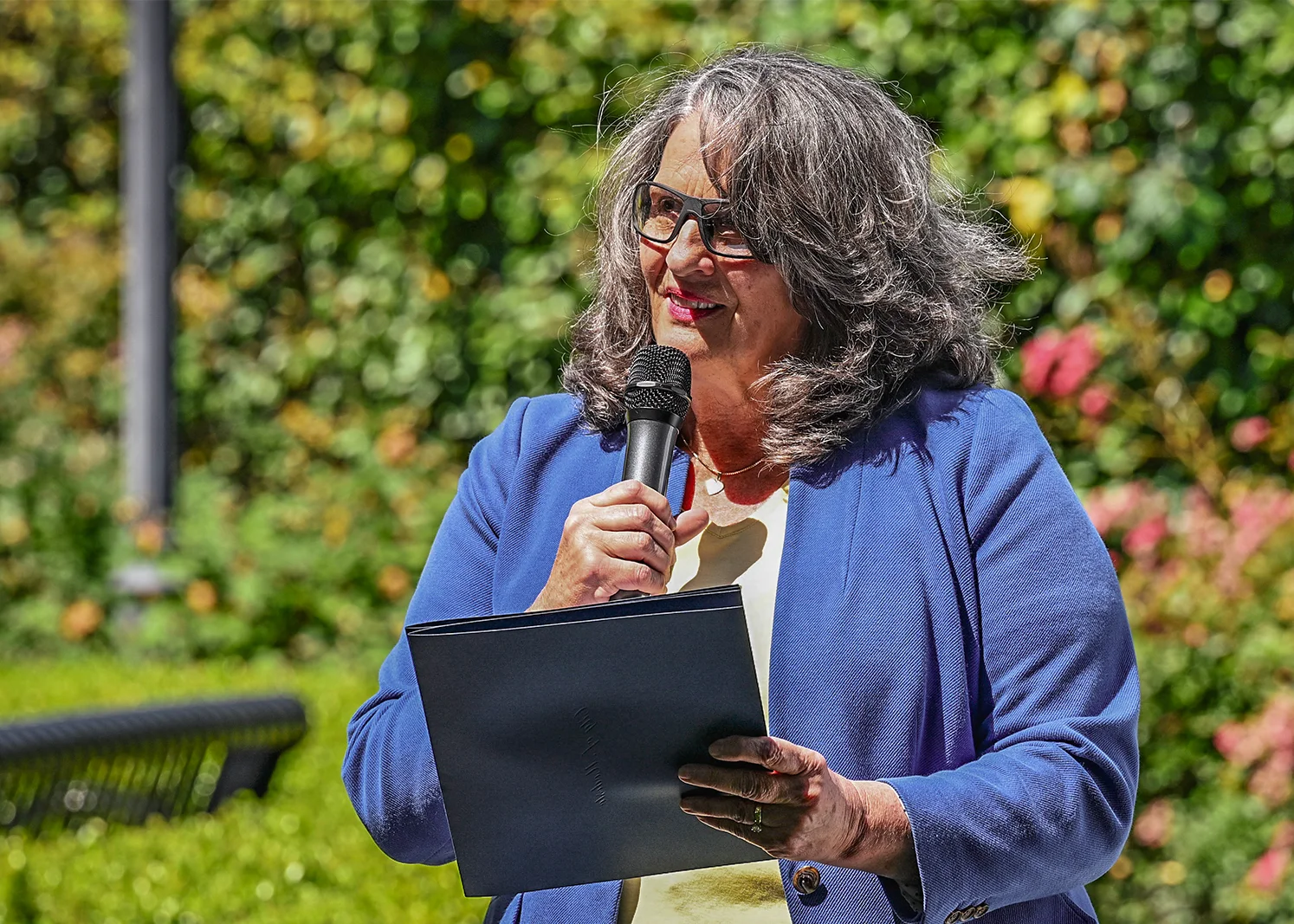
Modesto Mayor Sue Zwahlen urges the crowd to register, vote, and help others get to the polls — because Abigail Adams was right: "The fight goes on and much depends on women going to the polls. This is a chance for all your voices to be heard."
As our Tour stopped in Modesto, we celebrated the history of the suffrage movement and acknowledged the challenges of the ERA. More importantly, we were able to salute the women of the Central Valley whose resilience and leadership continue to shape California and the nation. From the agricultural fields to city halls, classrooms, small businesses, and community organizations, women here have long been a driving force for change.
Just as Alice and Nell used their bright yellow car to attract attention, inspire curiosity, and bring people together across America in 1916, we hope the Golden Flyer II continues to do the same here in Modesto and in other California cities and towns — reminding us that every generation has the opportunity, and the responsibility, to move equality forward.
Add your name to the one million:
Every dollar keeps the Golden Flyer II on the road:
Follow the Journey
Watch history happen. The Golden Flyer II is rolling — New York to the Pacific and back. Track every stop as we drive the ERA fight across 25 states. Real stops. Real people. Real pressure.

